Three department stores straddling Korea's semiconductor-manufacturing corridor logged luxury sales that outpaced every Seoul flagship this year, as record AI-chip profits translated into some of the biggest paychecks in Korean corporate history.
Lotte Department Store's Dongtan branch — situated near Samsung Electronics' (005930.KS) Hwaseong complex — posted a 25% year-on-year revenue gain in the January–May period, beating the company's nationwide average of 20%. Shinsegae's (004170.KS) South City outlet, flanked by Samsung and SK hynix (000660.KS) campuses in Suwon and Icheon, rose 23%, while Hyundai Department Store's (069960.KS) Pangyo branch added 20%, according to data released by the three retailers Tuesday.
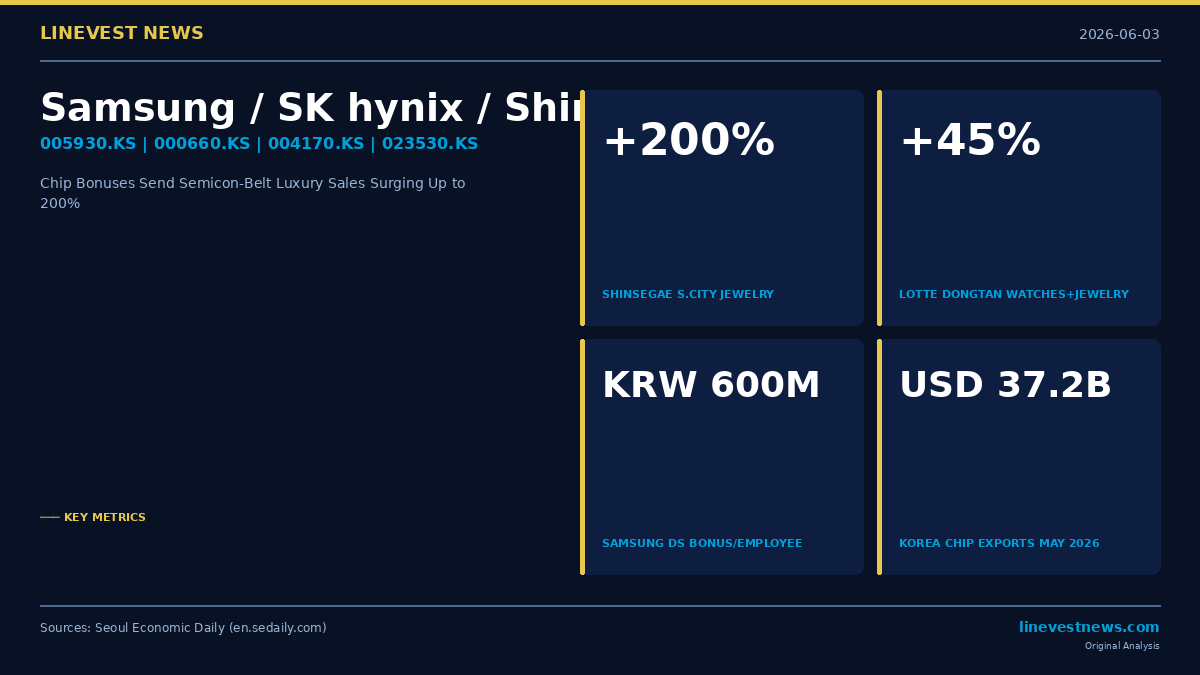
The headline figures, however, understate the luxury acceleration. Shinsegae South City's high-end jewelry counter surged 200% year-on-year — a pace without parallel at any Seoul location. Lotte Dongtan's luxury watches-and-jewelry division climbed 45%, and Hyundai Pangyo's high jewelry category jumped 59%. New VIP customer registrations were up 35% at Lotte Dongtan and 36% at Shinsegae South City over the same five-month window.
Record Chip Bonuses Reshape Spending Geography
The catalyst is a wage supercycle that accelerated alongside AI-driven chip demand. Samsung Electronics struck a deal with its Device Solutions division — the chip-making arm — under which a special performance bonus funded by 10.5% of operating profit will be distributed as treasury shares; Device Solutions employees could receive roughly KRW 600 million (approximately USD 434,000) each. SK hynix went further, abolishing the 10% cap on its profit-sharing programme entirely and pledging to maintain the scheme for at least ten years.
The compensation surge maps directly onto Korea's semiconductor export cycle. Customs data showed chip exports hit a record USD 37.16 billion in May — up 169.4% year-on-year — as high-bandwidth memory and AI server demand showed no sign of abating.
"Department stores are showing structural growth in both domestic consumption and inbound demand," said Lee Jin-hyup, a researcher at Hanwha Investment and Securities. Analysts have begun lifting second-quarter profit estimates for the big-three retailers: Lotte Shopping (023530.KS) is projected at KRW 102.1 billion in Q2 operating profit, up 18.3% from last month's forecast; Shinsegae at KRW 131.9 billion (+18%); and Hyundai Department Store at KRW 76 billion (+3.2%).
A Structural Shift, Not a Broad Recovery
The geographic split signals a structural shift rather than a broad consumer recovery. While foot traffic at prime Seoul department stores has remained sluggish, the semicon-belt branches are emerging as a rare bright spot — a way to ride Korea's AI hardware boom through a consumption proxy, with watches and gemstones standing in for wafers.
Korean stock markets are closed today for local elections, limiting immediate price discovery. Yet the data reinforces a theme visible across Korea's economy: the semiconductor supercycle is increasingly the primary engine of household income growth, with its wealth effects spreading most visibly in the communities — Hwaseong, Icheon, Pangyo — that host the fabrication halls at its core.
Sources: Seoul Economic Daily (June 3, 2026)