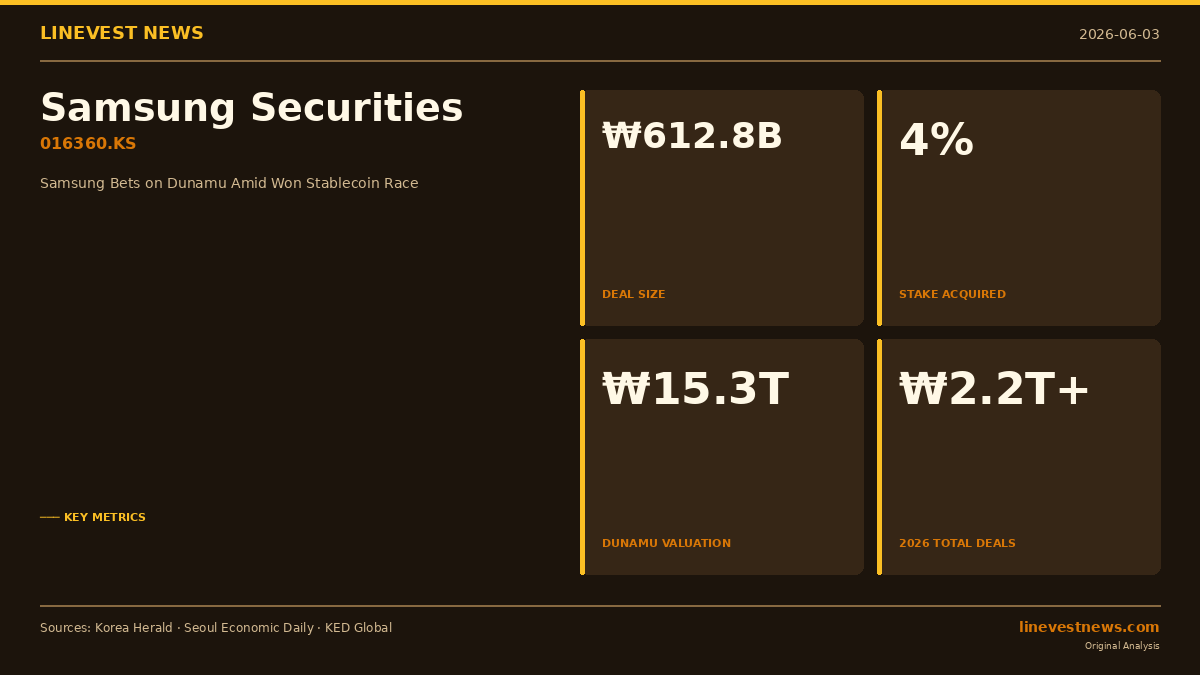
Samsung Securities, Samsung SDS and Samsung Card have agreed to pay a combined ₩612.8 billion (approximately USD 446 million) for a collective 4% stake in Dunamu, the operator of South Korea's largest cryptocurrency exchange Upbit, as the country's financial establishment moves swiftly to claim seats at the table before Korea introduces a won-backed stablecoin.
Under the agreement announced May 28, Samsung Securities will hold a 2% stake while Samsung SDS and Samsung Card each take 1%, with 1.39 million shares purchased from Kakao affiliates — including Kakao Investment, Kakao Ventures and Kakao Youth Entrepreneurship Fund. The deal is set to close June 19. The transaction implies a Dunamu enterprise value of roughly ₩15.3 trillion (USD 10.5 billion).
Three Platforms, One Foothold
Each Samsung entity outlined a distinct digital-asset roadmap inside the Dunamu ecosystem. Samsung Securities plans to develop tokenized securities issuance and virtual asset distribution in partnership with Upbit; Samsung SDS aims to layer its AI, cloud and cybersecurity capabilities onto Dunamu's blockchain infrastructure to build next-generation digital finance plumbing; Samsung Card will explore integrating digital asset payments into its Monimo app and may enable stablecoin-based settlement if South Korea's regulatory framework formally permits it.
A Samsung official said the investment was "intended to strengthen each affiliate's competitiveness in digital asset-related businesses," adding that the three units would pursue opportunities tied to "won-based stablecoins and tokenized asset markets, which are expected to broaden the role of crypto exchanges."
A ₩2.2 Trillion Buying Wave
The Samsung deal sits inside a broader surge of secondary-market stake purchases that has seen established financial institutions collectively commit more than ₩2.2 trillion to Dunamu in a matter of weeks. Hana Bank moved first in mid-May, paying roughly ₩1 trillion for a 6.55% stake; Hanwha Investment & Securities separately announced a USD 398 million acquisition that would position it ahead of Hana in the shareholder register. Korea Investment & Securities and Mirae Asset Financial Group are meanwhile pursuing stakes in rival exchanges Coinone and Korbit.
Industry observers say the frenzy reflects a single strategic calculation: that Upbit's dominance of South Korean retail crypto volume makes Dunamu an irreplaceable distribution partner if and when regulators license won-pegged stablecoin issuers and mandate exchange-level oversight. Regulatory changes enacted in 2026 already allow banks to hold controlling stakes in won-denominated stablecoin vehicles, removing a key structural barrier.
Kakao's AI Pivot Funds the Exits
For Kakao, the wave of sales represents a deliberate reallocation of capital rather than a distress exit. The conglomerate divested more than 10% of its Dunamu holding in May and June alone, raising more than ₩1 trillion in combined proceeds. A Kakao official stated that "accelerating the growth of our AI business is currently Kakao's top priority, so securing investment resources is important and essential."
Kakao's original outlay in Dunamu was modest — roughly ₩200 million via Kakao Ventures in 2013 followed by a ₩3.3 billion follow-on in 2015. At the current implied valuation, the group's remaining 4.03% stake alone represents more than 300 times its total early investment. Dunamu's valuation has climbed from ₩50 billion in 2016 to a peak of ₩20 trillion in 2021, before settling near ₩15.3 trillion in the present secondary-market round.
Dunamu welcomed the arrangements, pledging to "actively cooperate on developing blockchain-based financial investment products" with its new shareholders. The simultaneous commitments by Samsung, Hana and Hanwha mark a structural shift in how Korea's financial industry regards crypto infrastructure — no longer a fringe asset class to be monitored from a distance, but a core plumbing layer for the next generation of payments and capital markets.
Sources: Korea Herald, Seoul Economic Daily, KED Global, The Elec