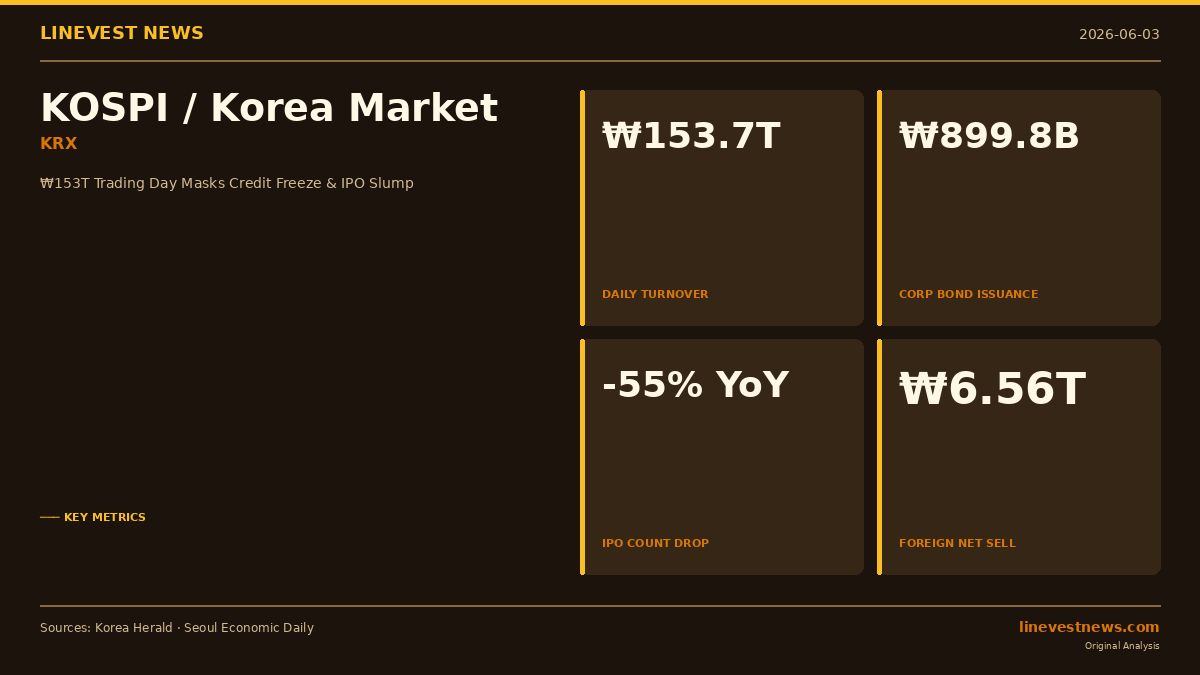
South Korea's benchmark KOSPI closed at a third consecutive record high of 8,801.49 on June 1 as domestic retail investors absorbed more than ₩6.29 trillion in foreign equity sales in a single session — but the ₩153.7 trillion in daily turnover that dominated headlines concealed a credit-market contraction that analysts warn could deepen.
Trading volume was 45% above May's daily average and has more than doubled since April, fuelled by retail investors channelling semiconductor bonus windfalls and margin-loan proceeds into Samsung Electronics and SK Hynix. Foreign investors, meanwhile, net sold ₩6.5644 trillion in Korean shares — the third-largest single-session outflow on record — while the benchmark still managed a 0.15% gain on the day.
The divergence showed up most visibly in the currency market. The won closed at 1,516.4 per dollar, up 12.1 won on the session and briefly touching 1,520 — its weakest intraday print since April 2. "Foreign equity flows are the key driver behind the rate's rise," said Wi Jae-hyun of Kyobo Securities, noting that the U.S. Dollar Index fell intraday even as the won weakened, underscoring currency-specific pressure on the Korean unit.
The fissure runs deeper in the debt markets. Net corporate bond issuance this year stands at just ₩899.8 billion — a decade low — compared with ₩20.3507 trillion over the same period in 2025, a drop of more than 95%. Government bond yields have risen 83.9 basis points since the start of 2026. NH Investment & Securities warned that "the K-shaped credit structure across industries will deepen further," with companies rated BBB+ and below facing acute liquidity pressure as capital concentrates in the chip sector.
The same dynamics are choking the IPO pipeline. Just 12 companies listed on the Kospi and Kosdaq in January through April, compared with 27 in the same period last year — a 55% decline, according to data compiled by the Korea Herald. Only K bank reached the main Kospi board in that stretch, listing in March. HD Hyundai Robotics, SK Ecoplant, Hanwha Energy and CJ Olive Young have all delayed plans pending finalisation of spinoff listing rules announced in April, adding supply-side uncertainty to an equity market that is otherwise generating record investor demand.
The sector disparities in equities are stark. IT hardware stocks rose 76.1% in May alone, semiconductors added 55.7%, and the KOSPI overall gained 28.4%. KOSPI-wide operating profit forecasts for 2026 were revised up 10.3%, and even companies outside the Samsung–SK Hynix orbit are tracking 10.5% improvement — suggesting some rally breadth. "An index correction does not occur simply because capital is concentrated in a few leading sectors," said Lee Sang-yeon of Shinyoung Securities. "Corrections historically require external shocks such as U.S. tightening or a liquidity contraction."
For now, the semiconductor earnings supercycle and record retail participation are keeping the headline index elevated. The risk, analysts caution, lies in the widening gap between capital-market winners and losers: a K-shaped split playing out in bond issuance, IPO filings and the currency, even as the benchmark approaches the psychologically significant 9,000 level for the first time in history.
Sources: Korea Herald, Seoul Economic Daily (June 3, 2026)
Key Numbers
- ₩153.7T — peak daily turnover (June 1), doubled from April
- ₩899.8B — net corporate bond issuance 2026 YTD, decade low vs ₩20.35T in 2025
- -55% YoY — IPO count Jan-Apr 2026 (12 listings) vs 2025 (27)
- ₩6.56T — foreign net equity sales June 1 (3rd-largest on record)