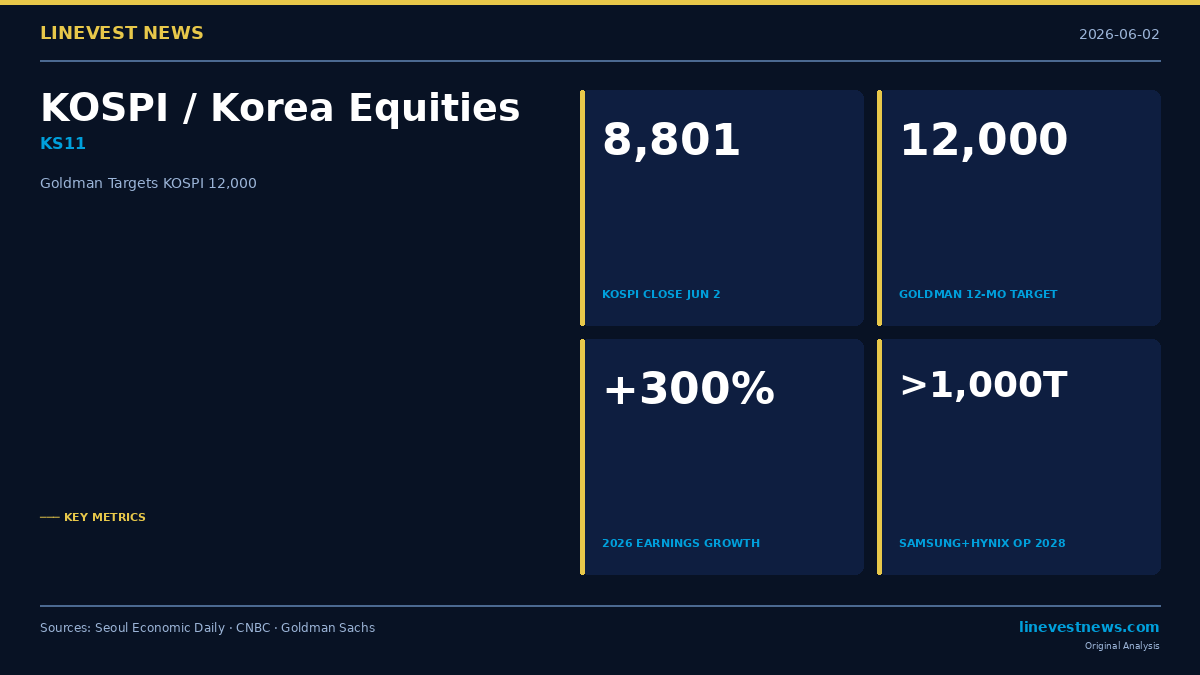
South Korea's KOSPI closed at 8,801.49 on Tuesday, breaching the 8,800 threshold for the first time in the index's history, on a day that Goldman Sachs raised its 12-month benchmark target to 12,000 — signalling a further 35% upside from current levels — and named Korea its highest-conviction equity market in Asia.
Goldman's Case: 300% Earnings, Highest Conviction in Asia
The U.S. investment bank cited a forecast 300% aggregate earnings expansion for Korean corporates in 2026, the strongest annual profit surge in any Asian market since the post-Asian financial crisis rebound of 1999. Goldman remains overweight Korea, pointing to "higher earnings, underpriced memory cycle duration, and rerating catalysts."
The core of the bull case rests on what Goldman calls a "Higher for Longer" memory supercycle. Demand for DRAM, NAND, and high-bandwidth memory has proved more durable than the market expected, sustained by expanding AI compute investment. Goldman's analysts upped their out-year estimates sharply: Samsung Electronics' 2028 operating-profit projection was raised 23.3% to KRW 610 trillion, while SK Hynix's was revised 24.0% higher to KRW 454 trillion, putting the two chipmakers' combined annual profit above KRW 1,000 trillion for the first time.
Nearer term, Goldman sees Samsung generating KRW 374 trillion in operating profit this year, scaling to KRW 530 trillion in 2027; SK Hynix is forecast at KRW 271 trillion in 2026 and KRW 401 trillion in 2027. Both stocks carry a "Buy" rating, with price targets of KRW 450,000 for Samsung Electronics and KRW 3.5 million for SK Hynix.
Volatile Milestone: 8,900 to 8,500 in Nine Minutes
Tuesday's session was anything but smooth. The KOSPI shot through the 8,900 line within minutes of the open as traders priced in the symbolic weight of Nvidia chief executive Jensen Huang's Korea visit, only for international investors to pour in record-scale profit-taking that sent the index plunging to 8,500 in roughly nine minutes — one of the most violent intraday reversals in recent memory. Domestic retail investors absorbed the shock, posting KRW 6.35 trillion in net purchases to partially offset foreign net selling of KRW 6.60 trillion, the third-largest single-session foreign exit on record.
The KOSPI ultimately found its footing, closing at 8,801.49, up 0.15%. Major movers included SK Telecom, which surged 11.59% after Huang named the group a linchpin of physical AI, Samsung Life Insurance, which soared 17.07%, and Naver, up 3.31% after disclosing a new Nvidia partnership. Samsung Electronics added 3.30%.
100% Year-to-Date: Headwinds Linger
The 8,800 close extends the KOSPI's extraordinary run: the index has roughly doubled year-to-date, establishing it as one of the world's top-performing major benchmarks. Not all signals are benign. South Korea's consumer-price inflation accelerated to 3.1% in May, the fastest pace in more than two years, injecting a note of caution even as equity bulls point to the continuing earnings upgrade cycle. Goldman's 12,000 target follows a sequence of broker upgrades throughout the year as the scale of Korea's earnings renaissance has repeatedly surprised to the upside.
Sources: Seoul Economic Daily, CNBC, Goldman Sachs Research