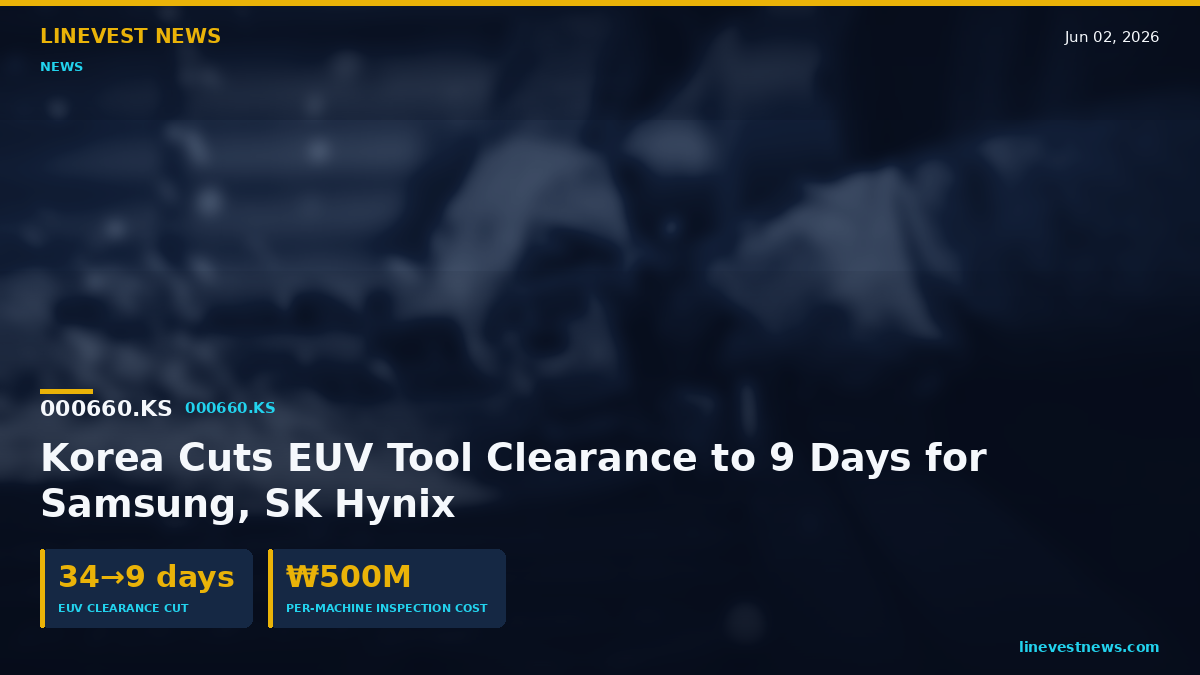
South Korea's cabinet approved a rule change on June 2 that compresses the regulatory clearance for importing extreme ultraviolet (EUV) lithography scanners — the single most critical and supply-constrained tool in advanced chipmaking — from 34 days to 9 days, a reduction of 25 days per machine, MOTIE (South Korea's Ministry of Trade, Industry and Energy) said. The amendment to the Enforcement Decree of the High-Pressure Gas Safety Control Act was passed at the State Council (Korea's cabinet) meeting and will take effect immediately upon promulgation next week (Chosun Biz; Newsis, June 2).
What actually changes
EUV scanners contain internal high-pressure gas piping and compressors, so Korean law had classified them as "high-pressure gas general manufacturing facilities." That forced a fresh, multi-step clearance every time a tool was installed: a 15-day technical review, a 5-day permit, a 7-day intermediate inspection and a 7-day completion inspection — 34 days in total (Chosun Biz, June 2). The intermediate inspection, a pressure and airtightness test performed by an overseas accredited body, cost roughly ₩500 million (USD 365,000) per machine.
The amendment reclassifies EUV equipment as "specific equipment (product)," eliminating the intermediate inspection and cutting both the technical review and completion inspection to two days each, for a 9-day total. Instead of per-installation checks, the manufacturer faces a factory audit and comprehensive process inspection on a three-year cycle — a shift MOTIE says preserves an equivalent safety standard while verifying the maker's quality controls (Newsis; Chosun Biz, June 2). The same decree adds tailored inspection standards for liquid-CO2 cleaning systems and eases safety-manager appointment rules for lower-risk gas facilities.
Who benefits, and how much it moves the needle
The named beneficiaries are Samsung Electronics (005930.KS), the world's largest memory chipmaker, and SK Hynix (000660.KS), the leading supplier of high-bandwidth memory (HBM) — both named directly in the source reports. EUV scanners are made only by ASML of the Netherlands, which uses 13.5-nanometer light to etch the finest circuit patterns; the global monopoly means delivery slots are scarce and every saved day of installation time pulls forward usable wafer output.
The scale of incoming tools is what makes a procedural tweak strategically relevant. SK Hynix placed a record USD 7.9 billion (11.9 trillion won) order for roughly 30 EUV machines through December 2027, destined for HBM output at its M15X plant in Cheongju and advanced DRAM at the Yongin cluster (Tom's Hardware, March 2026). Samsung separately ordered about 20 EUV systems worth over 10 trillion won for its Pyeongtaek P5 fab (Seoul Economic Daily, April 2026). Across roughly 50 machines, a clearance window shortened by 25 days each compresses cumulative installation lead time materially — the binding constraint when fabs are racing to qualify AI-memory capacity.
The per-unit cost saving, by contrast, is marginal in context: ₩500 million is a rounding error against a standard EUV scanner's roughly €150 million (USD 165 million) price tag, and far smaller still beside High-NA units — Samsung's foundry arm paid USD 773 million for two High-NA scanners (TechPowerUp, 2026). The value here is schedule, not invoice.
The precedent and the open question
Korea has repeatedly rewritten safety and zoning rules to clear bottlenecks for its chip champions; the 2022 "Special Act on National Advanced Strategic Industries" similarly fast-tracked fab permitting. The recurring trade-off is the same one MOTIE addresses here — substituting periodic manufacturer audits for case-by-case inspection raises the question of whether a three-year cycle catches the same faults that a per-tool pressure test would.
The concrete confirmation to watch: the decree's promulgation next week sets the effective date, and the first real test will be whether Samsung's P5 and SK Hynix's M15X tool-move-in schedules visibly accelerate in second-half 2026 capex commentary. If installation cadence picks up, the rule change will have done its job; if ramp timelines hold steady, the bottleneck lies elsewhere — in ASML's delivery queue, not Korean paperwork.
Minister Kim Jung-kwan called the change "a representative case of regulatory innovation that achieves both safety and advanced-industry competitiveness" (Chosun Biz; Newsis, June 2).
This article is for informational purposes only and does not constitute investment advice. Figures are sourced from the cited reports as of publication.
Sources
- https://biz.chosun.com/policy/policy_sub/2026/06/02/MHIZETED3RGVNMZC53X24FUOU4/
- https://www.newsis.com/view/NISX20260602_0003652767
- https://www.etnews.com/20260602000271
- https://www.tomshardware.com/tech-industry/semiconductors/sk-hynix-places-record-8-billion-order-for-asml-euv-lithography-machines
- https://en.sedaily.com/finance/2026/04/06/samsung-orders-20-euv-machines-for-p5-fab-in-over-10
- https://www.techpowerup.com/341964/samsung-foundry-buys-two-asml-high-na-euv-scanners-for-usd-773m