KB Financial (105560.KS) Opens Chairman Succession Early
KB Financial Group (105560.KS), South Korea's largest financial holding company by market value, formally launched the process to choose its next chairman on June 2, 2026 — about a month earlier than its previous succession and roughly five months before incumbent Chairman Yang Jong-hee's term expires on November 20. The early start makes KB the first major group whose leadership handover is set to collide with pending government rules on how bank holding companies choose their top executives (Chosun Biz, Asia Economy).
What Was Decided on June 2
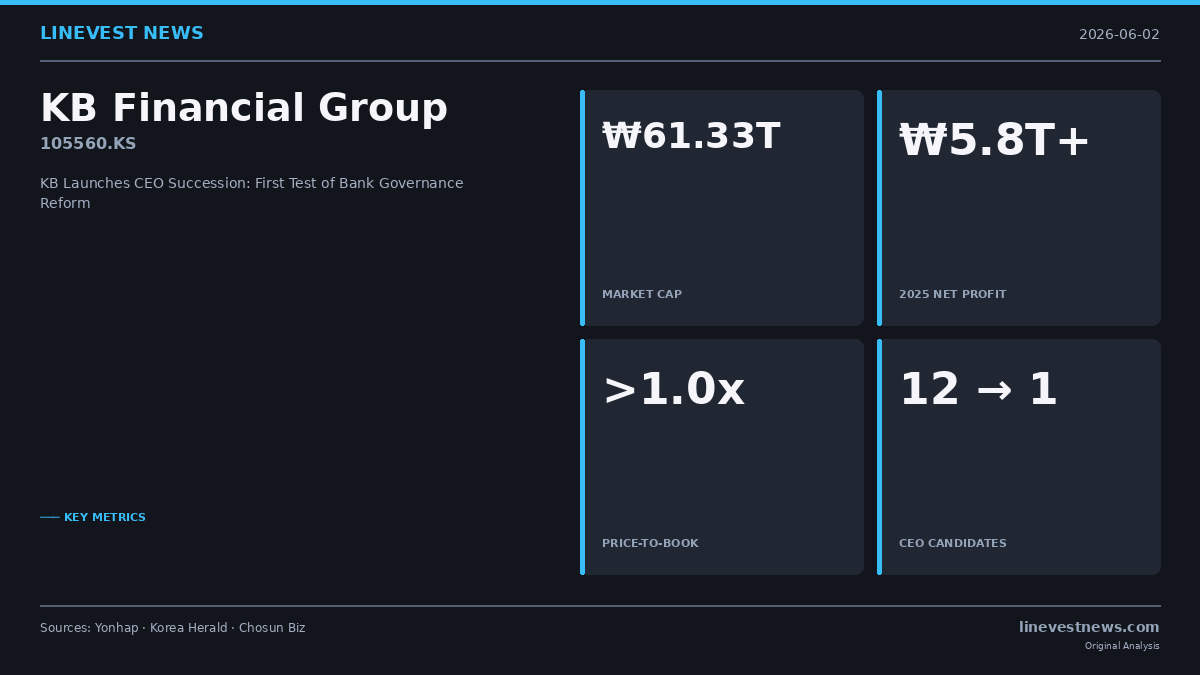
KB's Chairman Candidate Recommendation Committee, the board panel that nominates the group's chairman, met and approved detailed nomination rules, then cut a longlist of 20 potential candidates down to 12 — six internal and six external (Yonhap, Chosun Biz, Electronic Times). The committee, chaired by Cho Hwa-jun, laid out the rest of the calendar: a July 3 meeting to narrow the 12 to a six-name first shortlist; interviews and screening on August 27 to reach a three-name second shortlist; and a second round of in-depth interviews and a committee vote on September 11 to confirm a single final candidate (Chosun Biz). That nominee then undergoes a regulatory fit-and-proper review before formal appointment at an extraordinary shareholders' meeting in November.
KB stressed that it stretched the window from process kickoff to final selection to three months — longer than in past cycles — to allow fuller vetting, and deliberately gave roughly two months of preparation time after the first shortlist so external candidates are not disadvantaged versus insiders (Chosun Biz, Electronic Times). Cho said the committee would run the succession "more transparently and fairly" in line with the financial authorities' push to modernize sector governance (Chosun Biz).
Why the Leadership Question Carries Weight
The stakes are unusually high because of what KB has become under the current management. The group was the first Korean financial holding company to cross a 60 trillion won market capitalization, reaching 61.33 trillion won (approximately $41.6 billion) as of February 12, 2026, and is the only one of the country's four major financial groups trading above a price-to-book ratio of 1, versus Shinhan at 0.88, Woori at 0.81 and Hana at 0.79 (The Korea Herald). It also posted a record net profit of more than 5.8 trillion won (about $4.2 billion at roughly 1,370 won to the dollar) in its most recent full year, the highest among Korea's major financial groups (The Korea Herald). For global investors, the central question is whether the succession preserves the shareholder-return and capital-discipline strategy that drove that re-rating, or signals a shift.
The Regulatory Overhang
KB's timing intersects with a still-unfinished government overhaul of bank-holding governance. Korea's financial authorities have been preparing reform measures whose centerpiece is raising the bar for chairman reappointment from an ordinary shareholder resolution to a special supermajority resolution, alongside steps to strengthen outside-director evaluations and board independence (Seoul Economic Daily). The authorities' governance package has faced delays (Asia Economy), and KB — the only top-tier group whose succession was still open while peers wrapped theirs up — has been flagged as the likely first real test of the finalized guidelines (The Korea Times). Whether the rules are locked in before KB's September 11 decision is the key swing factor.
There is recent precedent for how charged these handovers can be: Yang Jong-hee himself was confirmed as chairman in a 2023 process, winning shareholder approval with a 97.52 percent vote and backing from advisory firms ISS and Glass Lewis as well as the National Pension Service, for a term that began November 21, 2023 (Investing.com, The Korea Herald).
What to Watch Next
The July 3 cut to six names will be the first concrete read on whether the committee leans toward internal continuity or an outside candidate, and the September 11 final selection is the date that resolves the strategy question. Equally important is whether the financial authorities publish their governance rules — including the supermajority reappointment threshold — in time to apply to this cycle.
This article is for informational purposes only and does not constitute investment advice. Figures are sourced from the cited reports and company disclosures; currency conversions are approximate.