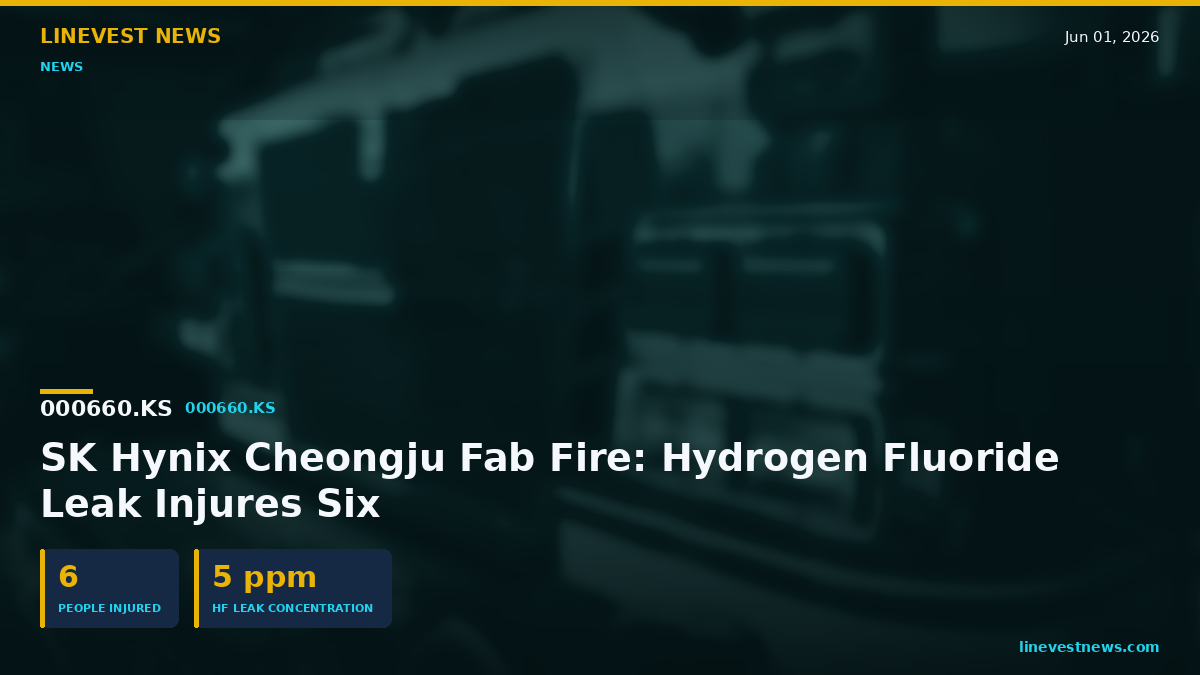
A fire broke out around 10:32 a.m. on June 1 at SK Hynix's Cheongju Campus 4 — part of the memory giant's main NAND flash and back-end hub in North Chungcheong Province — hospitalizing seven workers — five with eye irritation and two taken as a precautionary measure — according to Xinhua and Korean outlets chosunbiz and Electronic Times (etnews). SK Hynix evacuated all approximately 3,600 employees from the affected production lines for air-quality checks; the company said facility operations were unaffected and no production disruptions were expected. SK Hynix is the world's second-largest memory chipmaker and the leading supplier of high-bandwidth memory (HBM), the stacked DRAM that feeds AI accelerators.
The blaze started in a gas room — a chemical-supply utility area, not a wafer clean room — on the sixth floor of Building 3, both outlets reported. Sprinklers activated and the fire was extinguished quickly, but some hydrogen fluoride, an acutely toxic industrial chemical that causes severe burns, leaked out at a concentration of roughly 5 ppm, per chosunbiz. Fire authorities mobilized 34 personnel and 12 units of equipment and sent crews in protective suits to determine the cause, per chosunbiz.
Supply event or contained safety incident?
For a fund manager the reflex is to price the supply risk first. SK Hynix posted record first-quarter 2026 revenue of about ₩52.58 trillion ($38.4 billion) and operating profit of about ₩37.61 trillion ($27.5 billion) at a roughly 72% operating margin, according to the company's April results release — a haul built on AI-memory demand in which SK Hynix held a 57% HBM market share in the fourth quarter of 2025, per The Motley Fool. Company and trade-press accounts describe the Cheongju campus as housing the M11, M12 and M15 NAND fabs, the newer M15X line that is currently ramping DRAM and HBM output, and advanced packaging — which makes any disruption there potentially material to the AI-memory supply chain.
So far the incident reads as contained. Initial reports from chosunbiz and Electronic Times described the fire as confined to the gas room and made no mention of damage to wafer lines, and SK Hynix had issued no disclosure quantifying any output impact as of those reports. That distinction matters because of precedent. In September 2013, a fire at SK Hynix's Wuxi, China fab began in chemical-vapor-deposition equipment inside the clean room and affected up to 60,000 wafers, pushing PC DRAM spot prices up more than 20%, per TrendForce. A gas-room fire halted by sprinklers is a different category of event — unless the investigation reveals clean-room contamination.
The hydrogen fluoride history
The leak carries its own legacy. In late January 2013, a hydrofluoric-acid leak at Samsung Electronics' Hwaseong chip plant killed one worker and injured four, prompting a public apology and a regulatory crackdown on toxic-chemical handling, per Semiconductor Digest. Hydrogen fluoride's toxicity is why even a low-concentration release triggers a full hazmat response and casualty reporting, as seen on June 1.
What confirms the read
The decisive data point is disclosure. Watch whether SK Hynix files a damage assessment with DART (Korea's electronic corporate disclosure system), whether fire authorities trace the blaze to clean-room-adjacent equipment, and whether any wafer-line downtime is reported. Absent those, the event looks like a safety incident rather than a supply shock; their presence would reframe it.
This article is for informational purposes only and does not constitute investment advice. Figures reflect reporting available at publication and may change as the incident is investigated.