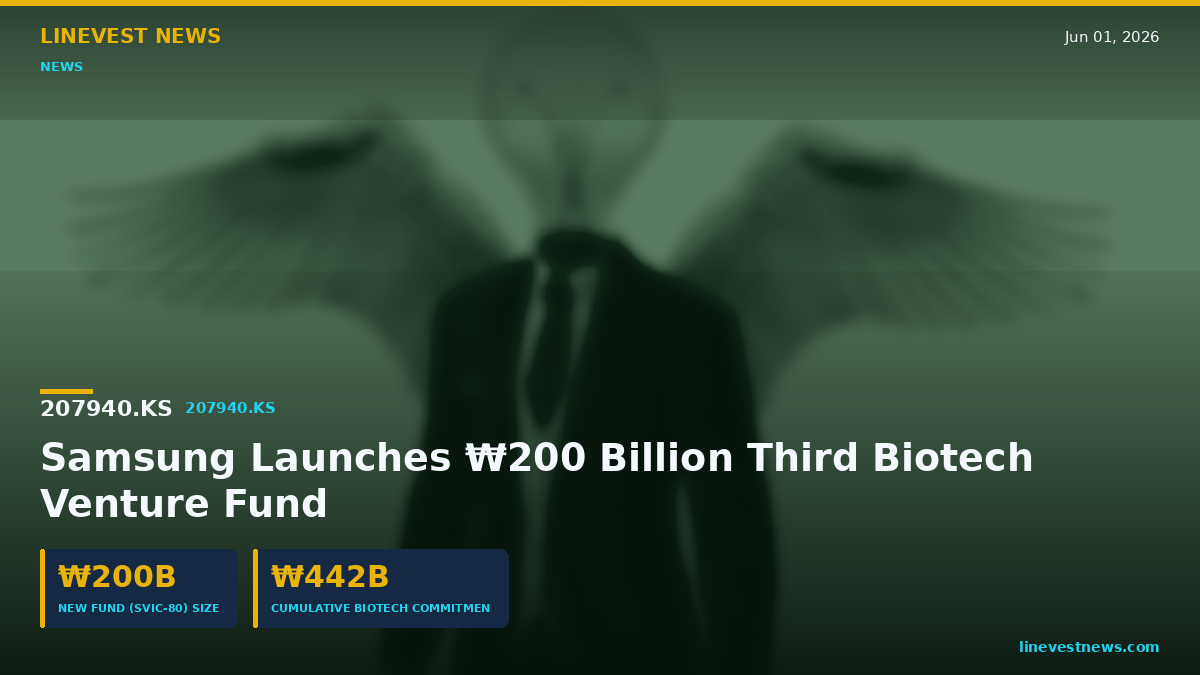
Samsung said on June 1 it has formed a third Samsung Life Science Fund — its in-house biotech venture vehicle — worth ₩200 billion ($146 million), expanding a four-year campaign to buy strategic footholds in next-generation drug technology. The new fund, formally designated SVIC-80, is jointly capitalized by Samsung C&T (the group's trading and engineering flagship), Samsung Biologics (the world's largest contract drug manufacturer by capacity, ticker 207940.KS), and Samsung Bioepis (Samsung's biosimilar developer, now a subsidiary of Samsung Epis Holdings), and managed by Samsung Venture Investment (the group's corporate venture-capital arm), according to Samsung's announcement carried by Chosun Biz and ETNews.
Is This Material for Samsung Biologics?
For the contract manufacturer whose shares carry the bio franchise, the direct cash commitment is small. Samsung C&T and Samsung Biologics each subscribed ₩79.2 billion ($57.8 million), or 39.6% of the fund; Samsung Bioepis put in ₩39.6 billion ($28.9 million), or 19.8%; and Samsung Venture Investment contributed ₩2 billion ($1.5 million), or 1.0%, per the disclosure detailed by Chosun Biz. Against Samsung Biologics' market capitalization of roughly $42.1 billion as of June 2026 (companiesmarketcap.com), the manufacturer's ₩79.2 billion stake represents about 0.14% of its equity value — too small to move the financial model on its own.
The signal, not the sum, is the point. With three funds now live, Samsung's cumulative commitment to biotech venture investing reaches ₩442 billion ($323 million), up from the first fund of ₩170 billion ($124 million) and a second fund of ₩72 billion ($53 million), according to figures Samsung provided to Chosun Biz. That is a deliberate, multi-year buildout of optionality in cell and gene therapy, antibody-drug conjugates, and AI-driven drug discovery — areas adjacent to, but distinct from, Samsung Biologics' core contract-manufacturing business.
What the Money Has Bought So Far
The Samsung Life Science Fund was launched in 2021 and made its first deployment — a stake in U.S. gene-therapy developer Jaguar Gene Therapy — in 2022, as reported by KED Global at the time. Since then the program has backed eight global biotech companies and venture firms, Samsung told Chosun Biz, including Korea's AimedBio, U.S. venture builder Flagship Pioneering, Latus Bio, Generate Biomedicines, C2N Diagnostics, Arbor Biotechnologies and Cartography Biosciences, and China's Frontline BioPharma. The most recent disclosed deal was a strategic investment in Cartography Biosciences, a U.S. antibody-oncology developer whose lead program is in Phase 1 trials, announced May 7, 2026 (The Korea Herald).
The pattern matters for context. The fund's third vintage arrives after Samsung Bioepis was separated under Samsung Epis Holdings in late 2025, a move that left Samsung Biologics positioned as a purer contract-manufacturing play. Continuing to co-fund the venture vehicle keeps the manufacturer exposed to early-stage innovation that could later convert into manufacturing mandates or licensing relationships — the strategic rationale Samsung itself cites in describing the fund as a tool to "expand its global network and business opportunities."
The Open Question
The fund's financial footprint is immaterial today, so the data point to watch is deployment, not the headline size. The confirming evidence will be how quickly the ₩200 billion is committed and whether any portfolio company — following the May Cartography deal — translates into a contract-manufacturing or co-development agreement that shows up in Samsung Biologics' order book. Samsung Biologics' next quarterly results will not capture this fund directly; the more telling signals will be the pace and profile of the next disclosed investments.
This article is for informational purposes only and does not constitute investment advice. All figures are sourced from company disclosures and the cited publications; currency conversions use an approximate rate of 1 USD = 1,370 KRW.