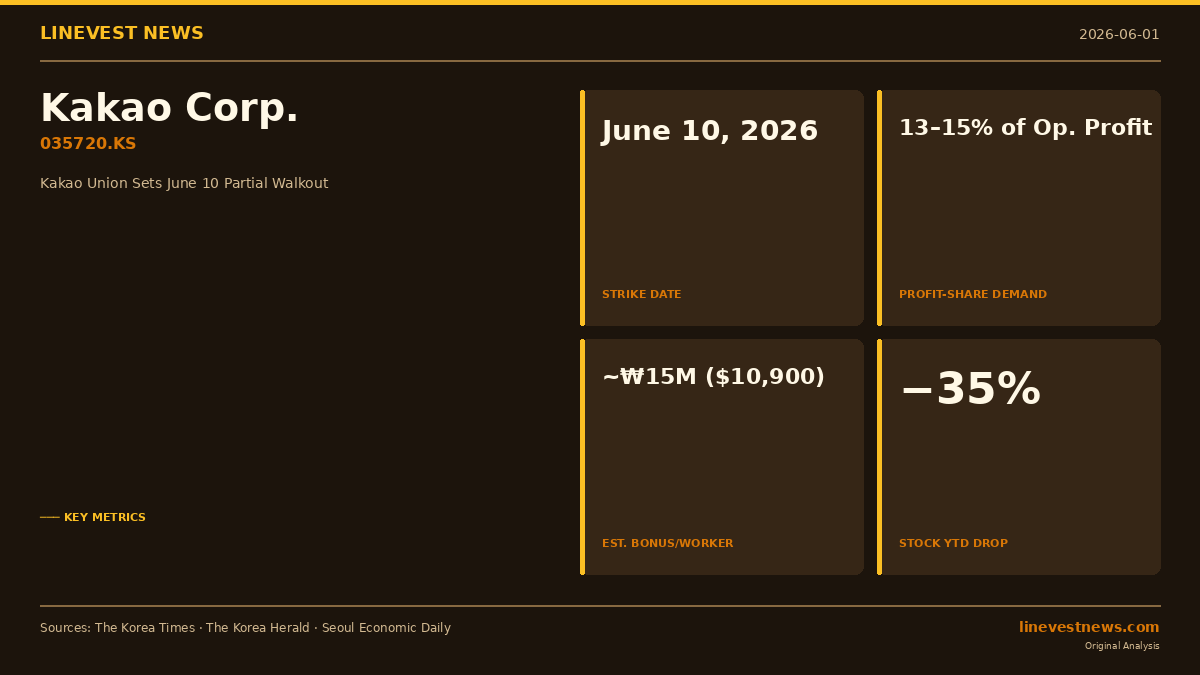
SEOUL — Kakao Corp.'s unified labor coalition has confirmed a four-hour partial walkout for June 10, after a second round of government-mediated wage talks collapsed in late May — setting the stage for the messaging platform's first-ever parent-company strike.
Unionized workers from five Kakao entities plan to walk off the job for four hours and march near the company's headquarters in Pangyo, south of Seoul. The union warned it could escalate the action depending on how future negotiations progress.
At the center of the standoff is a demand for performance bonuses equivalent to 13 to 15 percent of Kakao's 2025 operating profit. With last year's operating income at approximately ₩440 billion (18 million), full acceptance would translate into an estimated ₩15 million (roughly 0,900) per worker across the roughly 4,000-strong workforce. Management has responded that the total compensation package would place "a huge burden" on operations, arguing the company competes with major tech firms with far greater financial resources.
The five entities whose workers voted to authorize the strike span Kakao's core ecosystem: the parent company, Kakao Pay, Kakao Enterprise, DK Techin, and XL Games. The parent company has never faced a labor stoppage since its founding — making the June 10 deadline an inflection point in the platform's 14-year history.
Restructuring Backdrop Sharpens the Tension
The union has framed its demands partly as a response to what it calls an executive-biased compensation structure. Workers contend that executives received short-term performance bonuses of "up to 150 percent" while rank-and-file bonus pools were reduced — even as Kakao pursued a restructuring drive that cut or sold off several subsidiaries to lift operating margins. Management counters that the total cost of the union's bonus demands would outweigh the savings achieved, and that the package is incompatible with the company's cost structure.
The Samsung and SK Hynix Ripple Effect
The union's demands echo a wage-benchmarking wave spreading across Korea's technology sector. SK Hynix allocated roughly 10 percent of operating profit as its performance bonus pool — a settlement the Kakao union explicitly cited when it filed for mediation in early May. Samsung Electronics averted a strike in 2025 after extending a ₩500 million housing-loan benefit that has since become a benchmark for demands at peer companies. Kakao's union is essentially pressing the company to adopt a comparable profit-linked structure.
KakaoTalk AI Rollout at Stake
Kakao shares have declined about 35 percent year-to-date, sliding from ₩62,100 in January to the low ₩40,000 range, as investors question the commercial trajectory of KakaoTalk's AI services. The platform is rolling out features under the "Kanana" branding, pitched as a monetization engine for its roughly 47 million domestic monthly active users. A prolonged strike at the parent level could push back the Kanana rollout timeline — adding a second catalyst for stock underperformance on top of existing AI-monetization doubts. Kakao management said it "will take all possible steps to maintain stable service operations," specifically flagging KakaoTalk's continuity.
What Comes Next
The union said it would reassess the scale of the June 10 action after any further talks, leaving open the possibility of a full-day strike or broader coordinated action across all five affiliates. With two mediation rounds now exhausted under the Gyeonggi Regional Labor Relations Commission, there is limited procedural buffer before industrial action could expand. No third mediation date has been announced.
Sources: The Korea Times (Jun. 1, 2026); The Korea Herald (Jun. 1 and May 30, 2026); Seoul Economic Daily (May 21 and May 10, 2026)