Celltrion (068270.KS), the Incheon-based biosimilar maker that is South Korea's largest by sales, saw workers form the first labor union in its history on June 1, ending a no-union stretch that has held since the company's 2002 founding (Yonhap; Korea Times). The timing is what matters to investors: the union arrives weeks after Celltrion booked the most profitable year it has ever reported.
The question margins raise
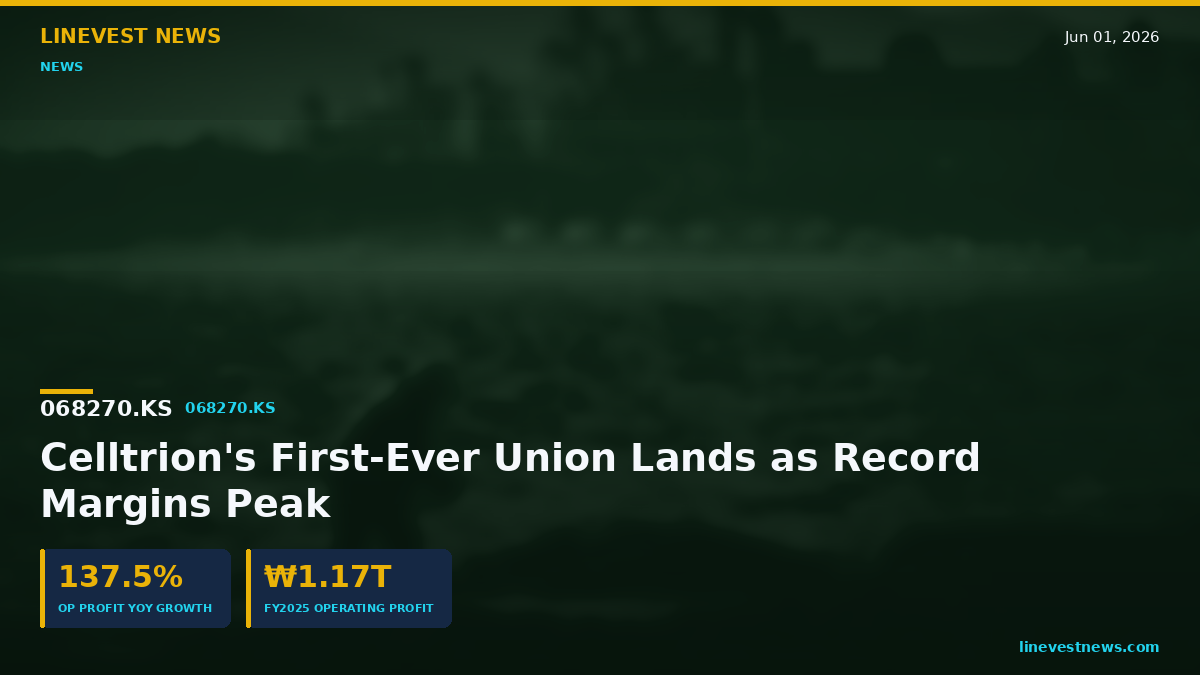
In FY2025, Celltrion's operating profit rose 137.5% year-on-year to ₩1.17 trillion ($880 million, per KED Global), on revenue up 17% to ₩4.16 trillion ($3.04 billion) — the first time the company has cleared both the ₩4 trillion revenue and ₩1 trillion operating-profit marks. The full-year operating margin widened 14.3 percentage points to 28.1% (KED Global). Global biosimilar sales drove the result, climbing 24% to ₩3.86 trillion ($2.82 billion).
Against that backdrop, the union's founding demands point straight at the margin line. In its founding statement the union called for "transparent compensation and respect that matches the devotion" of workers, declaring an "end to an era of fake communication," and pressed for increased staffing and better welfare benefits (Korea Times). Translated into financial terms, the new bargaining unit is asking to share in profits that more than doubled in a single year — a claim on the very margin expansion that has powered the stock.
The union organized as a local chapter under the Korean Chemical, Textile and Food Workers' Union, an affiliate of the KCTU (Korean Confederation of Trade Unions), one of Korea's two umbrella labor federations (Maeil Business Newspaper). Management said it "respects the labor rights guaranteed by law" and will respond in "good faith" to any union proceedings (Korea Times).
Why the no-union break is the story
For founder and chairman Seo Jung-jin, the unionization breaks a long-held principle of union-free management that had survived more than two decades of Celltrion's growth (Hankyung). That makes the closest read-across another founder-controlled Korean champion: Samsung. Samsung Group formally abandoned its decades-old "no-union" policy in 2020; the first strike in group history followed in June 2024, and the dispute ultimately settled with a 6.2% wage increase combining base pay and performance components (Korea Herald). The Samsung sequence — quiet unionization, then escalation to a wage-and-bonus settlement over a span of years — is the template the market will use to size Celltrion's risk.
There is a sector-specific wrinkle. Biosimilar manufacturing runs on continuous bioreactor processes and tightly scheduled regulatory batches, so any future work stoppage would carry different operational stakes than a one-day office walkout. No industrial action has been announced; at this stage the union has only formed and stated demands (Korea Times).
What confirms or refutes the thesis
The figure to watch is the operating margin in Celltrion's coming quarterly results against its 2026 revenue target of ₩5.3 trillion ($3.87 billion) (KED Global): the first wage settlement reached with the new union will show whether labor costs begin compressing the 28.1% margin, or whether management holds the line as Samsung largely did before its 2024 strike. The opening round of collective bargaining — not yet scheduled — is the next concrete signal.
This article is for informational purposes only and does not constitute investment advice. Figures are drawn from cited company disclosures and news reports; readers should verify current data before making any decisions. Currency conversions use approximate rates and figures cited from named sources.
Sources: www.yna.co.kr, www.koreatimes.co.kr, www.hankyung.com, www.mk.co.kr, www.kedglobal.com, companiesmarketcap.com