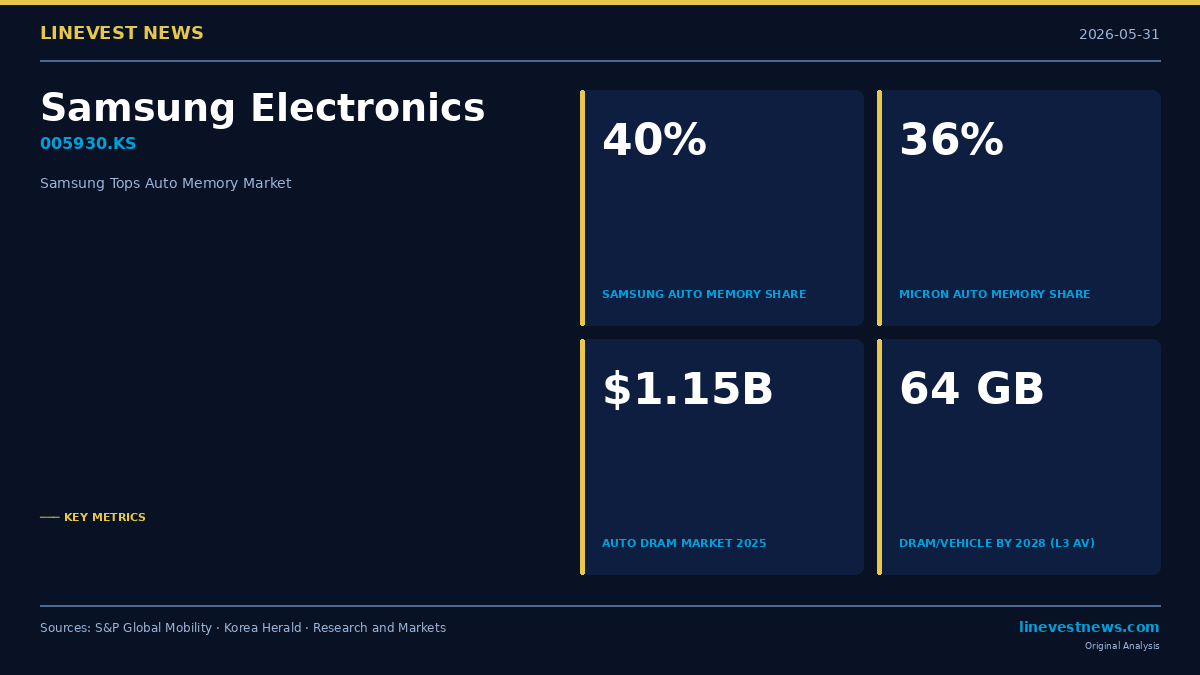
Samsung Electronics has dethroned Micron Technology as the world's top supplier of automotive memory chips, capturing 40 percent of the global market in 2025 — up five percentage points from a year earlier — according to a report by S&P Global Mobility published Saturday.
The reversal marks the first time Samsung has claimed the No. 1 position in automotive memory, a segment that until recently was considered Micron's domain. Micron's share fell to 36 percent from 40 percent over the same period, as Samsung's expanding footprint in China's fast-growing car market and surging demand for chips to power autonomous-driving and in-vehicle infotainment systems tilted purchasing decisions toward the Korean maker.
Samsung supplies automotive-grade DRAM and NAND flash to a broad set of auto-tech buyers, including Qualcomm, Bosch, Tesla, and Denso. The gains align with a broader industry shift: each next-generation electric vehicle requires 8 to 12 gigabytes of DRAM — two to three times the memory in a conventional car — while a vehicle equipped with Level 3 autonomous systems is projected to need up to 64 GB of DRAM and 512 GB of NAND by 2028, according to separate market research.
Analysts expect that structural tailwind to lift the automotive DRAM segment from roughly $1.15 billion in 2025 to $3.51 billion by 2032, implying a compound annual growth rate of around 17 percent.
Significance beyond revenue. For Samsung, the automotive win carries strategic weight that outpaces its current revenue contribution. The company has long trailed in high-margin specialty segments — server DRAM, high-bandwidth memory — despite holding the largest overall memory market share globally. Automotive-grade chips command higher average selling prices than consumer DRAM and are less exposed to the boom-bust cycles that have historically punished Samsung's commodity memory business.
Micron has spent years cultivating the automotive sector as a core growth engine, qualifying its products to meet the rigorous reliability and temperature standards demanded by Tier-1 suppliers such as Bosch and Denso. The loss of pole position to Samsung underscores how the Korean company's renewed cost competitiveness — bolstered by LPDDR5X process improvements and deeper relationships with Chinese EV platforms — is reshaping a segment Micron long treated as its stronghold.
SK Hynix, which has also sought to expand its automotive memory lineup, was not separately ranked in the S&P Global Mobility data.
Sources: Korea Herald · Korea Times · S&P Global Mobility (May 31, 2026)