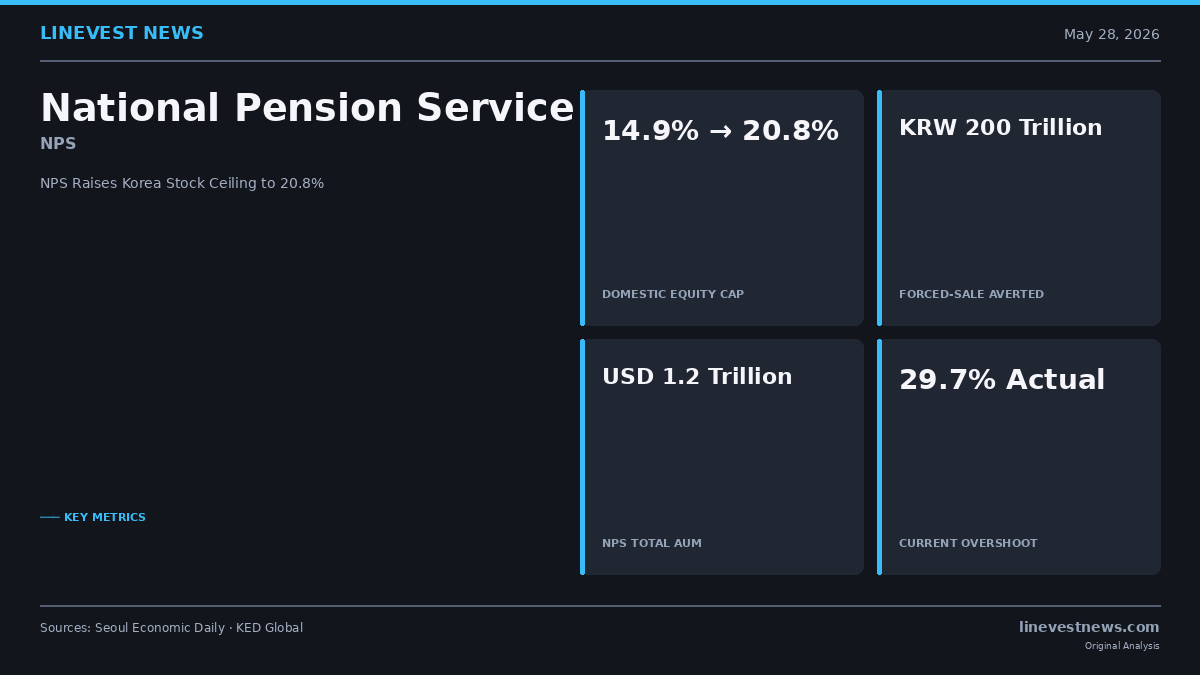
Korea's National Pension Service quietly neutralised one of the biggest structural risks hanging over the KOSPI this month, voting on May 24 to raise its domestic equity ceiling by 5.9 percentage points to 20.8% — averting more than ₩200 trillion in forced liquidations just as foreign investors were booking record profits from the chip rally.
A Policy Cap Written for a Different Market
The backdrop made the decision urgent. The KOSPI has surged 94% so far in 2026, with Samsung Electronics climbing 164% and SK hynix 258%, pushing the NPS's actual domestic equity weighting to roughly 29.7% of its ₩1,827 trillion fund — a full 15 percentage points above the prior 14.9% ceiling. Under the old rules, the fund would have faced mechanical selling requirements that could have dumped more than ₩200 trillion of Korean shares into a market already absorbing record foreign profit-taking.
The Committee Decision
The National Pension Fund Management Committee, chaired by Health and Welfare Minister Jeong Eun-kyeong, approved a revised allocation framework on Friday, May 28. The new domestic equity target is set at 20.8% and will remain in place through the end of 2027. The committee also widened the strategic allocation tolerance band, giving the fund room to rebalance gradually rather than selling into thin conditions. A further policy review is scheduled for year-end, once the market has had time to settle.
Minister Jeong said the decision "responds to recent changes in market conditions while enhancing the long-term profitability and stability of the National Pension Fund."
Still Some Overshoot — But the Urgency Is Gone
Even with the new ceiling, the NPS remains roughly 9 percentage points above its revised 20.8% target at current prices, meaning gradual selling pressure will persist. But the widened tolerance band means that process can unfold without mechanically hitting bid walls — the kind of forced selling that would have compounded the ₩44.7 trillion in net outflows that foreign investors posted in May, the largest monthly exodus from the KOSPI since at least 2009.
The effect, in practice, is that NPS shifts from a near-term forced seller to a passive holder with flexibility to rebalance over months rather than weeks.
Long-Term Arc: Toward 55% in Equities by 2030
The move fits a broader strategic pivot. A separate mid-term plan released last week shows NPS targeting total equity exposure — domestic and overseas combined — of approximately 55% of assets by 2030, up from about 40% at present. Within that, overseas equities are to rise to 38.9%, while domestic bonds will gradually contract.
The NPS posted a near-record 18.82% return in 2025 and has generated an estimated $33 billion in gains in recent weeks alone. With KOSPI at 8,476.15 as of Friday — up 28.45% in May — the fund's domestic portfolio has swelled far beyond any scenario that previous allocation caps were designed to handle.
Structural Implication
For international investors tracking Korean equities, the NPS ruling matters beyond headline allocation arithmetic. Caps set during calmer markets tend to bite hardest during rallies, forcing procyclical selling precisely when retail demand is most active — Korean domestic retail investors bought a record ₩35 trillion of KOSPI shares in May. By lifting the ceiling and widening the band, policymakers have at least temporarily suspended that mechanism, giving the KOSPI's 94% year-to-date rally a structural anchor it lacked going into June.
Sources
- Seoul Economic Daily — National Pension Service Raises Domestic Stock Allocation Cap by 5.9 Points, May 28, 2026
- Seoul Economic Daily — NPS Raises Domestic Stock Target to 20.8% Amid Market Pressure, May 28, 2026
- Seoul Economic Daily — Breaking: Korea's NPS Raises Domestic Stock Allocation to 20.8% from 14.9%, May 28, 2026
- KED Global — NPS raises 2026–2027 domestic equity cap, widens strategic allocation band, May 28, 2026
- KED Global — NPS to lift stock holdings to 55% by 2030, raising risk appetite, May 29, 2026