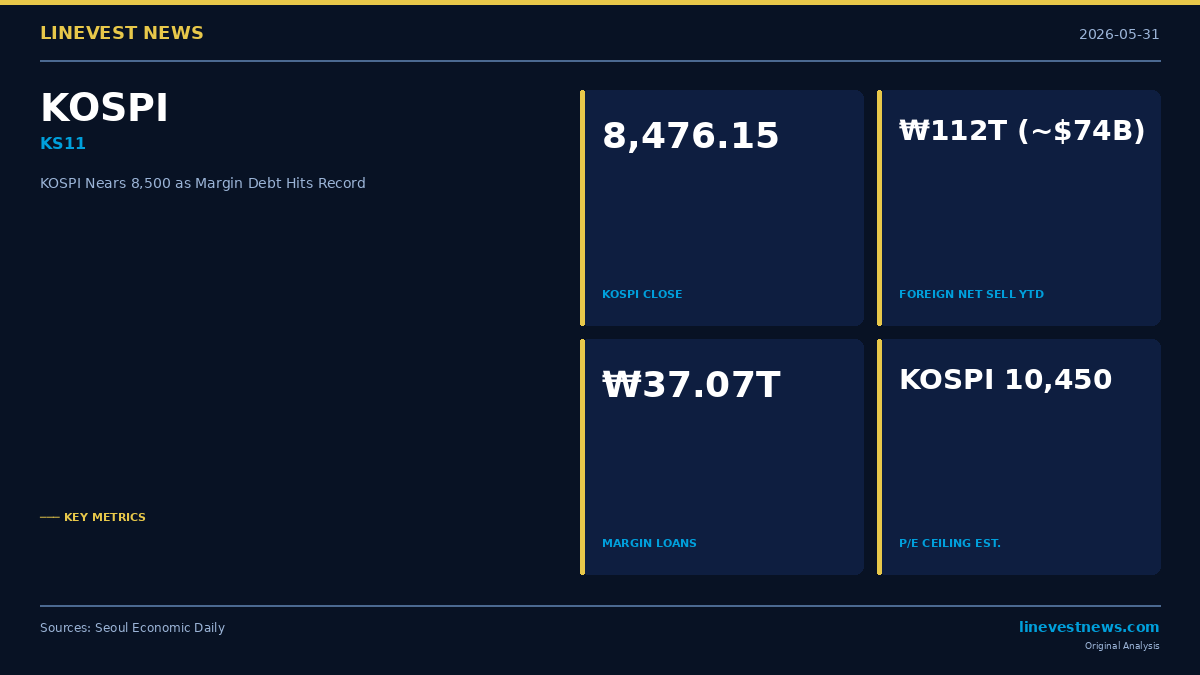
Korea's KOSPI index closed Friday at 8,476.15 — a hairsbreadth from 8,500 — capping its best weekly performance of 2026 at +8.01%, even as foreign investors extended their longest net-selling streak of the year and margin loan balances reached a fresh record. The juxtaposition marks the first week in this year's historic rally where the caution signs are as loud as the headline number.
The rally's engines. The week's gains were overwhelmingly concentrated in two names. Samsung Electronics climbed 8.38% to ₩317,000, pushing its market capitalisation above ₩2,000 trillion for the first time. SK hynix surged 20.20% to ₩2,333,000, a fresh record close. Together the chip pair now accounts for 50.71% of the KOSPI's total market value at ₩3,516 trillion. Analysts lifted targets accordingly: Mirae Asset, Shinhan Investment and Korea Investment & Securities raised their SK hynix price target to ₩3.8 million, while Korea Investment & Securities placed Samsung at ₩530,000 — implying more than 60% upside from Friday's close.
Foreigners keep selling. The enthusiasm for Korea is, so far, a domestic story. Foreign investors net-sold ₩4.1961 trillion on the KOSPI in the final week of May, extending their selling streak to a 16th consecutive session. Year-to-date, overseas funds have offloaded more than ₩112 trillion — approximately $74 billion — in Korean equities, a pace that Seoul Economic Daily described as the most aggressive foreign exit from a single Asian market on record. Retail investors absorbed ₩2.04 trillion of that outflow and domestic institutions another ₩2.13 trillion during the same week, keeping prices rising even as the largest holders reduce exposure.
Margin debt flashes a warning. Borrowed money is doing a growing share of the lifting. Margin loan balances — capital lent to investors to buy stock — reached ₩37.0687 trillion, a record level, with Samsung Electronics alone accounting for ₩4.24 trillion of that total and SK hynix for ₩3.46 trillion. Investor deposits grew from ₩122.38 trillion to ₩131.13 trillion over the week, a sign that retail participants are adding cash to buy rather than reducing positions. A sharp correction in either chip stock could trigger margin calls that mechanically amplify a drawdown.
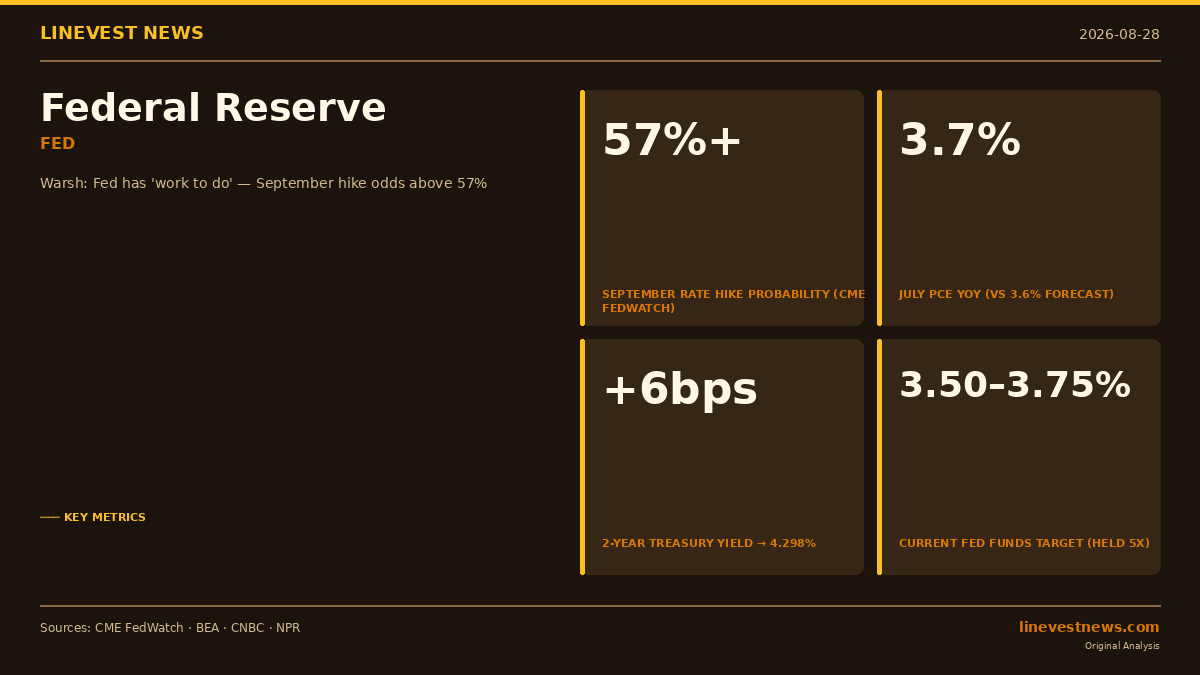
Three risk factors for June. Market strategists identified three external variables that could test the rally's footing next month. First, U.S. inflation: the Consumer Price Index stands at 3.8% year-on-year, above the Federal Reserve's 2% target, and the 10-year Treasury yield at 4.7% tightens the discount rate that underpins high-multiple growth stocks. Second, oil prices: West Texas Intermediate crude must remain below $90 a barrel for corporate earnings outlooks to remain intact, according to Seoul Economic Daily analysts. Third, breadth: despite the KOSPI's strongest single-session advance of the week — 3.55% — only 210 stocks rose while 688 fell, the latest data point in a broadening gap between index performance and underlying market health. Based on 2027 earnings projections and historical price-to-earnings ratios, the same analysts put the KOSPI's fundamental ceiling at approximately 10,450.
What to watch. The scorecard for June will be written as much in Washington and Houston — by the Federal Reserve and oil-market dynamics — as in Seoul. For domestic investors who have absorbed more than $74 billion in foreign selling since January, the question is whether that conviction holds if U.S. rate expectations shift or energy prices spike. The record KOSPI is, for now, a story of domestic faith in the chip supercycle; whether June tests that faith is the open question.
Sources: Seoul Economic Daily (May 31, 2026); Seoul Economic Daily (May 28, 2026). This article is for informational purposes only and does not constitute investment advice.