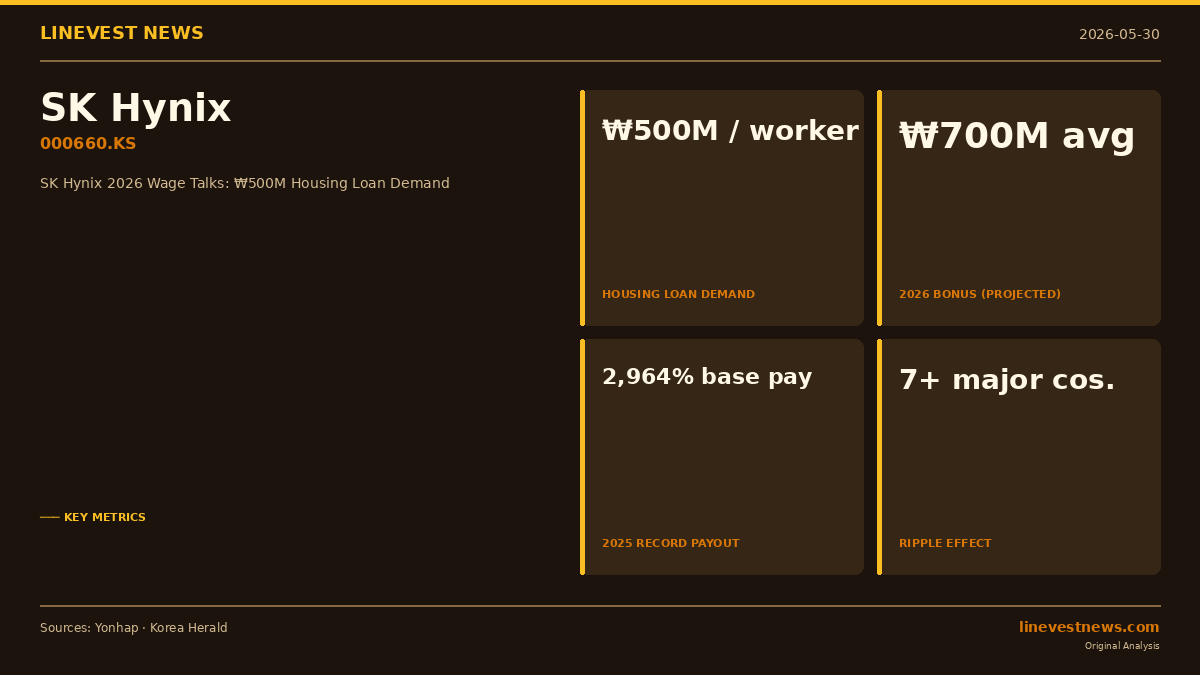
Even as SK hynix's profit-sharing model — the template that set Korea's wage-demand spiral in motion — is on track to deliver an average ₩700 million per worker this year, the chip giant is now facing an escalation of its own. Union negotiators opening the company's 2026 annual wage talks are demanding ₩500 million in mortgage-assistance loans, mirroring the benefit Samsung Electronics used last week to avert an 18-day strike, Yonhap reported Thursday.
The request marks a new dimension in SK hynix's bargaining season. The company's 2025 deal — which removed all caps on profit-linked bonuses and allocated 10 percent of annual operating profit to employee payouts — already produced record payouts equivalent to 2,964 percent of base pay in early 2026, averaging more than ₩100 million per employee. With SK hynix projected to sustain robust earnings through the AI memory cycle, analysts estimate the 2026 payout could average roughly ₩700 million per worker under the existing formula.
Now workers want the housing component too. Samsung's May 21 tentative agreement — reached hours before a planned walkout — included a ₩500 million low-rate mortgage facility alongside a special equity-linked bonus tied to semiconductor division operating profit. That deal is now the reference point in SK hynix's own talks.
The Company That Started the Trend Now Faces Its Echoes
There is an irony in the sequencing. It was SK hynix that ignited the current wave of profit-sharing demands across Korean industry when it became the first major conglomerate to peg bonuses directly to a fixed percentage of operating profit — with no ceiling — in September 2025. The agreement garnered a record 95.4 percent approval rate from union delegates. Early payouts in February 2026, averaging ₩140 million per employee, drew national attention and triggered immediate demands at competing firms.
Samsung's union subsequently demanded 15 percent of chip-division operating profit, a figure that would have yielded roughly ₩580 million per semiconductor worker. Management countered by offering to match SK hynix's 10 percent model. The May 21 settlement split the difference: a special bonus calculated at 10.5 percent of business-performance benchmarks, paid in company stock over ten years, with a housing loan added as a sweetener. Workers in Samsung's memory division could receive up to ₩600 million before tax if profit targets are hit.
That settlement is now feeding back into SK hynix's own talks, this time via the housing-loan channel.
Ripple Reaches Beyond Semiconductors
The same dynamic is reshaping bargaining tables across Korea's industrial landscape. According to Korea Herald reporting, at least seven major conglomerates have tabled or signaled profit-linked demands ahead of their 2026 annual rounds:
- Hyundai Motor and Kia: demanding bonuses equivalent to 30 percent of net profit — a figure that would exceed ₩3 trillion from last year's ₩10.36 trillion bottom line.
- HD Hyundai Heavy Industries: seeking at least 30 percent of operating profit.
- Samsung Biologics: tabling roughly 20 percent of operating profit.
- Kakao: filed for state mediation on May 11, demanding approximately 13–15 percent of operating profit, or about ₩15 million per employee.
- LG Uplus: proposed 30 percent of operating profit alongside an 8 percent wage hike and a 35-hour workweek.
- Hanwha Ocean, Samsung Display, Samsung Electro-Mechanics, Samsung SDI: each raising their own formulas.
Korea Herald described the phenomenon as profit-linked demands "rippling beyond chips" into autos, telecom and internet platforms — industries where margins are thinner and the feasibility of replicating semiconductor-scale payouts is openly questioned.
Context: SK Hynix at ₩1,500 Trillion
The talks unfold as SK hynix has cemented its position as the second Korean company — after Samsung Electronics — to surpass ₩1,500 trillion (approximately $1 trillion) in market capitalisation. Shares soared 9.31 percent in a single session last week on surging demand for its high-bandwidth memory chips. The company is currently the sole qualified supplier of HBM3E for Nvidia's Blackwell GPU platform, a position it expects to hold through at least the first half of 2027.
That dominance gives the workforce significant leverage. SK hynix's union will be aware that the company cannot afford a work stoppage at a time when AI infrastructure buildout is accelerating demand for memory chips at a pace that has repeatedly outstripped supply forecasts.
Whether management accepts the housing-loan parity demand or offers an alternative structure, the 2026 round will test whether the profit-sharing model SK hynix pioneered can absorb an additional layer of welfare benefits — or whether the upward spiral it began is starting to find its limits.
Sources: Yonhap (May 29, 2026); The Korea Herald — "Samsung deal ignites bonus pressure across industries" (May 2026); "Profit-linked bonus demands ripple beyond chips in Korea" (May 2026); "SK hynix workers got hefty bonuses. Now Samsung, Hyundai workers demand their share" (May 2026).