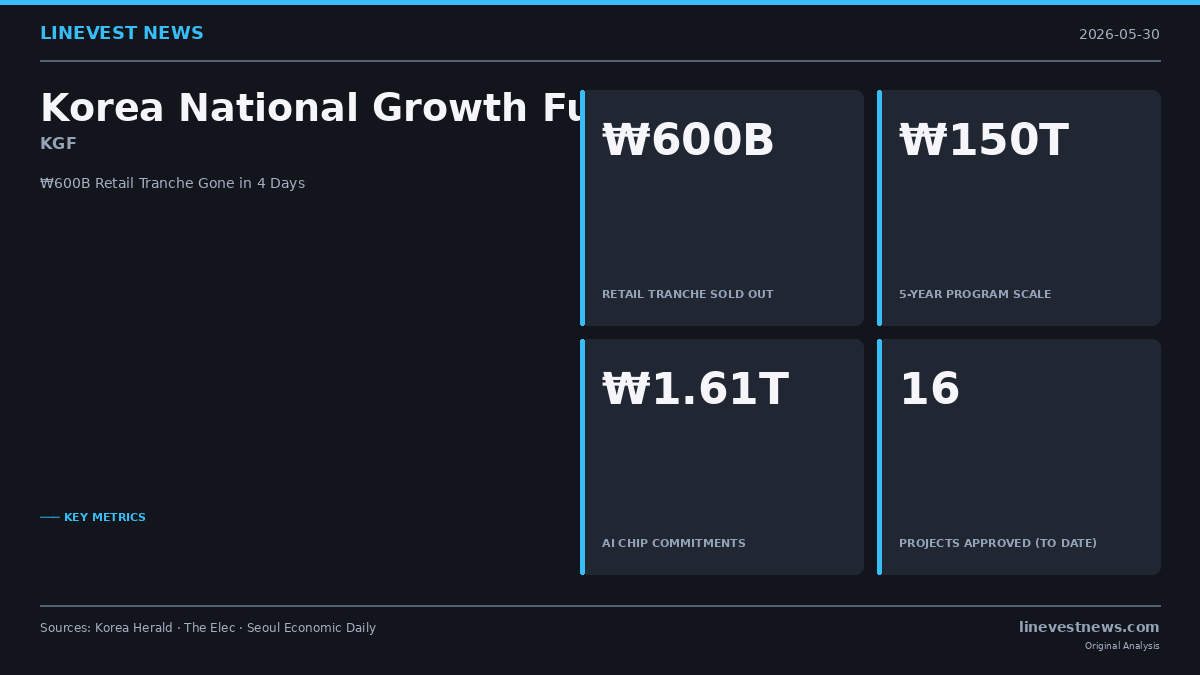
Retail investors snapped up South Korea's ₩600 billion ($400 million) National Growth Fund tranche in just four days, signaling surging confidence in the government's 150-trillion-won, five-year push to dominate AI chips, semiconductors, and sovereign technology.
The Financial Services Commission confirmed that 99.9 percent of the retail allocation had been absorbed as of Thursday, with the government injecting an additional ₩120 billion in subordinated capital — the tranche that absorbs losses first — to bring total fund resources to ₩720 billion. The five-year lockup did little to dampen appetite: on launch day, the Kosdaq surged roughly five percent, triggering buy-side sidecars for a second consecutive session, as foreign and institutional investors net-bought approximately ₩600 billion and ₩290 billion, respectively.
The retail product is channeled into ten privately managed subfunds with a mandate that at least 60 percent of capital target strategic industries — including unlisted companies and tech-special listing firms — with Kospi-listed holdings rounding out the portfolio for stability. Investors receive income deductions scaled to their commitment size, and dividend income is subject to separate taxation.
By late May the broader National Growth Fund program had approved 16 projects worth ₩12.5 trillion, with AI chips drawing the largest share. FuriosaAI, the neural-processing-unit startup competing to build Korea's answer to Nvidia, received an ₩800 billion commitment — including ₩370 billion in policy loans from the Advanced Strategic Industry Fund — to fund NPU mass production and next-generation chip development. AI chip rival Rebellions had earlier secured ₩250 billion, and language-model developer Upstage is linked to ₩560 billion in direct investment as part of the sovereign AI initiative.
Established players also feature prominently. Samsung Electronics is receiving ₩2.5 trillion in low-rate financing to build out its AI chip cluster, while Naver has been allocated ₩400 billion toward data-center expansion and GPU server procurement. Biotech and battery materials round out the portfolio, with SK Bioscience's vaccine capacity and L&F Plus's cathode-material operations among the recipients.
The speed of the sellout nonetheless drew a note of caution from Seo Ji-yong, a business professor at Sangmyung University, who said expectations for the stock market were "a big factor" in the demand and warned that a five-year lockup would expose investors if interest rates and inflation turned against growth stocks.
The fund launch sits inside a broader Korean government effort to mobilize ₩30 trillion in 2026 alone through four channels — ₩3 trillion in direct investment, ₩7 trillion in indirect investment, ₩10 trillion in infrastructure financing, and ₩10 trillion in ultra-low-rate loans — with the full ₩150 trillion target spread across the five-year plan. Whether retail enthusiasm translates into chip-industry returns will hinge on whether FuriosaAI, Rebellions, and Upstage can scale before deeper-pocketed U.S. and Taiwanese rivals lock in the next AI hardware cycle.
Key Figures
- ₩600B retail tranche — sold out in 4 days (99.9% allocated)
- ₩150T total five-year National Growth Fund program
- ₩12.5T committed across 16 approved projects to date
- ₩800B to FuriosaAI, ₩560B to Upstage, ₩250B to Rebellions
- ₩2.5T low-rate financing to Samsung Electronics for AI chip cluster