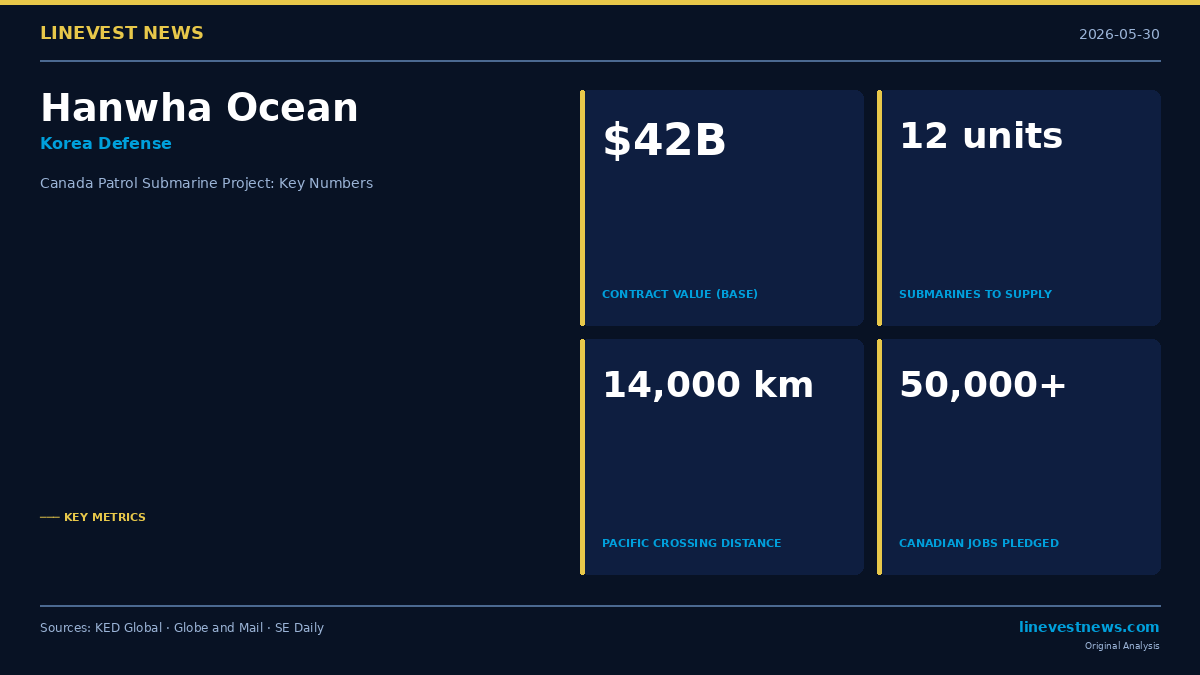
South Korea's most advanced submarine has arrived in Canadian waters, completing a 14,000-kilometre Pacific crossing to demonstrate that Hanwha Ocean's KSS-III is ready for NATO operations — and for a contract worth up to $42 billion.
The Dosan Ahn Chang-ho, a 3,000-tonne diesel-electric vessel, docked at Canadian Forces Base Esquimalt in Victoria, British Columbia on May 23–24, becoming the first Korean-built submarine to traverse the Pacific Ocean. During the stopover, Canadian naval personnel ran the vessel's Combined C4I system through simulated operational conditions alongside Canada's Pacific Maritime Forces — validating, for the first time in live conditions, the submarine's full interoperability with NATO communications architecture. The reaction from Canadian observers was pointed: one official reportedly compared upgrading from Canada's current Victoria-class fleet to the KSS-III to "driving a 1999 Honda Civic and then buying a new Tesla."
The bid at stake is one of the largest defence-export contracts ever put up for competition in North America. Canada's Patrol Submarine Project (CPSP) calls for up to 12 next-generation diesel-electric submarines at a base value of roughly $42 billion, with a full lifecycle value estimated at $60–120 billion. Two finalists remain: Hanwha Ocean — working alongside HD Hyundai Heavy Industries — offering the KSS-III, and Germany's ThyssenKrupp Marine Systems (TKMS) offering the Type 212CD, an evolution of the vessel operated by Germany, Norway and Singapore.
Both consortia submitted revised bids by an April 29 deadline after Ottawa asked for stronger Canadian-content commitments. Hanwha Ocean proposed a joint venture with the Canadian Automotive Parts Manufacturers' Association (APMA) to produce industrial and military vehicles — including variants of its K9 Thunder self-propelled howitzer and Redback Infantry Fighting Vehicle — at a new Canadian facility with Canadian-majority ownership and a Canadian CEO, targeting more than 50,000 automotive-sector jobs. Hanwha also signed a memorandum of understanding with Canadian space startup Reaction Dynamics, deepening its industrial network ahead of the decision.
Germany's TKMS countered with a pledge of an $86 billion economic contribution to Canada and the creation of tens of thousands of jobs through a government-to-government partnership and cooperation with Bombardier.
Ottawa's timeline points to a selection as early as late June 2026. Canadian Prime Minister Mark Carney, who has framed the submarine project as part of a broader effort to diversify Canada's supply-chain ties away from US dependence, has signalled that domestic production commitments will weigh heavily in the final call.
What a Win Would Mean for Korean Defence Exports
Should Hanwha Ocean prevail, it would mark a landmark moment for South Korea's defence industry. Korea has established itself as a credible tier-two exporter — the K9 howitzer is now operated by 11 countries, and the Redback IFV is a finalist in Australia's Land 400 Phase 3 programme — but a Canadian submarine contract would be its first major entry into Western undersea procurement. South Korean defence exports hit a record $17.3 billion in 2024 and are on pace to surpass that figure in 2026, with CPSP representing the single largest prize on the board.
Hanwha Ocean (042660.KS), the Hanwha Group shipbuilding arm formerly known as Daewoo Shipbuilding and Marine Engineering, has seen its order backlog swell on the back of global rearmament spending. Analysts estimate that a CPSP win would add the equivalent of roughly eight years of average annual submarine revenue to its books, a potential catalyst for a meaningful re-rating of the stock's target price.
For Germany's TKMS, the stakes are equally high: the Type 212CD has yet to win an export order outside Europe, and a Canadian contract would validate the platform as a NATO-standard choice across the wider Indo-Pacific market — where Australia, Japan and India are also weighing next-generation undersea platforms.
The decision, expected within weeks, will be watched closely not just in Seoul and Berlin but across NATO capitals weighing how much industrial leverage — not just technical capability — shapes the next generation of allied submarine fleets.
Sources: KED Global (May 29, 2026) · The Globe and Mail · Seoul Economic Daily (May 26, 2026) · CBC News
KED Global — South Korea, Germany in billion-dollar showdown for Canada submarine bid (May 29, 2026)
The Globe and Mail — South Korean bidder to build military vehicles in Canada if it wins submarine contract
Seoul Economic Daily — Korea's Dosan Ahn Changho submarine verifies NATO communications with Canada (May 26, 2026)