A minority labor union at Samsung Electronics (005930.KS), the world's largest memory-chip and television maker, said Friday it will keep fighting in court to stop a freshly ratified wage agreement that steers an uncapped bonus almost entirely to the company's semiconductor staff. The key question for investors is narrow: does this challenge actually threaten the payout, or the chips business behind it? On the evidence so far, the answer is that it threatens neither materially — but it crystallizes a deepening split inside Samsung's workforce that has now drawn in Korea's labor ministry.
The deal, and who is contesting it
The Samsung Electronics Co Union (SECU), which represents about 13,000 employees drawn mainly from the smartphone, TV and home-appliance divisions, will seek to block implementation of the accord and plans to file revised injunction papers next week, with a ruling expected within a month, the union's lawyer told reporters (Korea Times, May 29, 2026). SECU had initially tried to suspend the ratification vote itself; after the deal passed, it shifted to attacking the rollout.
It is contesting a deal that already has overwhelming support. Samsung's two largest unions, together representing more than 65,000 members, approved the agreement earlier in the week (Korea Times). With the representative bargaining unions already on board, SECU is the dissenting minority rather than a blocking bloc.
Why the money is lopsided
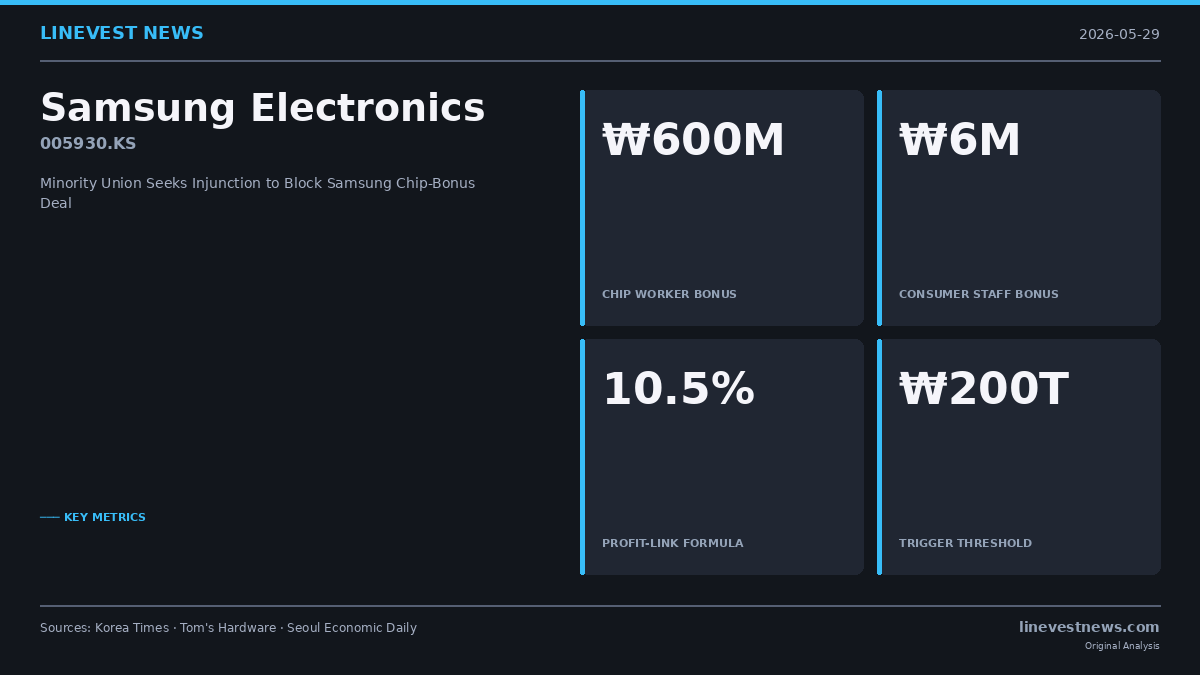
The dispute is fundamentally about distribution. Under the agreement, Samsung will pay a special semiconductor performance bonus equal to 10.5 percent of the chip division's operating profit with no cap, disbursed in company stock over at least a decade, and triggered only if the chip division (Device Solutions) hits annual operating-profit targets of more than ₩200 trillion ($132 billion) from 2026 to 2028 and ₩100 trillion (roughly $66 billion at the same conversion) from 2029 to 2035 (Tom's Hardware).
The gap that has angered the smaller union is stark. Samsung's roughly 28,000 semiconductor workers could receive stock worth up to ₩600 million each (about $400,000), while consumer-electronics staff are in line for shares valued near ₩6 million (about $4,000) (Korea Times; Tom's Hardware). That roughly 100-to-1 spread reflects where Samsung's profit is being made: its memory operation is the prime beneficiary of the AI-driven boom in high-bandwidth chips, while the handset and appliance units are not.
A familiar fault line
This is the same workforce that produced Samsung's first walkout. In July 2024 the National Samsung Electronics Union (NSEU), then the company's largest union with about 30,000 members, staged the first strike in Samsung Electronics' 55-year history before the action wound down on Aug. 1, 2024 (Labor Notes; Wikipedia, "Samsung and unions"). The current clash is the mirror image: instead of pressing for more, a smaller bloc is trying to slow a payout it says shortchanges everyone outside the chip lines.
The fight has gone national
What began as an internal bonus quarrel has drawn in the national government. Korea's Minister of Employment and Labor (the cabinet ministry overseeing labor policy), Kim Young-hoon, has framed large-company "excess profits" as a matter of social distribution and argued that social dialogue is the way to address it (Seoul Economic Daily, May 28, 2026). Kim has since pushed back on the idea that the government intends to seize or redistribute Samsung's profits, saying the state has "neither the authority nor the intention" to do so (Seoul Economic Daily, May 28, 2026 — "Labor Minister Denies Plan to Redistribute Samsung's Excess Profits"). His ministry separately postponed a planned June 1 forum on a "Korean-style social solidarity wage," citing a need to gather more views (Seoul Economic Daily, May 28, 2026 — "Korea Labor Ministry Delays 'Excess Profit Sharing' Forum").
What to watch
The concrete signal is the court's ruling on SECU's revised injunction, expected within a month per the union's counsel. A rejection would clear the bonus mechanism to proceed; an injunction would delay disbursement rather than alter Samsung's chip earnings, since the payout is contingent on multi-year operating-profit thresholds that run through 2035. Either way, the more durable variable is whether the AI-memory cycle keeps the Device Solutions division near the ₩200 trillion profit bar that switches the bonus on — a figure Samsung's quarterly results, not the courtroom, will settle.
This article is for informational purposes only and does not constitute investment advice. Figures are sourced from the reporting cited inline; currency conversions are approximate.