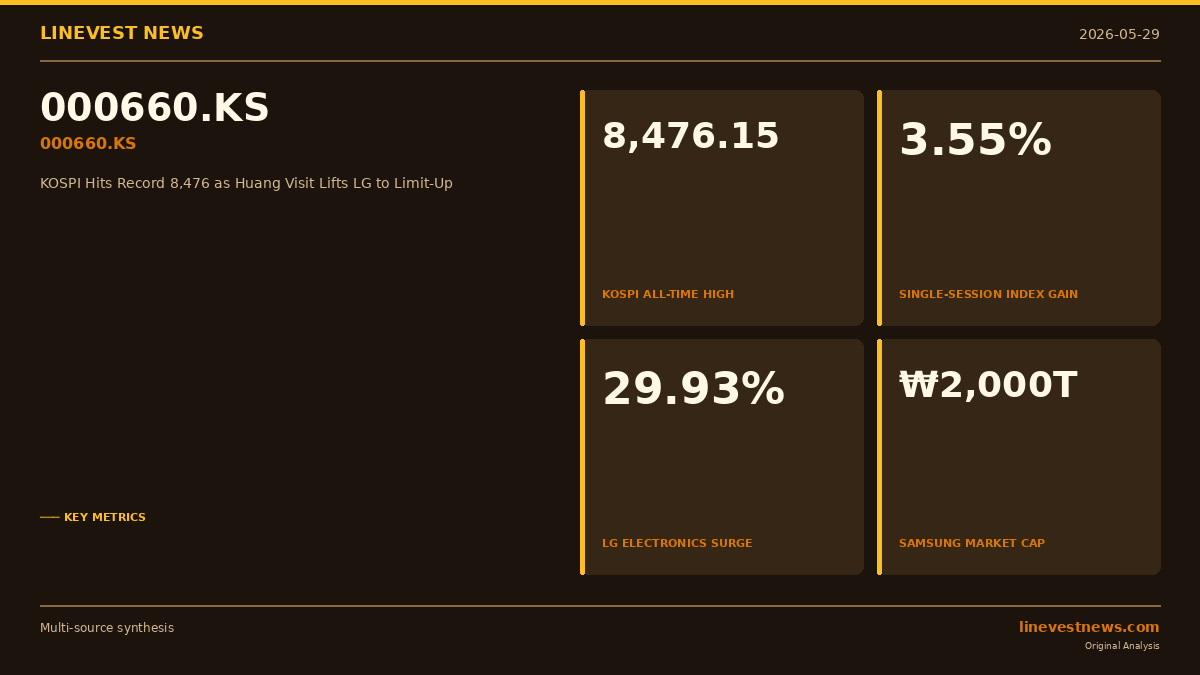
South Korea's KOSPI (the country's benchmark stock index) closed at an all-time high of 8,476.15 on May 29, surging 290.86 points, or 3.55%, after touching an intraday peak of 8,615.09, according to Korea Exchange (KRX, Korea's bourse operator) data reported by Newsis. The single-session jump was led by a near-vertical rally in stocks tied to Nvidia CEO Jensen Huang's anticipated visit to Korea in early June — a rally large enough that one affiliate group, LG, locked limit-up across multiple listings.
The question for any allocator looking at a +3.55% index day driven by a meeting that has not yet occurred: how much of this is a durable AI re-rating, and how much is anticipatory positioning? The session offers evidence on both sides.
What actually moved
The sharpest moves were in the LG complex, on speculation that the group will deepen "physical AI" cooperation — robotics, smart factories and manufacturing AI — with Nvidia. LG Electronics (066570.KS; Korea's major home-appliance and consumer-electronics maker) closed at ₩293,000 ($214), up 29.93%, hitting its daily price limit, per Newsis and VOI. Affiliates moved in lockstep: LG Innotek (011070.KS; the group's camera-module and substrate unit) +28.57%, LG CNS (064400.KS; its IT-services arm) +29.91%, and holding company LG Corp (003550.KS) +26.60%, according to Newsis. Naver (035420.KS; Korea's largest internet and search company) gained 14.15% to ₩234,000 ($171) on expectations of cloud, digital-twin and AI-platform tie-ups.
The memory names, where Nvidia exposure is most concrete, moved far less. Samsung Electronics (005930.KS; the world's largest memory chipmaker) rose 5.84% to ₩317,000 ($231), helped by reports it has begun shipping HBM4E samples, Newsis reported; the combined market capitalization of its common and preferred shares topped ₩2,000 trillion ($1.46 trillion) for the first time. SK hynix (000660.KS; the world's second-largest memory maker and Nvidia's principal high-bandwidth-memory supplier) added a comparatively modest 1.92% to ₩2,333,000 ($1,703). Institutions were the marginal buyer, net purchasing ₩2.37 trillion ($1.73 billion) of shares on the main board, per Newsis.
That split — anticipatory consumer/internet names up 14–30% versus established chip suppliers up roughly 2–6% — is itself the answer to the allocator's question: the day's largest gains sit in the names with the least confirmed Nvidia revenue, not the most.
What is actually scheduled
Huang is expected to travel to Korea immediately after Nvidia's GTC Taipei 2026 conference, which runs June 1–4 in Taipei, with conglomerate chairmen having all but finalized schedules for June 5, the Seoul Economic Daily reported. He is expected to meet SK Group Chairman Chey Tae-won, Hyundai Motor Group Executive Chairman Chung Euisun, LG Group Chairman Koo Kwang-mo and Naver's Lee Hae-jin, per Newsis; the Seoul Economic Daily also lists Samsung's Jay Y. Lee, framing the Samsung and SK meetings around memory-chip supply and the Hyundai and LG meetings around physical AI. The Koo–Huang meeting would be their first official one, that outlet noted.
As of the close, no deal had been signed — the move discounts a meeting agenda, not announced contracts.
Precedent and the macro overlay
There is a template for this. In October 2025, Samsung's Lee, SK's Chey and Hyundai's Chung gathered with Huang at a Seoul chicken restaurant in what local media dubbed the "kkanbu" (buddy) summit; observers are now watching for a "second kkanbu summit," the Seoul Economic Daily reported. That gathering preceded a wave of Nvidia–Korea AI announcements, which is part of why the market is pricing the sequel aggressively.
The rally was not purely an Nvidia story. VOI reported that sentiment was also lifted by Middle East news of a reported 60-day ceasefire extension and continued talks on Tehran's nuclear program, which it characterized as a secondary factor behind the Nvidia-related enthusiasm. The Wall Street Journal described Huang's planned visit as a strategic move to preempt next-generation technology standards as software and hardware converge, per Newsis.
The open question
The confirming — or refuting — data point is concrete and dated: the June 5 round of chairman meetings. Whether they produce signed supply or physical-AI agreements, or remain relationship-building sessions, will determine whether the limit-up names hold their re-rating or give it back. A second, slower-burn checkpoint is Samsung's HBM4E qualification progress following its reported sample shipments, which bears directly on the memory leg of any Nvidia partnership.
This article is for informational purposes only and does not constitute investment advice. Figures are drawn from cited reporting as of May 29, 2026; currency conversions use an approximate rate of 1 USD = 1,370 KRW and are for reference only.