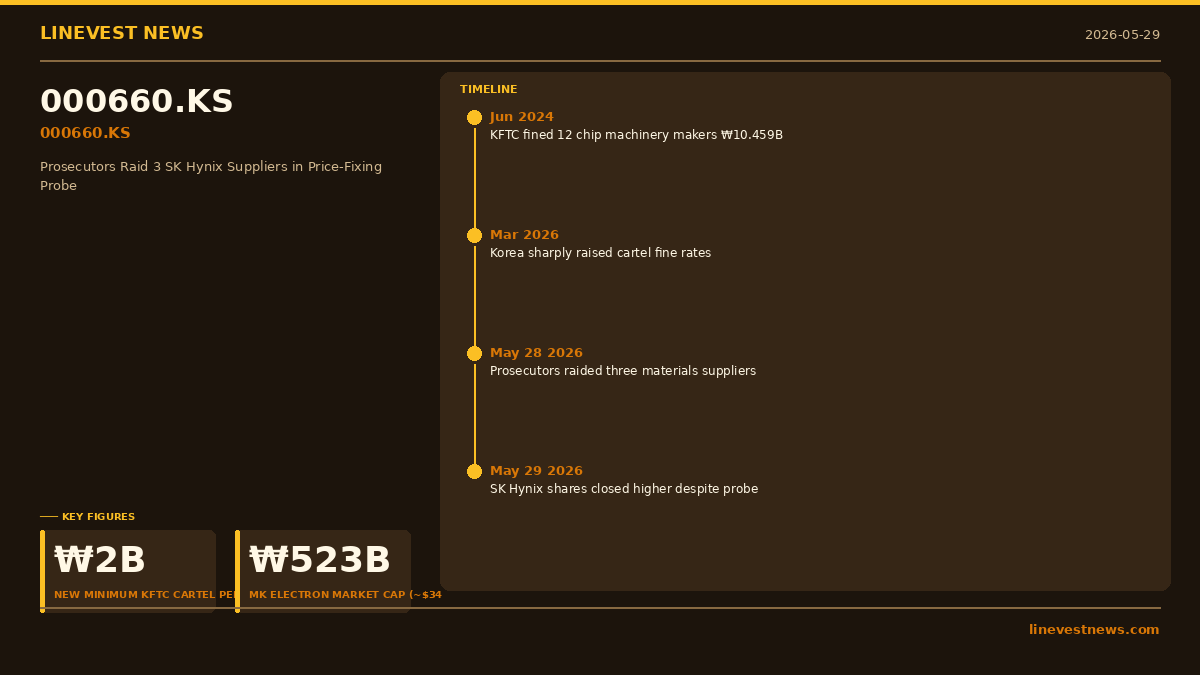
Seoul Central District Prosecutors' Office, the country's lead office for major financial crime, raided three South Korean semiconductor-materials makers on May 28 over allegations they coordinated prices and supply volumes for materials sold to SK Hynix (000660.KS), the world's second-largest memory-chip maker, and other chipmakers, according to Maeil Business Newspaper and Hankyung.
The office's Crime Proceeds Forfeiture Division, led by senior prosecutor So Jeong-su, searched MK Electron (033160.KQ), LT Metal and Duksan Hi-Metal (077360.KQ), per Hankyung. Investigators plan to comb e-mails, messenger logs and internal documents to test whether the firms pre-agreed delivery prices and divided up supply, Hankyung reported.
The question for a chipmaker's shareholder: cost shock, or a small-cap problem?
The materials at issue sit in back-end packaging, the stage where finished chips are wired and mounted. The three suppliers are leaders in narrow niches: MK Electron is a leading domestic maker of gold bonding wire (the hair-thin wire that links a chip die to its lead frame), Duksan Hi-Metal is the top domestic maker of solder balls (the tiny conductive spheres in BGA and CSP packages), and LT Metal, a privately held Seoul-based firm founded in 1974, makes bonding wire and recovers precious metals. These products are inputs to chip assembly rather than the silicon itself.
That distinction frames the financial read. Bonding wire and solder balls are minor line items in a memory maker's cost stack, so even a confirmed cartel would do little to SK Hynix's bill of materials. The market appeared to treat the probe as immaterial to the chipmaker: SK Hynix shares closed higher on May 29, on a day the broader KOSPI also advanced. (USD conversions use the May 29 close of ₩1,507.9 per dollar reported by ChosunBiz.)
The sharper exposure is to the suppliers themselves. MK Electron carried a market capitalization of about ₩523 billion (roughly $347 million) as of April 20, 2026, per stockanalysis.com — a small-cap for which a criminal probe and any follow-on antitrust penalty is a more meaningful event than for its customers. Hankyung noted skepticism among some investors that thin-margin component makers would risk a cartel, citing one reaction: "Does collusion yield single-digit operating margins?"
Why the penalty math changed in 2026
The timing matters because Korea has just sharply raised the cost of being caught. In March 2026, the Korea Fair Trade Commission (KFTC), the country's antitrust regulator, moved to lift cartel fine rates across the board and raise the minimum fixed penalty from ₩10 million (about $6,600) to ₩2 billion (about $1.3 million), with surcharges of up to 100% for firms that violated within the prior decade, according to Seoul Economic Daily. The same outlet reported that fine rates for minor violations would jump from 0.5%–3% of relevant revenue to 10%–15%. Because KFTC penalties scale to revenue, the revised regime bites harder on the suppliers' top lines than on their customers'.
The criminal raid and any KFTC case are separate tracks. Hankyung reported the matter was assigned to the Crime Proceeds Forfeiture Division — not the office's dedicated fair-trade investigation unit — because of that unit's caseload, an unusual routing for an alleged price-fixing matter.
A recent precedent
Korea has pursued the chip supply chain before. In June 2024 the KFTC fined 12 makers of semiconductor production machinery a combined ₩10.459 billion (about $7.6 million, per MLex) for rigging 334 bids run by Samsung SDS, the Samsung group's IT-services arm, between 2015 and 2023, predetermining winners and using cover bids, according to Asia Economic Daily. That case targeted equipment vendors rather than materials suppliers, but it shows the regulator's willingness to penalize coordinated conduct among the chipmakers' vendors.
What to watch
The confirming or refuting signals are concrete: whether the KFTC opens a parallel administrative case, whether prosecutors move from searches to indictments, and how MK Electron and Duksan Hi-Metal characterize the probe and any contingent liabilities in their next filings on DART (Korea's electronic corporate disclosure system). Until then, the allegations remain unproven and no penalty has been assessed.
This article is for informational purposes only and does not constitute investment advice. All figures are sourced as cited above; allegations described here are unproven, and the companies have not been charged as of publication.