The deal closed. The union didn't.
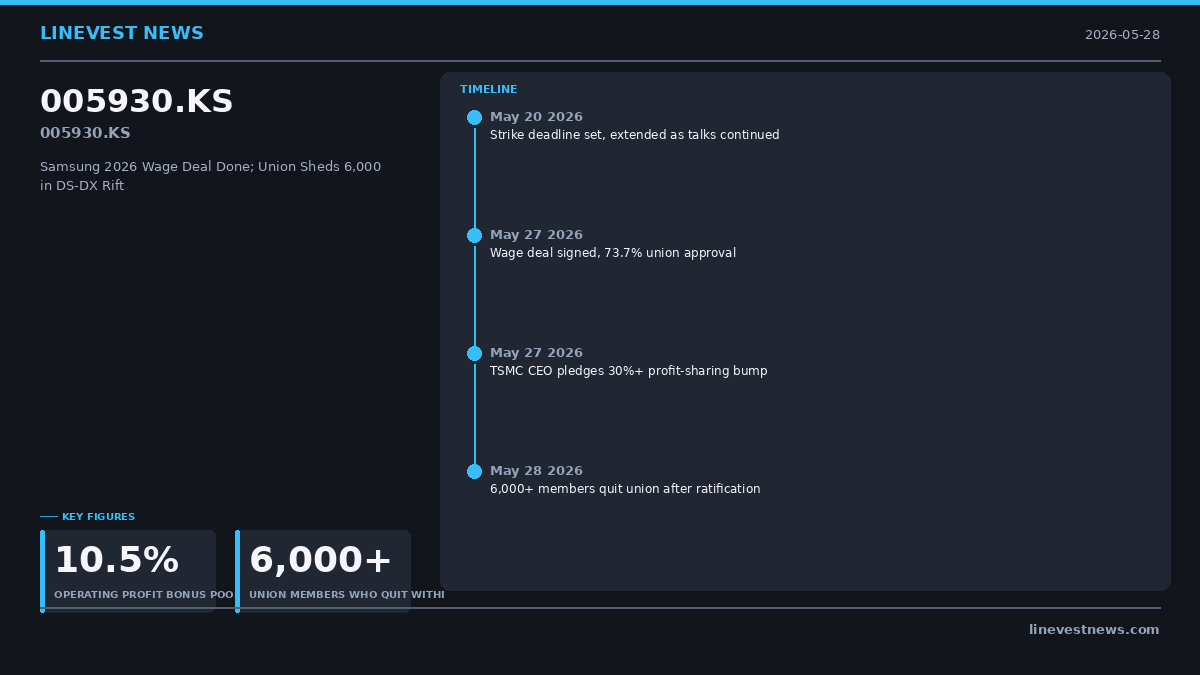
Samsung Electronics (005930.KS), the Korean memory and foundry giant, signed its 2026 wage agreement on May 27 at its UniverSE campus in Yongin, Gyeonggi Province, averting a strike that had originally been scheduled to begin May 20 before the deadline was extended as talks continued. The agreement won 73.7% support from 62,616 union members who cast ballots, on 95.5% turnout from 65,593 eligible voters at the time of the ballot (Korea Herald).
The vote was the easy part. Within hours of ratification, Samsung's largest in-house union — the Samsung Group Supra-Enterprise Union (often rendered as "Cho-gi-eop" union), an umbrella covering employees across both chips and consumer electronics — began hemorrhaging members. By the morning of May 28, membership had fallen to 69,575, down from a peak above 76,000 during the talks, a loss of more than 6,000 in days (Seoul Economic Daily). Hankyung reported that 1,100 members walked out in a single five-hour window (Hankyung).
The union must hold roughly 64,500 members to keep majority-union status — the legal threshold that lets it bargain on behalf of all employees (Seoul Economic Daily). It is now within striking distance of losing that standing, and it has already announced that future negotiations will move to a two-track system separating the Device Solutions (DS, semiconductors) and Device eXperience (DX, smartphones/TVs/appliances) divisions (Yonhap; Hankyung).
Why one deal split one union
The walkouts are protest votes against the bonus math. The agreement creates a special management bonus pool equal to 10.5% of operating profit from Samsung's semiconductor business, paid in shares to DS employees, plus a revised regular profit incentive capped at 50% of annual salary (Korea Herald).
In practice, that means a memory-division employee on a ₩100 million ($73,000) annual salary could see roughly ₩550 million ($401,000) in special bonus before tax, and total performance compensation around ₩600 million ($438,000) (Korea Herald). Foundry and System LSI workers expect closer to ₩200 million ($146,000). DX employees — the people building Galaxy phones and TVs — face payouts described as "several million won," far smaller in absolute terms (Korea Herald).
The inside-union vote made the rift legible: the Supra-Enterprise Union recorded 80.6% in favor, but the separate National Samsung Electronics Union (heavily DX) supported the deal at just 21.1% (Seoul Economic Daily). A rival body, the Donghaeng Labor Union, has absorbed much of the discontent, growing from about 2,600 members to roughly 13,000 (Korea Herald).
The formula is already being copied
The 10.5%-of-operating-profit anchor did not stay inside Samsung. On the same day the wage deal was ratified, TSMC chairman and CEO C.C. Wei told a Taipei town hall that 2026 employee profit-sharing would rise more than 30% year-on-year — and canceled an overseas trip to deliver the message in person. Wei's pledge was reported by Bloomberg and explicitly framed by Korean and Taiwanese press as a response to the Samsung settlement (Bloomberg via The Edge Singapore; Newsis). TSMC's first-quarter 2026 revenue was NT$1.1341 trillion (₩54.4 trillion), up 58.3% year-on-year, giving it ample room for the bump (Newsis).
Kakao (035720.KS), the Korean internet platform behind KakaoTalk, is now demanding the same template. Its head-office union, which won the right to strike on May 27 after mediation broke down at the Gyeonggi Regional Labor Relations Commission, is asking for 13–14% of 2025 operating profit as bonus. Kakao's 2025 operating profit was ₩732 billion ($534 million), so the ask translates to roughly ₩95–103 billion ($69–75 million). For scale, Samsung's 2025 operating profit was ₩43.6 trillion ($31.8 billion) (Chosun Biz).
The shareholders are not done
The Korea Shareholders Movement Headquarters (대한민국 주주운동본부), a domestic activist body, has called the bonus structure illegal, arguing that paying out a fixed share of operating profit is a corporate cash outflow that requires shareholder approval, not collective bargaining. It has signaled a damages suit against board members and is pushing for an extraordinary general meeting; it is also lobbying institutional holders, including Korea's National Pension Service, to enforce the stewardship code (Chosun Biz).
Industry Minister Kim Jeong-gwan, head of MOTIE (Korea's Ministry of Trade, Industry and Energy), told reporters Samsung is "at a crossroads — whether this becomes poison or medicine" (Chosun Biz). Labor Minister Kim Young-hoon separately said he will convene a June 1 forum on a "Korean-style solidarity wage" examining redistribution of excess corporate profit (Newsis).
Separately, the dual tower-crane operator unions affiliated with the FKTU and KCTU federations began an indefinite general strike on May 27, demanding a 15% wage increase. Union representatives say about 3,100 of Korea's roughly 3,500 tower-crane operators (88.5%) are members, and claim 85% of national tower-crane capacity could halt — a risk flagged for Samsung's chip-fab construction sites in particular (Chosun Biz; MK).
Historical context: year two of acute friction
The National Samsung Electronics Union staged the first strike in Samsung Electronics' 55-year history on June 7, 2024, then escalated to a three-day walkout on July 8, 2024, which converted into an indefinite action and ran until August 1, 2024 (Bloomberg, 2024-07-01). The 2026 cycle replaces the strike risk with a different one: a permanent split of bargaining along the DS/DX line, which removes the company's ability to settle pay across the whole workforce in one round.
What to watch
The next dated checkpoint is June 17, 2026, when the Supra-Enterprise Union holds a confidence vote on chairman Choi Seung-ho. A no-confidence outcome, combined with continued exits, would put majority-union status at risk and concretize the DS-DX split. The shareholder lawsuit timeline and the June 1 MOTIE/Labor Ministry forum on profit redistribution are the other near-term data points. None of them will tell us anything about second-quarter shipments — but together they decide whether 10.5%-of-DS-operating-profit becomes a one-off settlement or a sector-wide template.
This article is for informational purposes only and does not constitute investment advice. LineVest does not recommend any specific securities transaction. Readers should consult their own advisors before making investment decisions.
Sources
- Korea Herald — Samsung union ratifies wage deal, May 28, 2026
- Korea Herald — Samsung union loses thousands of members after wage deal, May 28, 2026
- Seoul Economic Daily — Samsung's largest union cracks as 6,000 members quit, May 28, 2026
- Hankyung — Samsung union membership falls below 70,000 in single day, May 28, 2026
- Hankyung — Samsung supra-enterprise union DS-DX bargaining split, May 28, 2026
- Yonhap News — Samsung supra-enterprise union DS-DX separation, May 28, 2026
- The Edge Singapore — TSMC CEO pledges 30%+ bonus bump as AI profits soar, May 2026
- Newsis — Samsung union confidence vote scheduled June 17, May 28, 2026
- Newsis — Samsung union membership drops, May 28, 2026
- Chosun Biz — Samsung union membership below 70,000 as backlash grows, May 28, 2026
- Chosun Biz — Ministry of Industry warns Samsung at crossroads, May 28, 2026
- Chosun Biz — Tower crane union national strike starts, semiconductor fab disruption risk, May 28, 2026
- Maeil Business Newspaper — Samsung DS-DX bargaining separation after wage deal, May 28, 2026
- Bloomberg — Samsung Electronics labor union three-day strike, July 2024