A 6 GWh order lands as ESS becomes the company's loss-mitigation story
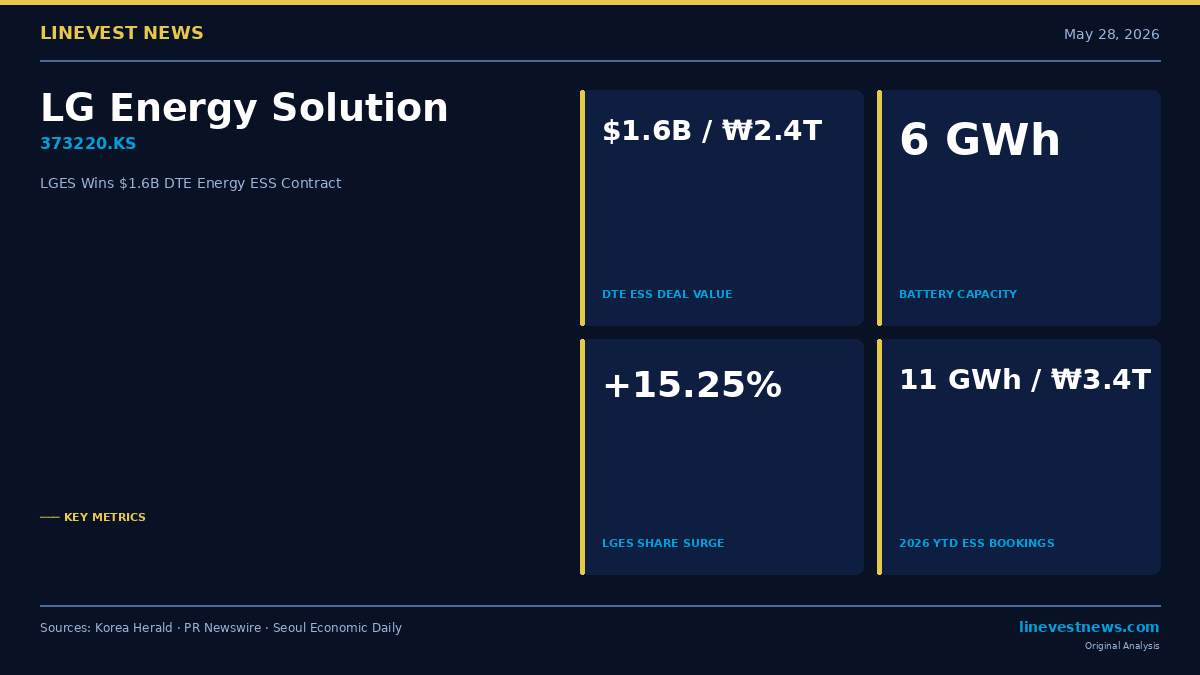
LG Energy Solution (KRX: 373220), Korea's largest battery maker, said on May 28 that it had signed a two-year contract to supply 6 gigawatt-hours of energy storage system (ESS) batteries to DTE Energy, Michigan's largest electric utility, for a total of $1.6 billion (₩2.4 trillion). Shares of LG Energy Solution surged in Korea Exchange trading, with shares up roughly 15.25% to ₩442,000 from the prior close of ₩383,500, according to market data tabulated by Morningstar (Morningstar 373220 quote). The same session saw the broader KOSPI (Korea's benchmark equity index) close 0.53% lower at 8,185.29, down 43.41 points, on profit-taking after a four-session rally, with the LG Energy Solution announcement cited as one of the few large-cap drivers on the upside (Seoul Economic Daily).
The deal is being read as the most concrete validation yet of management's claim, made on the Q1 2026 earnings call, that grid-scale storage can offset weakening pouch-type EV battery sales in North America. Q1 consolidated revenue was ₩6.6 trillion ($4.82 billion), but the company posted an operating loss of ₩207.8 billion ($152 million) on ESS ramp-up costs and unfavorable EV mix, even after a ₩189.8 billion ($139 million) U.S. production tax credit (PR Newswire — LG Energy Solution Q1 2026 results). Management disclosed that the ESS business now accounts for the mid-20% range of total revenue, up from a single-digit share two years ago.
What is actually being sold, and to whom
DTE Energy, the Detroit-based holding company that serves about 2.3 million electricity customers and 1.3 million natural gas customers across southeastern Michigan, will use the LG batteries across eight grid-infrastructure projects. The largest single project tied to the contract is the new Oracle AI data-center development in Saline Township, Michigan, according to LG's announcement summarized by The Asia Business Daily and The Korea Herald (Asia Business Daily, Korea Herald).
The cells are being produced at LG's Holland, Michigan plant, which began ESS battery output in June 2025 as the first dedicated large-scale ESS production line in North America for the company. Park Jae-hong, president of LG Energy Solution's Vertech ESS integration subsidiary, said in the announcement that the contract was anchored by "locally produced ESS in Michigan, our core U.S. manufacturing base" — relevant because U.S. utility procurement increasingly favors domestically manufactured cells eligible for Section 45X advanced manufacturing credits.
Sizing the order against the strategy
LG Energy Solution has guided global ESS capacity to exceed 60 GWh by year-end 2026, with more than 50 GWh located in North America — a footprint built across five facilities including Holland and Lansing, Michigan; NextStar Energy in Canada; the Ultium Cells Tennessee plant (being converted to LFP for ESS); and a JV with Honda in Ohio (Asia Business Daily). Against that target, the DTE 6 GWh contract absorbs roughly 12% of the planned North American annual run-rate over its two-year delivery window.
Including the DTE deal and a previously disclosed 5 GWh agreement with Hanwha Qcells, Korea's solar and energy storage arm of Hanwha Group, LG Energy Solution's 2026 year-to-date ESS bookings total 11 GWh worth approximately ₩3.4 trillion ($2.26 billion) (Korea Herald). Total order backlog across product lines stood at more than 440 GWh as of end-April 2026, supported by over 100 GWh of new 46-Series cylindrical EV cell orders booked in Q1 (PR Newswire).
Why this particular customer matters
U.S. utility ESS procurement has largely relied on Chinese cell suppliers, and recent tariff and IRA-related sourcing rules have left American utilities scrambling for domestically produced alternatives. DTE Energy is one of the larger regulated utilities in the Midwest, with annual revenue around ₩21.7 trillion ($15.8 billion) according to Asia Business Daily's company description (Asia Business Daily). A multi-year, multi-project commitment from a customer of that scale is a different proposition than a one-off project-developer order — utilities typically expand initial framework contracts if early projects perform, and DTE's eight-project structure leaves room for follow-on volume.
The Oracle data-center tie-in is also notable. Hyperscaler-driven load growth has become the central bullish narrative for U.S. grid investment in 2025-2026, and ESS is increasingly procured not just for renewables firming but for AI-data-center load shifting and outage backup. LG Energy Solution flagged on the Q1 call that demand was being driven by "electricity consumption increases and grid stability needs," framing ESS as critical infrastructure (PR Newswire).
What still has to be proven
The single open question is whether ESS volume can pull the consolidated business back to operating profit. Q1 2026's ₩207.8 billion operating loss came after roughly two years of ESS-line ramp-up costs that management has repeatedly described as transitional. With 11 GWh of 2026 ESS bookings already in hand and Holland, Michigan running on its first full year of production, the Q2 2026 results — due in late July — will be the first quarter in which a meaningful share of new ESS contract revenue is recognized rather than offset by ramp-up costs.
A second data point worth watching is whether the Tennessee LFP conversion (the former Ultium Cells line) stays on track for the next-generation ESS products that LG said will deliver a 15% total cost reduction versus current LFP offerings when they launch in 2028 (PR Newswire). Cost competitiveness against Chinese suppliers is the long-run constraint on the North American ESS thesis, not order volume.
Where this fits in the 2026 order book
The DTE agreement is the largest single ESS contract LG Energy Solution has publicly disclosed in 2026 by both gigawatt-hours and dollar value: at 6 GWh and $1.6 billion, it is larger than the 5 GWh Hanwha Qcells contract that preceded it, and together those two deals make up the company's 11 GWh / ₩3.4 trillion ($2.26 billion) of year-to-date ESS bookings as recapped by the Korea Herald on May 28 (Korea Herald). Unlike module supply to a downstream solar integrator, a direct utility purchase carries longer-dated revenue visibility and is more sensitive to U.S. domestic-content rules — the cells are eligible for the Section 45X advanced manufacturing credit because they are produced at Holland, Michigan rather than imported.
This article is for informational purposes only and does not constitute investment advice or a recommendation to buy, sell, or hold any security. Figures cited are drawn from company disclosures and reporting by Korean and U.S. media on May 27-28, 2026.
Sources
- Korea Herald — LG Energy Solution secures 2-year ESS contract with DTE Energy, May 28, 2026
- Maeil Business Newspaper — LGES wins ₩2.4 trillion ESS order, May 28, 2026
- Yonhap News — LGES shares close +15% on U.S. ESS supply contract, May 28, 2026
- PR Newswire — LG Energy Solution Q1 2026 financial results, April 2026
- Seoul Economic Daily (English) — KOSPI closes -0.53% at 8,185.29, May 28, 2026