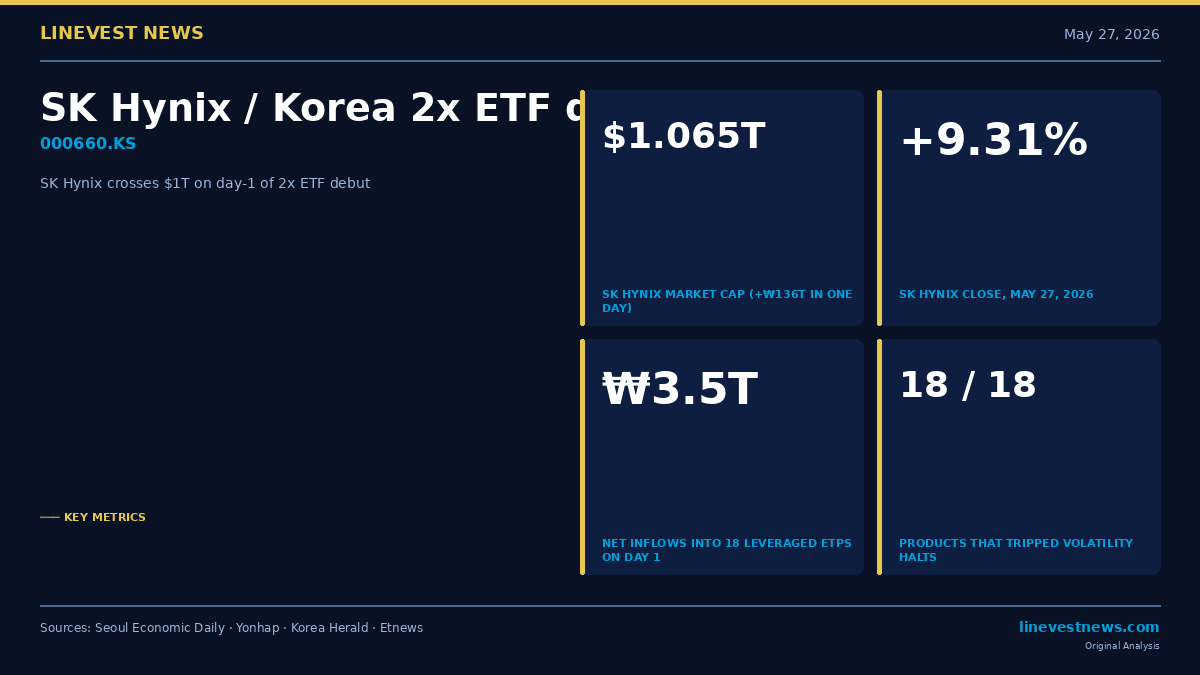
Seoul — May 27, 2026. Korea's first leveraged exchange-traded funds tracking individual stocks drew roughly ₩3.5 trillion ($2.33 billion) of net inflows on their first session, triggered both static and dynamic volatility halts across every product on the slate, and helped push SK Hynix into the $1 trillion market-cap club, according to Seoul Economic Daily coverage of the launch.
Eight asset managers — Samsung Asset Management, Mirae Asset Global Investments, Korea Investment Management, KB, Shinhan, Hanwha, Kiwoom, and Hana — simultaneously listed 16 single-stock ETFs (14 long 2x and 2 inverse 2x) on the Korea Exchange (KRX, the country's stock-market operator), per The Korea Herald's pre-launch line-up. Mirae Asset Securities, the brokerage arm of the Mirae Asset Financial Group, separately added two long 2x exchange-traded notes — codes 520100 (Samsung Electronics) and 520101 (SK Hynix) — bringing the day's slate to 18 products, according to Etnews.
What the leverage flow actually moved
Underlying-stock moves were sharp but, relative to the inflows, restrained on the close. Samsung Electronics (005930.KS), Korea's largest semiconductor maker, finished +2.68% at ₩307,000 (~$204.60). SK Hynix (000660.KS), Korea's second-largest chipmaker and the dominant supplier of AI-grade high-bandwidth memory, finished +9.31% at ₩2.243 million (~$1,495), per Seoul Economic Daily. The Hynix move added ₩136 trillion ($90.6 billion) of market capitalization in a single session to reach ₩1,598.5914 trillion — about $1.065 trillion at the day's ₩1,500.60/USD reference rate cited by the same paper — making Hynix the second Korean company after Samsung Electronics to clear the $1 trillion line.
Inflows clustered heavily in SK Hynix products. TIGER SK Hynix Single-Stock Leverage drew ₩690.8 billion ($460 million), KODEX SK Hynix Single-Stock Leverage ₩667.3 billion ($444.7 million), and KODEX Samsung Electronics Single-Stock Leverage ₩315.5 billion ($210.3 million) on day one, per Seoul Economic Daily. The widest one-day spread among the new products: 1Q SK Hynix Futures Single-Stock Leverage closed +19.46%, while SOL SK Hynix Futures Single-Stock Inverse 2X closed −18.70%. Inverse 2x products together drew only ₩37.7 billion ($25.1 million) of net inflows.
Yonhap put aggregate first-day trading value across the new products at ₩10.4 trillion ($6.93 billion), with combined market capitalization near ₩5.0 trillion ($3.33 billion) at the close. Each of the 18 products tripped both static and dynamic volatility interruptions immediately after listing as buy orders piled up "during a time slot when liquidity providers had no obligation to submit quotes," an asset-management official told Seoul Economic Daily.
Why only two stocks qualify
The Capital Markets Act amendment that authorized single-stock leveraged products took effect on April 28, 2026, with eligibility limited to stocks that represent at least 10% of benchmark market capitalization and at least 5% of trading volume over the trailing three months, according to TradingKey's pre-launch summary. Only Samsung Electronics and SK Hynix currently meet both thresholds — both are the leading beneficiaries of 2026's AI-memory cycle, with Samsung up 144% year-to-date and SK Hynix up 199% through May 25, per the same source.
Because Korean cash equities already carry a ±30% daily price limit, the 2x products can theoretically swing ±60% in a single session — a tail risk regulators flagged before launch. To trade them, retail investors must complete a one-hour advanced single-stock leverage course and a one-hour derivatives pre-training module hosted by the Korea Financial Investment Association (KOFIA, Korea's investment-industry self-regulator). KOFIA's investor-education portal crashed under 6,000–7,000 concurrent users around 10 a.m. local time on launch day; "Recovery work is under way, and we plan to restore service as soon possible," a KOFIA representative told Seoul Economic Daily.
Historical context
Korea's broad-index 2x precedent is Samsung Asset Management's KODEX Leverage (KRX 122630), which Investing.com's product profile dates to February 17, 2010 — Asia's first leveraged ETF tracking the KOSPI 200, per Samsung Asset Management. That product became a fixture of Korean retail derivatives flow over the following decade; the single-stock equivalents now arrive in concentrated form on the two most heavily owned names on the index, both already extended after 144–199% year-to-date moves.
What to watch
The early test is whether the volatility-halt pattern repeats once the launch-week subscription rush clears. With ₩690.8 billion sitting in a single TIGER product alone, daily rebalancing flows from the 2x slate will land in the underlying tape every afternoon. The next concrete data points: KOFIA's next disclosure of completed training certificates (a proxy for sustainable retail demand) and Korea Exchange's first weekly turnover release showing whether the launch-day premium holds. Two specific risks regulators highlighted pre-launch — the ±60% theoretical daily range and compounding-driven tracking error on holding periods longer than one day — will be tested first by the inverse products, which closed nearly −19% on day one against a +9.31% move in the Hynix cash line.
This article is for informational purposes only and does not constitute investment advice. Leveraged and inverse exchange-traded products carry compounding and tracking-error risks that can produce returns substantially different from a simple multiple of the underlying's performance over holding periods longer than one trading day.
Sources
- Seoul Economic Daily — Samsung, SK Hynix leverage ETFs trigger volatility halts on debut, May 27, 2026
- Seoul Economic Daily — Big-2 leverage ETFs soar on debut; SK Hynix joins $1 trillion club, May 27, 2026
- Seoul Economic Daily — Samsung/Hynix leverage ETF debut crashes KOFIA investor education portal, May 27, 2026
- The Korea Herald — Pre-launch lineup of 16 single-stock 2x ETFs on Samsung Electronics and SK Hynix, May 27, 2026
- TradingKey — Korea’s first 2x leverage ETF on Samsung Electronics and SK Hynix: eligibility thresholds and YTD moves, May 2026
- The Korea Economic Daily Global — Korean stock market view of the leverage ETF debut, May 27, 2026
- Yonhap News — 18 leveraged single-stock products log ₩10.4T trading value on day 1, May 27, 2026
- Etnews — Mirae Asset Securities lists 520100/520101 single-stock leverage ETNs, May 27, 2026
- Investing.com — Samsung KODEX Leverage (122630) product profile (Feb 17, 2010 launch reference)