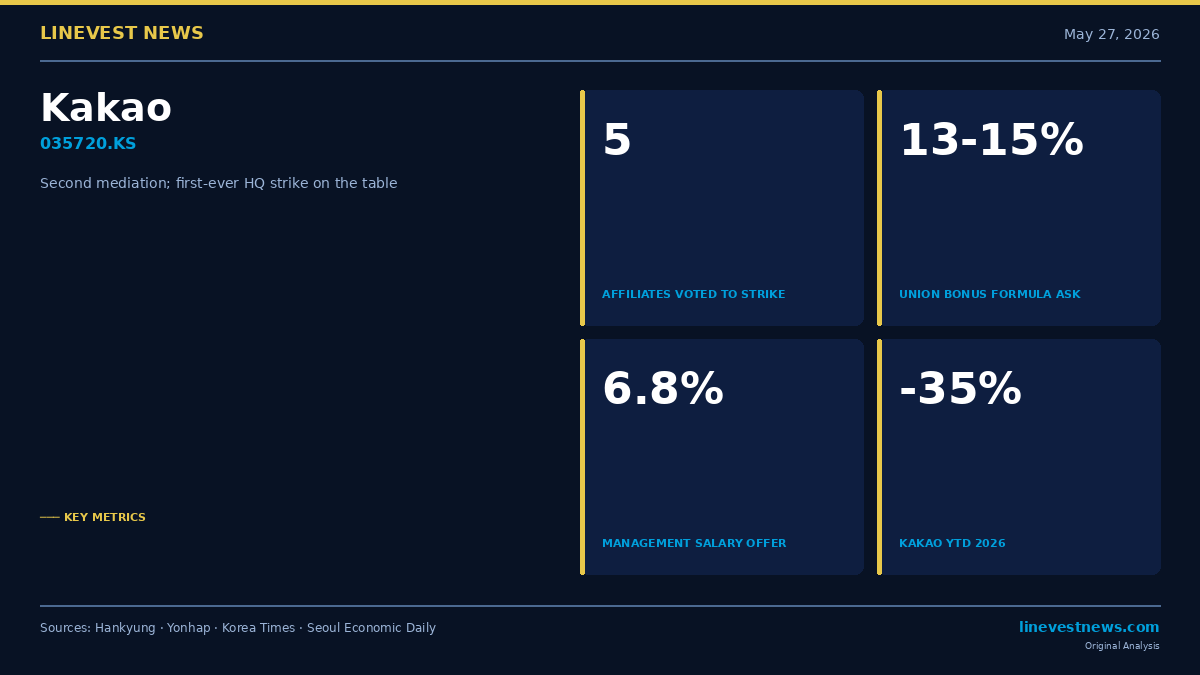
Seoul — May 27, 2026. Kakao (035720.KS), South Korea's dominant messaging-platform operator and parent of KakaoTalk, sits down at 3 p.m. Wednesday at the Gyeonggi Regional Labor Relations Commission, the provincial body that mediates collective labor disputes, for a second mediation session with unions at five group companies, according to the Korea Economic Daily (Hankyung). If talks fail, Kakao's headquarters will face its first strike since the company was founded, with simultaneous walkouts at affiliates Kakao Pay, Kakao Enterprise, XL Games and DK Techin.
The deadlock has little to do with messaging service continuity. It centers on a single question: how big should employee performance bonuses be relative to operating profit, and should restricted stock units already granted count toward that pool.
Sizing the gap in won
Union members affiliated with the Korean Federation of Chemical, Textile and Food Workers' Unions, the umbrella labor body whose Kakao chapter coordinates the dispute, are seeking a formula that allocates roughly 13–15% of operating profit to employee performance pay, per Seoul Economic Daily; Korea Times places the target at 13–14%. Management has offered a 6.8% total salary increase plus a separate ₩1 million ($730) encouragement payment per worker across roughly 4,000 employees, according to NewsWay's May 15 negotiation coverage — well short of the union's demand for a formula tying bonuses to 13–15% of operating profit.
Applied to Kakao's 2025 results — operating profit of ₩732 billion ($534 million) on revenue of ₩8.10 trillion ($5.91 billion), per company earnings disclosures summarized by financial-data providers — a 13–15% formula implies a bonus envelope of roughly ₩95–110 billion ($69–80 million). That is the order-of-magnitude headline figure the company would have to absorb to settle on union terms.
A secondary fight concerns the ₩5 million ($3,600) annual restricted stock unit grant Kakao began awarding all full-time employees last year. Management wants those RSUs counted inside the performance-pay calculation; the union wants them classified separately so that a falling share price does not silently shrink compensation, per Hankyung and Bloomingbit.
Union grievance reporting from Korea Times notes that Kakao executives received incentive bonuses of up to 150% tied to 2024 targets even as the employee bonus pool contracted — the trigger that escalated wage talks into a strike-vote dispute.
Why KakaoTalk likely keeps running
For a portfolio modeling top-line exposure, the operational hit is narrower than the headline suggests. KakaoTalk's core messaging infrastructure runs on automated systems and is partly staffed by non-union engineers; analysts cited by Bloomingbit and Asiae expect service disruption to be limited even in a full walkout. The exposed surface is forward-looking — the AI roadmap including Kakao's Kanana model, new business launches, and service upgrades — per Korea Times.
That exposure matters because Kakao's investor case has shifted from messaging dominance to AI monetization. Q1 2026 revenue reached a record ₩1.94 trillion ($1.42 billion) with operating profit of ₩211.4 billion ($154 million), up 11% and 66% year-on-year respectively, according to Kakao's Q1 disclosure as reported by BigGo Finance. The same report cited Mirae Asset Securities analyst Hee Seok Im, who noted that 'neither Naver nor Kakao has met market expectations for growth, nor have they provided clear metrics to prove AI business success' — reflecting investor frustration that AI investments have yet to deliver demonstrable returns. A protracted labor dispute lengthens that visibility gap precisely when investors are looking for the opposite.
Stock reaction has already arrived
Kakao shares have fallen roughly 35% year-to-date from ₩62,100 ($45) at the start of 2026, briefly trading below ₩40,000 ($29) intraday on May 20 — the day the strike vote at all five affiliates was confirmed — before closing at ₩40,150, according to Seoul Economic Daily. The KOSPI's gains over the same window have widened the relative gap.
Precedent is thin
The only meaningful precedent inside the Kakao group is a two-hour partial strike at Kakao Mobility in June 2025 after collective wage negotiations broke down, per English-language coverage summarized in Korean and international press. The headquarters itself has never stopped work since Kakao was founded — the basis for Korean media's "first-ever" framing of Wednesday's session.
What to watch out of Wednesday
Three outcomes from the May 27 mediation would matter most:
- Whether the labor commission terminates mediation. If it does, every voted-up union obtains the immediate legal right to strike, per Hankyung's procedural timeline.
- Whether Kakao concedes a formula-based bonus link. Hankyung's reporting indicates the company has so far offered only to "continue making efforts toward a mutually agreeable resolution" without committing to a percentage anchor. A formula concession — even at the low end of union demands — would materially compress the overhang.
- Whether RSUs are reclassified outside the performance pool. This is the single concession most likely to break the deadlock without touching the headline bonus rate.
Kakao's next scheduled operational data point is its Q2 2026 earnings release, expected in early August.
This article reflects information available as of May 27, 2026 and is for informational purposes only. It does not constitute investment advice or a recommendation to buy or sell any security. Won-to-dollar conversions use an indicative rate of 1 USD = 1,370 KRW.
Sources
- Hankyung — Kakao HQ and four affiliates head into second mediation; first-ever joint strike on the table, May 27, 2026
- Yonhap — Kakao labor talks enter second mediation, joint strike at crossroads, May 26, 2026
- Yonhap — XL Games voluntary-resignation dispute draws Kakao union pushback, May 26, 2026
- Korea Times — First-ever strike looms at Kakao as final mediation set for Wednesday, May 24, 2026
- Seoul Economic Daily — Kakao plunges 35% YTD as strike vote passes; shares break below ₩40,000, May 26, 2026
- Seoul Economic Daily — Five Kakao affiliates vote to walk out, May 21, 2026
- Bloomingbit — Union grievance over executive 150% incentive bonuses vs shrinking employee pool, May 2026
- NewsWay — Management offers 6.8% salary increase plus ₩1M encouragement payment, May 15, 2026
- Asiae — KakaoTalk service likely uninterrupted; non-union engineers staff core infra, May 21, 2026
- BigGo Finance — Kakao Q1 2026 revenue ₩1.94T, op profit ₩211.4B (+66% YoY); Mirae Asset analyst Hee Seok Im on AI visibility gap