Huang-Wei Taipei Dinner Telegraphs AI Supply Crunch — and Sets the Stage for SK's Chey at GTC Taipei
TAIPEI / SEOUL — May 27, 2026. Nvidia CEO Jensen Huang hosted TSMC Chairman C.C. Wei (Wei Che-chia) for a closed-door dinner in Taipei on the evening of May 26, joined by TSMC Co-COO Y.P. Chyn and eight senior vice presidents, in what local outlets described as a working session over next-generation AI chip production rather than a courtesy call (Chosun Biz; Seoul Economic Daily). One week later, on June 1, SK Group Chairman Chey Tae-won — head of Korea's second-largest chaebol and parent of HBM leader SK Hynix — flies in to meet Huang at GTC Taipei and, per Korean reporting, to sit with Wei as well (Maeil Business Newspaper; Yonhap News Agency, Korea's national wire service).
The two events bracket the same question: is the AI chip supply bottleneck loosening, or tightening?
What was actually said over dinner
Huang told the room that production of Nvidia's current-generation Grace Blackwell platform is running smoothly and that manufacturing of the next-generation Vera Rubin AI supercomputer has already begun, thanking TSMC for the ramp (Chosun Biz). He then framed the second half of 2026 in stark terms: "The next six months will be very busy," adding that the two companies are "working closely together to secure all the production capacity we need" (Seoul Economic Daily).
Per Korean reporting from the venue, Wei was quoted as saying TSMC was "already working very hard" to meet Nvidia's order book (Chosun Biz) — though Western outlets covering the same dinner reported Wei declined to answer reporters' shouted questions outside the restaurant and attributed a similar "work very hard" framing to Huang. Either way, it is not the language of a foundry with slack capacity.
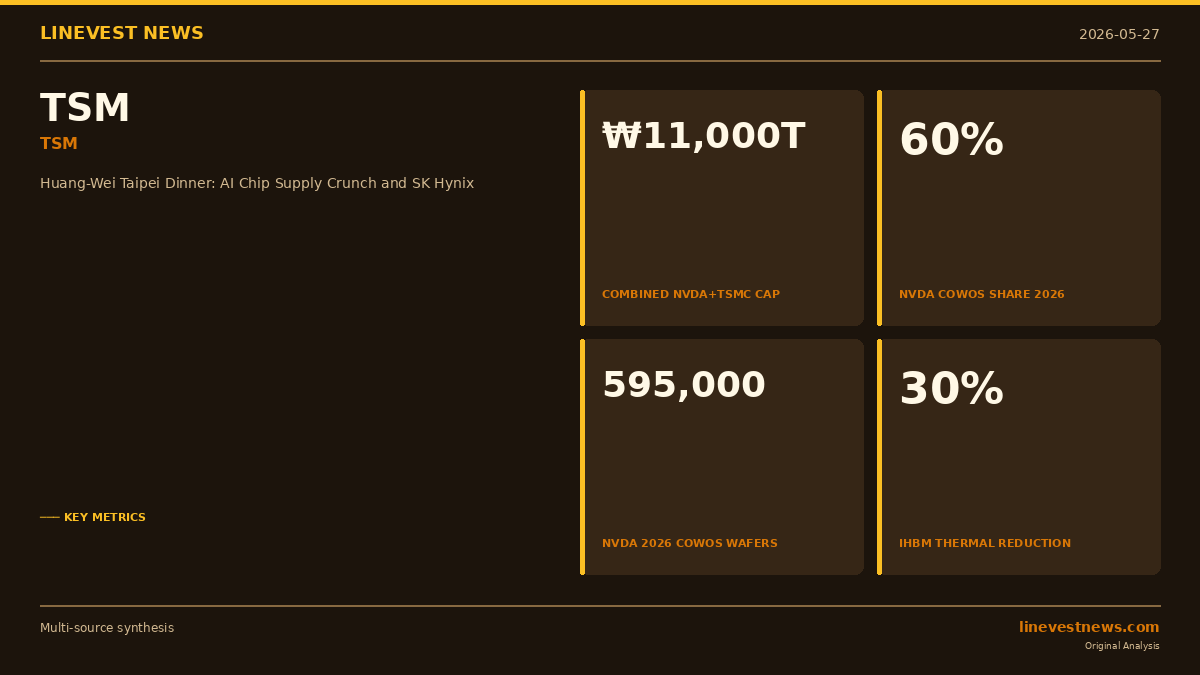
The market context is unsubtle. Chosun Biz pegs the combined market capitalization of Nvidia and TSMC — the world's No. 1 and No. 6 listed companies, respectively — at roughly ₩11,000 trillion (about $8.0 trillion) at the 1,370 KRW/USD reference rate. When two companies of that combined heft meet over advanced-packaging scheduling, the read-through is not whether they will cooperate, but whether the cooperation can move physical constraints fast enough.
The bottleneck the dinner could not solve
The constraint everyone in the room has been wrestling with sits in TSMC's advanced packaging line. Nvidia has reportedly pre-committed to more than 60% of TSMC's 2026 CoWoS (Chip-on-Wafer-on-Substrate) capacity to support the Rubin ramp, and CoWoS slots remain sold out through 2026 (Astute Group). Per Morgan Stanley research summarized by 36Kr, Nvidia's 2026 CoWoS demand is projected at 595,000 wafers — about 60% of global demand — of which roughly 510,000 wafers would be supplied by TSMC (36Kr). Morgan Stanley estimates 2026 Nvidia GPU shipments could reach 5.4 million units, of which 2.4 million would come from the Rubin platform (36Kr) — a volume that explains Huang's choice to fly in personally rather than dial in.
The dinner, in other words, was not about whether to scale CoWoS. It was about sequencing — which Rubin SKUs get which packaging slots, in what order, in the second half.
Why Chey Tae-won is the next variable
The Korean angle runs through HBM (high-bandwidth memory), the stacked DRAM that sits atop each Nvidia accelerator. Chey, who has met Huang four times in the past seven months per Maeil Business Newspaper, arrives in Taipei this week with a fresh card to play. On May 26 — the same day as the Huang-Wei dinner — SK Hynix unveiled iHBM, a packaging-level cooling design that embeds an "Integrated Cooling Element" inside the HBM stack and which the company says reduces thermal resistance by more than 30% versus current HBM (Seoul Economic Daily). SK Hynix has positioned iHBM for introduction starting with HBM5, the eighth-generation HBM aimed at the next wave of Nvidia GPUs.
That positions the SK Hynix–Nvidia–TSMC "trilateral" — language Korean media including Yonhap and Maeil have been using since SK Hynix's HBM4 logic-base-die collaboration with TSMC — as more than a slogan ahead of June 1 (Korea Herald, April 2025 precedent). If TSMC's CoWoS is the choke point Huang and Wei discussed on May 26, then HBM thermal headroom is the adjacent constraint Chey can offer to relax.
Why It Matters
The Huang-Wei dinner is the first on-the-record signal from both sides of the Nvidia–TSMC relationship that second-half 2026 capacity is being allocated chip-by-chip rather than wafer-by-wafer. The Korean-language readout of Wei's remarks — that TSMC is "already working very hard" to meet Nvidia's demand — is as close as a foundry chairman typically comes to publicly conceding that demand is outrunning the ramp. For Korea, this is the moment when HBM stops being a component and becomes part of the supply diplomacy: Chey is arriving in Taipei one week after the supply problem was named out loud, with a cooling-tech announcement timed to the same news cycle.
What to watch
- June 1, 11:00 a.m. Taipei time — Huang delivers the GTC Taipei keynote at the Taipei Music Center, where he is expected to detail Vera Rubin specifications and production cadence (NVIDIA GTC Taipei; VideoCardz). Any explicit reference to HBM5 timelines or named memory partners would be the cleanest tell on whether SK Hynix's iHBM has been designed into the Rubin successor.
- Chey–Huang readout — A joint statement after the June 1 meeting, or its absence, will indicate whether the trilateral framing has produced anything beyond a photo. Maeil Business Newspaper has reported the two principals have now met four times in seven months; a fifth meeting without a deliverable would be conspicuous.
- Nvidia's $150B Taiwan spend — Huang told a Nvidia employee gathering this week that annual Nvidia spending in Taiwan will rise to as much as $150 billion per year (roughly ₩205 trillion at the reference rate), up from about $100 billion currently and just $10–15 billion four to five years ago (CNBC; Chosun Biz). The specific year in which $150 billion is reached was not disclosed; subsequent Nvidia capex filings will define whether "epicenter" is rhetoric or budget.
This article is for informational purposes only and does not constitute investment advice. All figures are sourced as cited; readers should verify specifics with the underlying disclosures and primary releases before acting.
Sources
- Chosun Biz — Huang and Wei hold Taipei working dinner on next-generation AI chip production, May 27, 2026
- Seoul Economic Daily — Jensen Huang dines with TSMC Chairman, likely discussing Rubin ramp, May 27, 2026
- Maeil Business Newspaper — Chey Tae-won to meet Huang and Wei in Taipei; combined market cap nears ₩10,000 trillion, May 27, 2026
- Yonhap News Agency — Chey heads to Taiwan, emphasizing SK-Nvidia-TSMC triangular alliance, May 27, 2026
- Seoul Economic Daily — SK Hynix unveils iHBM in-package cooling, May 26, 2026
- Korea Herald — SK Hynix iHBM cuts thermal resistance 30% as HBM5 race opens, May 26, 2026
- Astute Group — Nvidia secures ~60% of TSMC CoWoS advanced-packaging capacity
- 36Kr — TSMC CoWoS capacity allocations and Nvidia priority access
- NVIDIA — GTC Taipei 2026 official event page
- VideoCardz — Nvidia confirms Jensen Huang GTC Taipei keynote on June 1, day before Computex
- CNBC — Huang says annual Nvidia spending in Taiwan to climb toward $150 billion