Samsung Electronics (Korea's largest memory chipmaker, KOSPI 005930) is on track to ratify its 2026 wage and special-bonus agreement after the Suwon District Court — the regional court covering Samsung's main chip campus in Gyeonggi Province — on Tuesday rejected a request from non-chip employees to halt the collective-bargaining process, even as turnout in the ongoing union vote crossed 93%.
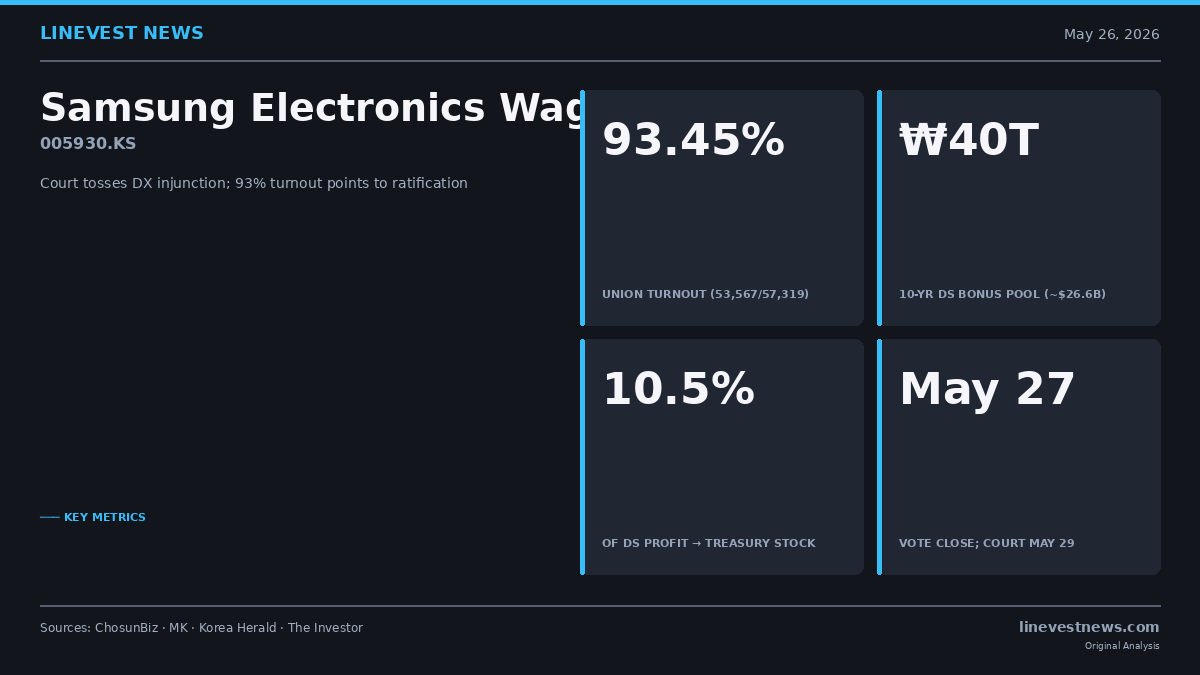
The ruling and the turnout, taken together, neutralize the two procedural levers that dissenters from Samsung's consumer-electronics business had been trying to pull before voting closes at 10 a.m. Wednesday. As of 5:40 p.m. Tuesday, 53,567 of 57,319 eligible members of the Samsung Group Super-Enterprise Labor Union's Samsung Electronics chapter — known locally as the Cho-gi-eob union and the company's largest single labor body — had cast ballots, a turnout of 93.45%, ChosunBiz reported.
What the deal actually does
The tentative agreement, signed May 20, creates a new "Special Management Performance Bonus" funded by 10.5% of the Device Solutions (DS) division's business performance — Samsung's semiconductor arm. Combined with the existing Overall Performance Incentive (OPI, Samsung's long-standing profit-linked bonus), the DS bonus pool reaches roughly 12% of business performance, per ChosunBiz. The special bonus is paid entirely in treasury stock after taxes, with one-third sellable immediately, one-third locked for one year, and one-third locked for two years, The Investor reported.
For a memory researcher earning ₩100 million ($73,000) in annual base salary, the package implies total compensation of roughly ₩600 million ($438,000) before taxes this year, including ₩50 million ($36,500) under OPI and an additional ₩440 million ($321,000) in special bonuses, per The Korea Times. The package also includes a 6.2% average wage increase and a housing-loan program of up to ₩500 million ($365,000), the Korea Herald reported.
Employees in the Device eXperience (DX) consumer-electronics division — covering mobile, home appliances and network devices — and the Customer Service team receive treasury stock worth roughly ₩6 million ($4,400), a roughly 100-fold gap relative to peak DS payouts, per the Korea Herald. That gap is the source of the entire dispute.
Why internal dissent mathematically cannot stop the vote
The Cho-gi-eob union has roughly 71,000 members, of which about 63,000 — roughly 90% — sit in DS divisions (memory at ~24,000, non-memory at ~17,000, and DS common functions at ~22,000), versus only about 8,000 in DX, per ChosunBiz. With turnout already at 93% and the voter base structurally skewed toward chip employees who stand to receive the new bonus, passage is "highly likely," ChosunBiz reported, citing the union's own data. The deal becomes binding with majority participation and majority approval, per the Korea Herald.
The Suwon District Court's Civil Division 31 on Tuesday rejected a separate injunction filed on May 15 by five DX employees seeking to halt the negotiations, ruling that the union's bargaining position could not be shown to ignore overall member interests and noting that the union had run member surveys before signing, per Maeil Business Newspaper.
What is still pending
A second injunction — filed Tuesday by Donghaeng ("Together"), a DX-focused minority union — asks the Suwon District Court to halt the vote itself. The court set the hearing for May 29, two days after voting closes, per ChosunBiz. Donghaeng's membership has surged from about 2,200 a month ago to roughly 12,900 currently, but it was excluded from the joint bargaining group after withdrawing on May 4 and was therefore not included in the ballot on the May 20 deal, ChosunBiz reported.
Separately, the Korea Shareholders' Rights Movement (대한민국 주주운동본부), a minority-shareholder advocacy group, has postponed a planned nullification lawsuit until after the union injunction is decided, Yonhap reported. In aggregate, the agreement is reported to distribute roughly ₩40 trillion (about $26.6 billion) in bonuses to chip employees, per Tom's Hardware.
Market context and the multi-year funding mechanism
Samsung Electronics shares rallied roughly 6% on May 21, the day after the tentative deal was reached and the planned 18-day general strike was suspended, per CNBC. The bonus program runs for ten years and is contingent on the DS division hitting annual operating-profit targets of ₩200 trillion ($146 billion) from 2026 through 2028, with the threshold dropping to ₩100 trillion ($73 billion) from 2029 through 2035, per Tom's Hardware. There is no ceiling on the payout rate, The Investor noted.
Historical context
This is the first ratification vote on a wage deal under the bargaining era that began when Samsung Electronics formally abandoned its decades-old "no-union" management policy in 2020, per The Investor. The averted strike — 18 working days beginning May 22 — would have been the largest labor action in the company's history. The Korea Times characterized the settlement as "a state-engineered compromise" that creates a precedent for managing labor disputes in strategically vital export industries by transforming cash bonuses into equity instruments with multi-year vesting locks.
What to watch next
Two dates determine whether the settlement holds: the vote result at 10 a.m. on May 27 KST, and the Suwon District Court ruling on the Donghaeng vote-halt injunction on May 29. If both clear, the 10.5%-of-DS-performance formula — with one-, two-, and immediate-tranche stock vesting — becomes a template that other Korean chaebol unions are likely to test in their own 2026 bargaining cycles.
Disclaimer: This article is for informational purposes only and is not investment advice. Figures attributed to specific outlets reflect those outlets' reporting at the time of publication. Won-to-dollar conversions use an approximate rate of ₩1,370 per US dollar unless otherwise stated.
Sources
- ChosunBiz — Samsung wage vote turnout 93%, court rejects bargaining injunction, May 26, 2026
- ChosunBiz — Donghaeng DX union files separate vote-halt injunction, hearing May 29, May 26, 2026
- Maeil Business — Suwon court dismisses DX five-employee bargaining injunction, May 26, 2026
- Korea Times — ₩600M memory-researcher total comp vs ₩60M public-sector peers, May 26, 2026
- Korea Times — Samsung labor settlement and Korea's new industrial strategy, May 26, 2026
- Korea Herald — Tentative agreement details: 6.2% raise, ₩500M housing loan, ~100x DS/DX gap, May 26, 2026
- The Investor — Treasury-stock tranche structure (1/3 immediate, 1/3 one-year, 1/3 two-year), May 21, 2026
- Yonhap — Korea Shareholders' Rights Movement postpones nullification suit until injunction ruling, May 26, 2026
- CNBC — Samsung shares rally ~6% on May 21 as 18-day strike suspended, May 21, 2026
- Tom's Hardware — Up to $26.6B aggregate bonus pool across 10 years for chip employees, May 22, 2026
- Tom's Hardware — Ten-year DS operating-profit thresholds: ₩200T (2026-28) and ₩100T (2029-35), May 26, 2026