The Number That Broke the Ceiling
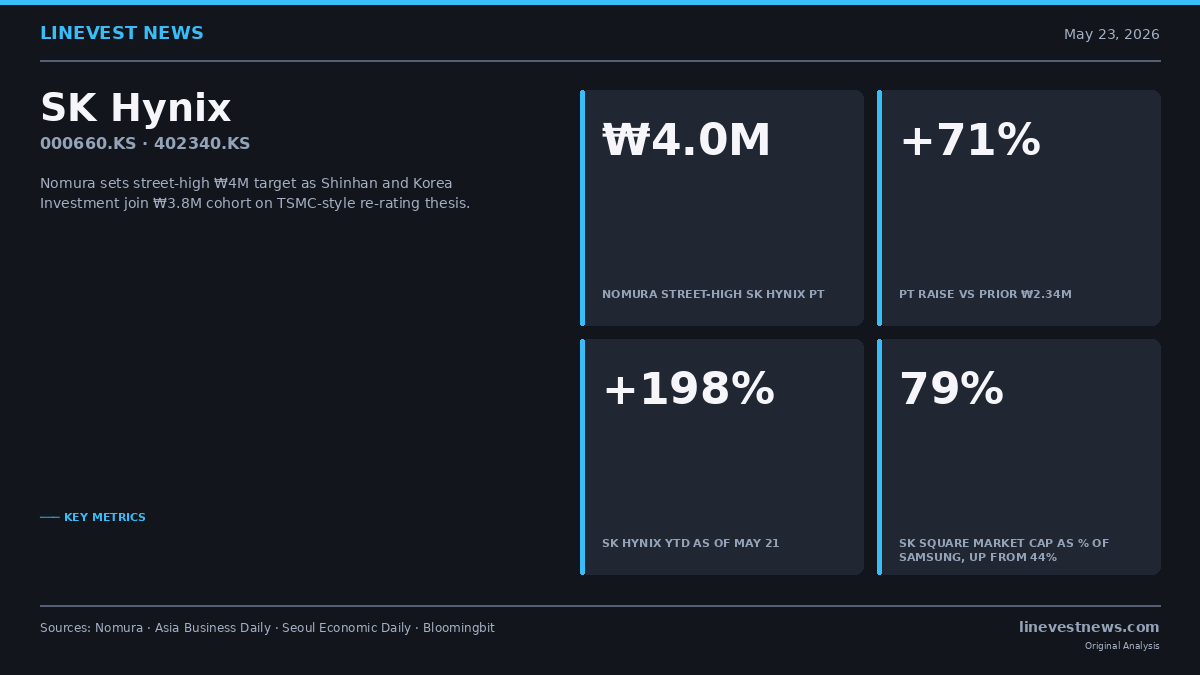
Nomura Securities (Japan's largest investment bank) became the first broker on record to put a ₩4,000,000 (about $2,920) price target on SK Hynix (000660.KS, Korea's leading HBM and DRAM maker), up from ₩2,340,000 ($1,708) in a report dated May 17, 2026 (The Asia Business Daily). On the same call, Nomura lifted its Samsung Electronics (005930.KS) target to ₩590,000 ($431) from ₩340,000 ($248), and raised its KOSPI (Korea's benchmark equity index) target range to 10,000–11,000 from a prior 7,500–8,000 (Seoul Economic Daily, May 21, 2026).
The headline upside on SK Hynix from Nomura's prior target is roughly 70%, but the firm framed the move as more than 118% upside versus the May 15 closing print after a sharp selloff (Bloomingbit).
Why ₩4M Is Not an Outlier Anymore
The critical context for a foreign reader: Nomura is the loudest voice, not the only one. Shinhan Investment & Securities (a Seoul-based brokerage) has doubled its SK Hynix target to ₩3,800,000 ($2,774), and Korea Investment & Securities lifted its target to the same ₩3,800,000 level from ₩2,050,000 ($1,496) per Asia Business Daily on May 23, 2026 (asiae.co.kr). In other words, Nomura's ₩4M is now only about 5% above the next-highest published Street targets, not a solo moonshot.
The valuation argument unifying these revisions is a methodology swap. Nomura's note states that Samsung and SK Hynix trade at roughly 6x 12-month forward earnings while TSMC (Taiwan's foundry leader) trades near 20x, and argues the Korean memory duo should now be "valued as structural growth companies rather than cyclical stocks" (Bloomingbit; Seoul Economic Daily). The implied re-rating, not earnings revisions alone, does most of the work in getting to ₩4M.
Sizing the Move Already Banked
SK Hynix is up 198.16% year-to-date as of May 21, 2026, lifting its market capitalization to ₩1,383 trillion (about $1.01 trillion) from ₩146 trillion ($107 billion) a year earlier, per Korea Exchange data cited by Asia Business Daily (asiae.co.kr). The rally has spilled into holding company SK Square (402340.KS), which owns 20.1% of SK Hynix and has gained 222.01% year-to-date through the same date; SK Square's market cap now equals 79% of Samsung Electronics', up from 44%. DB Securities raised its SK Square target to ₩1,450,000 ($1,058) from ₩740,000 ($540), and BNK Investment Securities set a ₩1,400,000 ($1,022) target (asiae.co.kr).
The Domestic Bid Behind the Re-Rating
A second leg of the bull case sits on the demand side rather than the valuation side. Samsung Securities (one of Korea's largest brokerages) published a note on May 23, 2026 arguing that KOSPI ownership is structurally shifting from foreign investors to Korean retail, channeled through passive ETFs whose largest weightings sit in Samsung Electronics and SK Hynix (Asia Business Daily, May 23, 2026). Researcher Maeng Nakhee described the two chipmakers as the "absolutely dominant" constituents of major domestic ETFs and the preferred long-term-money names; the mechanical implication is incremental bid pressure on the index's two heaviest stocks every time a retail ETF subscription clears.
What Would Actually Confirm or Break the Thesis
The TSMC-multiple thesis lives or dies on whether SK Hynix's HBM cycle behaves like a structural plateau rather than a peak. Three near-term data points are worth watching, all of them already on the calendar:
- SK Hynix's capex execution. The company's most recent disclosure shows $14.8 billion (₩20.4 trillion) of assets under construction and another $22.5 billion (₩30.9 trillion) in committed but unstarted project spend as of March 31, 2026, plus a ₩19 trillion ($13.8 billion) Cheongju advanced packaging fab (P&T7) approved in April 2026 (Bloomingbit). The next quarterly filing will show whether that pipeline is accelerating or being pushed out.
- The US ADR listing. SK Hynix has confidentially submitted a registration statement to the US SEC for an ADR offering targeting completion by end-2026, per the same Bloomingbit report. A priced deal would force the public valuation conversation onto a TSMC-comparable footing in front of US investors and is the cleanest validation event for Nomura's framework.
- R&D run-rate. Q1 2026 R&D spend of ₩2.55 trillion ($1.9 billion) was up 68.3% year-over-year (Bloomingbit); a deceleration would be the first concrete sign that even the company itself doesn't see the HBM cycle running through 2028.
For reference, the last time a foreign broker doubled a Korean chip target on a structural re-rating thesis was Goldman Sachs' January 2017 Samsung Electronics upgrade tied to the 2017–18 memory cycle, which preceded a Samsung operating-profit peak in 2018 and a roughly 24% peak-to-trough share decline through 2019 before the next cycle. That history is precisely why the gap between Nomura's ₩4M and the rest of the Street's ₩3.8M still matters: the cyclical-versus-structural debate is what gets priced into that final 5%.
This article is for informational purposes only and does not constitute investment advice. All figures are sourced from cited reports; currency conversions assume a reference rate of approximately 1 USD = 1,370 KRW unless otherwise noted in the source.