The headline number
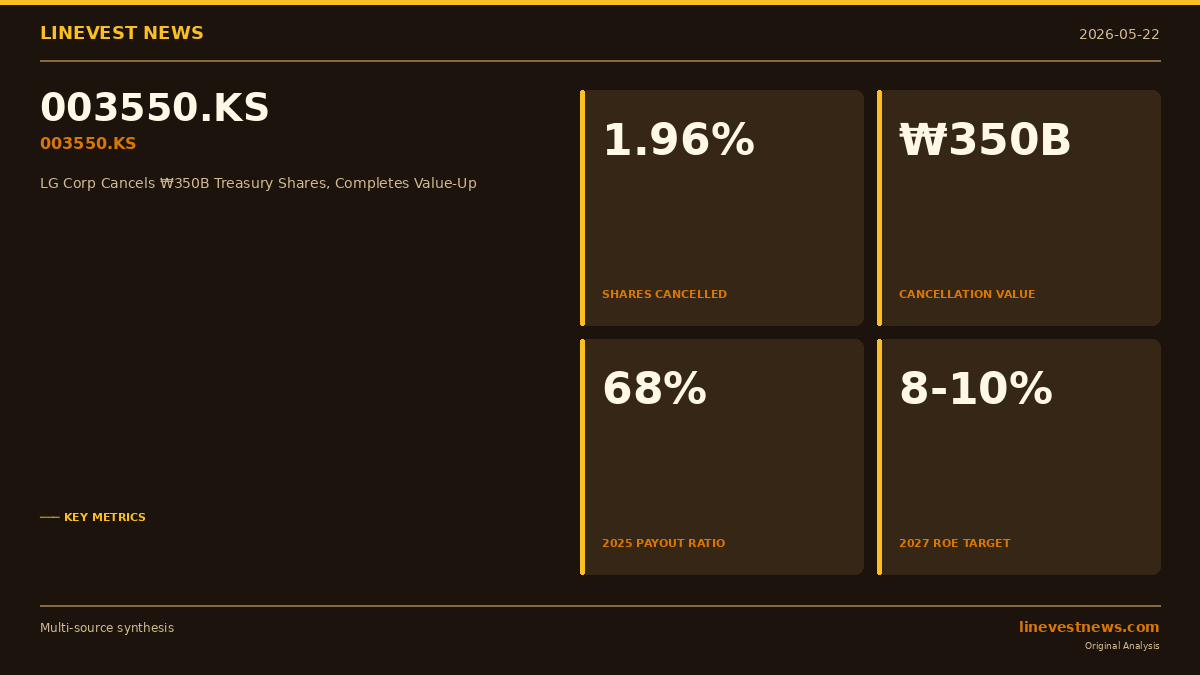
LG Corp (003550.KS), the Seoul-listed holding company of South Korea's LG Group, said on May 22 it will cancel its entire remaining treasury stake — 3,029,581 common shares, equal to 1.96% of outstanding common stock — in a single batch on May 28. At the May 22 closing price the shares are worth approximately ₩350 billion ($255 million); on the book-value basis (average acquisition cost of ₩82,520, or about $60 per share) the company will write off roughly ₩250 billion ($182 million) of carrying value [Chosunbiz, Yonhap, Maeil Business, Electronic Times — all May 22, 2026].
With this step LG Corp finishes the buyback-and-burn program it telegraphed in November 2024, when it pledged to retire roughly ₩500 billion ($365 million) of treasury stock by 2026 as part of its corporate value-up plan [Korea Times, Nov. 22, 2024]. The first tranche — half of an original 6,059,161-share treasury block — was cancelled last year; the May 28 action eliminates the rest.
Why a New York fund manager should care: this is a clean completion, not a new commitment
The announcement does not enlarge the prior pledge — it executes it. What changes is the EPS denominator: removing 1.96% of common shares mechanically lifts earnings per share by roughly 2%, all else equal, because cancellation permanently extinguishes the shares rather than parking them on the balance sheet. That is the distinction Korean holding-company investors have been watching since the Financial Services Commission's 2024 value-up guidelines pushed conglomerates to convert dormant treasury stock into actual share-count reductions.
Sizing against the company: LG Corp's market capitalization stood at roughly ₩18.14 trillion (about $13.2 billion at 1,370 KRW/USD) on May 22, 2026, per Stockanalysis.com. The ₩350 billion cancellation is therefore roughly 1.9% of market cap — closely matching the 1.96% share-count cut, as you would expect when the market price approximates the carrying basis used by the company, and modest in absolute terms but meaningful as a signal that the 2024 roadmap is on schedule.
The dividend and ROE backdrop
LG Corp last year raised the floor on its standalone adjusted net-income payout ratio from 50% to 60% [Korea Times, Nov. 22, 2024]. Korean-language coverage on May 22 cited a 2025 payout ratio of about 68% against a trailing five-year (2021-2025) average near 69%; if confirmed, the 68% figure also clears the threshold for Korea's new separate-taxation regime for high-dividend stocks, a status that matters for domestic retail flows but has no direct effect on foreign investors.
The genuinely open question is on the return side. LG Corp has stated a consolidated return-on-equity target of 8-10% by 2027 [Seoul Economic Daily, May 22, 2026]. Korean holding companies have historically traded at steep net-asset-value discounts in part because of single-digit ROEs; whether the ABC investment theme — the company's shorthand for artificial intelligence, bio, and clean tech — can lift group profitability into that band is the variable that will decide whether the buyback completion is read as a one-off or as the first deliverable in a longer rerating story.
Historical comparison
Korean holding companies have run uneven shareholder-return programs. SK Inc disclosed an October 2024 value-up plan committing to annual shareholder returns equal to 1–2% of market cap, and in March 2026 announced the cancellation of roughly 14.7 million treasury shares worth about ₩5.2 trillion ($3.8 billion) — to be completed by January 2027 — while Hyundai Motor Group affiliates have layered cancellations on top of expanded dividends since 2023. LG Corp's two-stage approach — half last year, half this week — is unusual in that it sets and meets a pre-announced calendar without re-leveraging the balance sheet, with the company stating it will fund future buybacks only from surplus cash after dividends and investment.
What to watch next
The next concrete data point is LG Corp's interim dividend declaration, scheduled under the semiannual program first flagged in November 2024 [Korea Times, Nov. 22, 2024]. A 2026 first-half payout consistent with the 60% floor would confirm the value-up plan is operating as designed; a step-down would signal management is preserving cash for ABC-sector capex, which is itself a legitimate use but one the market would price differently.
The second checkpoint is the 2026 full-year ROE print. With the value-up program now largely executed on the capital-return side, the burden shifts to the operating businesses to validate the 8-10% target by 2027.
This article is for informational purposes only and does not constitute investment advice. Figures are sourced from company disclosures and Korean-language coverage published May 22, 2026; FX conversions use an approximate rate of 1 USD = 1,370 KRW.
Sources
- Yonhap News Agency — LG Corp to cancel entire remaining treasury stake, May 22, 2026
- Maeil Business Newspaper — LG Corp scraps all ₩350 billion in treasury shares, May 22, 2026
- ChosunBiz — LG Corp cancels remaining 1.96% treasury stake on May 28, May 22, 2026
- The Electronic Times — LG Corp to retire all remaining treasury shares, May 22, 2026
- Seoul Economic Daily — LG Corp to cancel all 350 billion won treasury shares, May 22, 2026
- The Korea Times — LG Corp to cancel ₩500 bil. of own shares by 2026 to enhance corporate value, Nov 22, 2024
- Stockanalysis.com — LG Corp (KRX:003550) Market Cap reference data, May 22, 2026
- Seoul Economic Daily — SK Inc. surges 10% in after-hours on record ₩5.2 trillion buyback-cancel, Mar 10, 2026