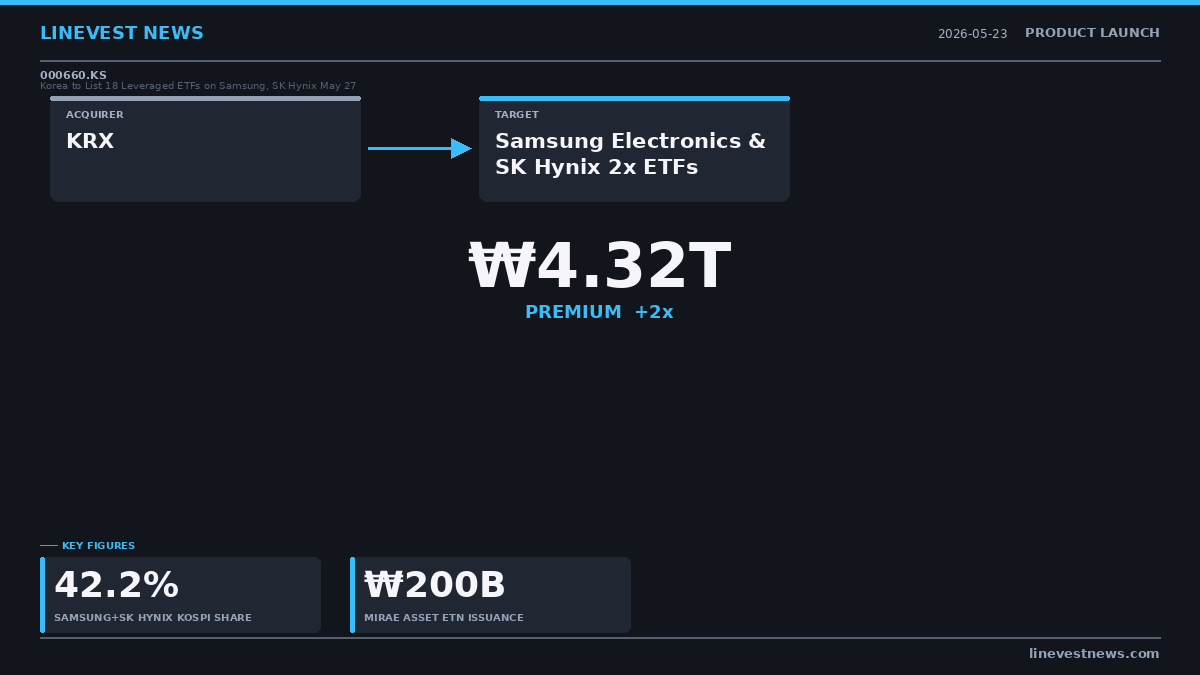
Seoul — May 22, 2026. The Korea Exchange (KRX, the country's primary bourse) said Friday it will list 18 single-stock leveraged and inverse products tied to Samsung Electronics (005930.KS, Korea's largest memory-chip and smartphone maker) and SK Hynix (000660.KS, a leading high-bandwidth-memory supplier) on May 27, with a combined planned issuance of ₩4.32 trillion ($3.15 billion). It is the first time Korean regulators have permitted 2x leveraged ETFs on individual stocks, and the rule confines eligibility to just these two semiconductor names (Yonhap; Digital Today).
What is actually launching
The 18 products comprise 16 exchange-traded funds with combined trust principal of ₩4.12 trillion ($3.01 billion) and 2 exchange-traded notes from Mirae Asset Securities (one of Korea's largest brokerages) with issuance of ₩200 billion ($146 million), per the KRX disclosure cited by Digital Today (Digital Today). Five of the ETFs track Samsung Electronics spot returns at +2x and five track SK Hynix spot returns at +2x; the remaining six are futures-based, paired with inverse and −2x variants. The Samsung Electronics +2x slate carries the KODEX, TIGER, ACE, RISE and PLUS brand prefixes, while the SK Hynix +2x slate uses KODEX, TIGER, ACE, RISE and SOL. Eight asset managers are participating — Samsung Asset Management, Mirae Asset Global Investments, Korea Investment Management, KB Asset Management, Hanwha Asset Management, Shinhan Asset Management, Kiwoom Asset Management and Hana Asset Management. All 16 ETF units are priced at ₩20,000 ($14.60) at listing (Digital Today).
Why only Samsung and SK Hynix
The Financial Services Commission (FSC, Korea's top financial regulator) approved a rule revision effective April 28 limiting single-stock leveraged ETF eligibility to issuers averaging at least 10% of KOSPI market capitalization and at least 5% of KOSPI trading value over the trailing three months (Korea Herald; Seoul Economic Daily). According to Seoul Economic Daily's account of the FSC criteria, Samsung Electronics' three-month trailing average market-cap share ran near 24.5% and SK Hynix's near 13.7% over the qualifying window; the next-largest names — Hyundai Motor and LG Energy Solution — sit around 2.2% each and fall well short of the threshold. The FSC framed the restriction as a way to "achieve global regulatory consistency, enhance capital market attractiveness" and curb capital outflows to overseas single-stock leveraged products (Seoul Economic Daily).
Retail guardrails were tightened in parallel. Investors must complete a mandatory one-hour training module on top of Korea's existing derivatives education and post a minimum ₩10 million ($7,300) deposit, the Korea Herald reported. The KRX itself warned in its launch statement that "investment risks are higher than for general ETFs and ETNs" and flagged "negative compounding effects" that make the products unsuitable for long-term holding (Korea Herald; Digital Today).
The capacity arrives into an already-concentrated index
The ₩4.32 trillion in nominal issuance lands on a market already extraordinarily reliant on the same two names. Samsung Electronics and SK Hynix alone hit a record 42.2% of KOSPI market capitalization in early May — a peak reading that outpaces the trailing averages used in the April eligibility assessment, as both stocks extended gains ahead of the listing — with the broader semiconductor complex pushing toward roughly half the index per Daol Investment Securities (a mid-tier Seoul brokerage) (CNBC; Seoul Economic Daily). Daol draws an explicit parallel to Taiwan's TSMC-led rally. Korea's domestic equity ETF assets crossed the ₩200 trillion mark for the first time on May 7, reaching ₩212 trillion ($155 billion), with leveraged and semiconductor-themed ETFs driving the inflow (Seoul Economic Daily).
The demand-side context explains why issuers raced to fill all five spot-leverage slots on each name. Foreign investors have been net sellers across most of 2026, but Korean retail and ETF flows have absorbed the supply and lifted the index — a pattern that echoes Taiwan's post-2020 retail-led leg.
What the launch will and will not change
Korea has long offered 2x leverage at the index level — KODEX Leverage and similar Kospi-200 products have traded for over a decade — but extension to single names was repeatedly deferred on retail-protection grounds; the April 28 rule revision is the first carve-out. A useful comparison is the US 2x single-stock ETF wave, where GraniteShares' 2x Long NVDA Daily ETF (NVDL) launched in 2022 and the T-REX 2X Long NVIDIA Daily Target ETF (NVDX) from REX Shares/Tuttle Capital Management followed in 2023; these and similar single-name leveraged products absorbed concentrated retail flow during the 2024–2025 AI rally, while the Korean launch is among the first attempts at the structure inside an emerging-market benchmark.
For portfolio managers tracking the trade, the cleanest first-month signal will be net creations in the new tickers and whether realized intraday volatility in Samsung Electronics and SK Hynix widens after May 27 — single-stock leverage products, by design, force end-of-day hedging that can amplify late-session moves. SK Hynix's next quarterly results, expected in late July, and any FSC follow-up on margin balances inside the products will sharpen the picture. The KRX has signalled it can suspend trading or tighten margin requirements if volatility breaches preset bands (Digital Today).
Disclaimer: This article is published by LineVest News for informational purposes only and does not constitute investment advice. Figures are sourced from cited reports and may be subject to revision.