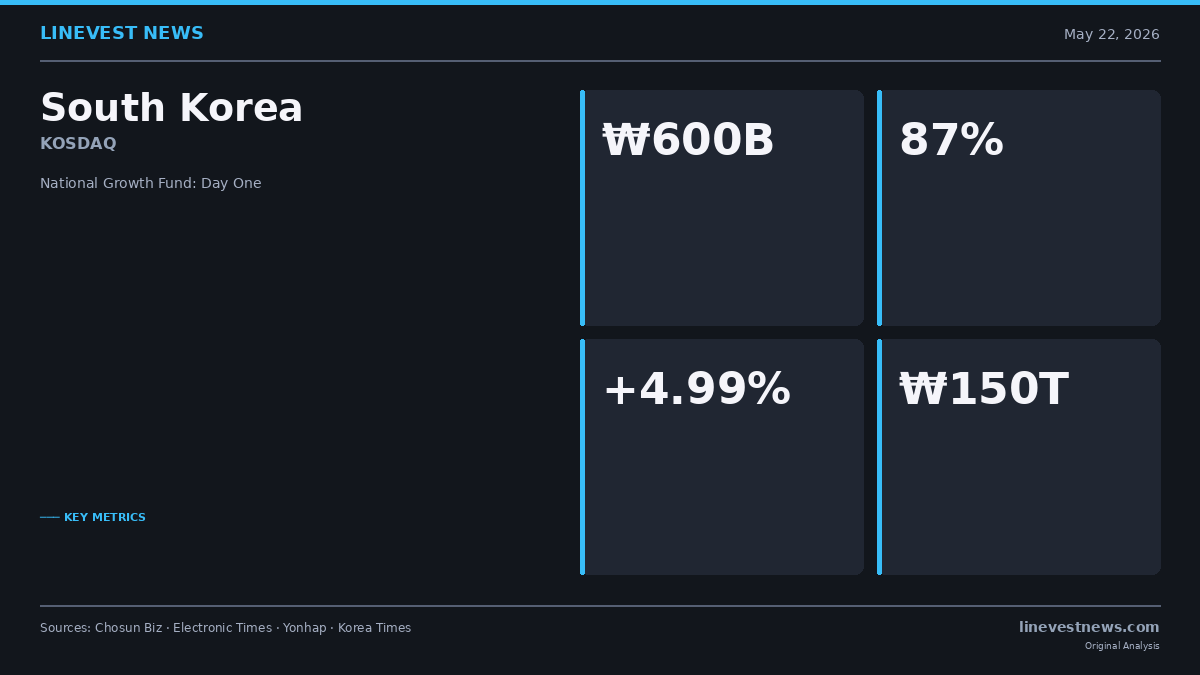
SEOUL — South Korea's first retail-accessible tranche of the National Growth Fund — a five-year, ₩150 trillion ($109.5 billion) state-led policy vehicle channeling household and fiscal capital into 12 designated "advanced strategic industries" including AI, semiconductors, secondary batteries, robotics and biotech — drew 87% of its ₩600 billion ($438 million) opening allocation within a single trading session on May 22, the Financial Services Commission (FSC, Korea's top financial regulator) said. Just ₩77.65 billion ($56.7 million) of inventory remained unsold across 25 banks and brokerages by the close, per the FSC's end-of-day tally reported by Chosun Biz.
The reaction in equities was immediate and concentrated. The KOSDAQ (Korea's secondary tech-heavy bourse) closed +4.99% at 1,161.13, with a buy-side sidecar — Korea's program-trading circuit breaker triggered on accelerated upside — firing 33 minutes into the session, the second straight day a sidecar hit on the KOSDAQ, according to Chosun Biz's market wrap. The KOSPI (Korea's main board) closed +0.41% at 7,847.71 even as foreign investors net-sold nearly ₩2 trillion ($1.46 billion) of main-board shares for a 12th straight session; offshore flows instead rotated into the KOSDAQ at ₩598 billion ($436 million) of net buying, per Maeil Business Newspaper.
Why a $438 Million Tranche Moved the KOSDAQ 4.99%
The ₩600 billion retail allocation is small relative to KOSDAQ's market capitalization, but Friday's trade priced a much larger pipeline behind it. Three figures define the structural read:
- The retail tranche compounds. The FSC said on May 22 that it plans to raise ₩600 billion from retail investors every year for five years, for a cumulative ₩3 trillion ($2.19 billion) in direct household subscriptions, per Chosun Biz reporting of the regulator's day-one briefing.
- The mother fund is larger than the retail slice. Each year's ₩600 billion is matched with ₩120 billion ($87.6 million) of fiscal money to form a ₩720 billion ($525 million) mother fund, which then deploys into 10 asset-manager-run sub-funds, the FSC's product structure shows (per Electronic Times and Chosun Biz coverage).
- The umbrella program is ₩150 trillion. The retail vehicle sits inside the Lee Jae-myung administration's (South Korea's current government) signature ₩150 trillion National Growth Fund, framed by the FSC and the Ministry of Economy and Finance to channel state and private capital into AI, semiconductors and secondary batteries as first-priority sectors, per the FSC's product launch documentation and Electronic Times.
Sub-funds are required to deploy at least 60% of capital into the 12 strategic sectors, with at least 30% as fresh capital (via rights issues or mezzanine) into unlisted or KOSDAQ technology-special-listed companies, per the FSC's launch document and Electronic Times. That mandate is what tied the day-one subscription number directly to the KOSDAQ tape.
The Three-Layer Incentive That Pulled In Retail
The pull was less about expected return than about a stacked subsidy stack on top of equity risk:
- Loss buffer. Government and sponsor-manager seed capital absorb the first approximately 20% of any sub-fund losses before retail principal is touched, per the FSC structure published with the launch and confirmed by The Korea Times.
- Income-tax deduction. Investments through the dedicated account qualify for a 40% income deduction on the first ₩30 million ($21,900), 20% on ₩30–50 million, and 10% on ₩50–70 million, Chosun Biz reported, citing the FSC.
- Reduced dividend tax. Dividend income from holdings of five years or longer is taxed at a separated 9% rate, versus Korea's standard 15.4% withholding, per Chosun Biz.
In return, investors accept a five-year hard lock — no early redemption, no installment subscriptions, lump-sum only — and exclusion of anyone classified as a financial-income comprehensive tax filer in any of the prior three years, according to Electronic Times's product summary.
The per-person subscription cap is ₩100 million ($73,000) annually, with a ₩200 million ($146,000) cumulative cap over the five-year program, per multiple FSC-disclosed product terms.
How Fast It Sold
Of the ₩600 billion opening allocation, the FSC split ₩300 billion ($219 million) to online channels and ₩300 billion to branches. By session close, 99.8% of the online slice was gone — effectively a sellout within roughly 20 minutes at major distributors — while branch sales reached 74% (₩222.6 billion / $162 million), Chosun Biz reported, citing FSC figures.
Seven of ten participating banks fully cleared their daily allocation: NongHyup, Shinhan, Hana, KB, iM, Gwangju and Busan. The three banks left with inventory at the bell were Woori (₩60 million remaining), the Industrial Bank of Korea (₩4.1 billion), and Gyeongnam Bank (₩2.0 billion), per the FSC tally reported by Chosun Biz.
Four of fifteen brokerages also went to zero: Daishin Securities, Mirae Asset Securities (Korea's largest brokerage by capital), Kiwoom Securities, and Korea Investment & Securities. Mirae Asset's ₩30 billion ($21.9 million) online allocation cleared in roughly 10 minutes, per Seoul Economic Daily's English edition. Korea Investment's mobile app crashed under load and remained down for about 20 minutes, Chosun Biz reported. Samsung Securities (Samsung Group's brokerage arm) was left with the largest unsold inventory at ₩26.2 billion ($19.1 million), followed by KB Securities at ₩9.7 billion ($7.1 million) and Yuanta Securities at ₩7.8 billion ($5.7 million).
FSC Chairman Lee Eok-won personally subscribed ₩10 million ($7,300) on launch day to anchor public promotion, Asia Business Daily reported. President Lee Jae-myung is scheduled to subscribe next week, the presidential office told Chosun Biz.
Where the Money Was Bid
KOSDAQ heavyweights traded as if the five-year, ₩3 trillion pipeline were already deployed. Per Chosun Biz's session close:
- EcoPro BM (Korea's leading cathode-material supplier, KOSDAQ #1 by market cap): +10.77%.
- EcoPro (the KOSDAQ-listed parent holding company of EcoPro BM): up roughly 13%, overtaking Alteogen to reclaim the #2 market-cap slot.
- LigaChem Biosciences (Korea's antibody-drug-conjugate platform biotech): +12.83%.
- ABL Bio (Korean clinical-stage biotech): +9.37%.
- HLB (KOSDAQ-listed biopharma): +8.76%.
Quantum-related KOSDAQ names surged on a separate U.S. policy headline about direct federal equity stakes in quantum-computing firms — Photon (Korean quantum-security listing) closed limit-up at +30.00% and X-Gate at +24.19% — making clear that not all of Friday's KOSDAQ tape was attributable to the National Growth Fund headline alone, per Chosun Biz.
What Confirms or Breaks the Thesis
Roughly ₩77.65 billion of inventory remains for a sale window running through June 11. A clean sellout before that date would lock in the FSC's annual ₩600 billion run rate and validate the pricing embedded in Friday's KOSDAQ move — that this is a recurring institutional bid, not a one-time rebate trade.
Three signals to watch over the next 20 days:
- Whether the FSC raises the cap. The regulator said it will consider expanding the program only after "review of budget capacity and tax-revenue impact," per its statement to Chosun Biz — a hedge against early editorial pushback. The Hankyung Business Daily editorial board on May 22 questioned whether the stacked incentives — 40% income deduction, ~20% loss buffer, and reduced 9% dividend tax — are excessive relative to the public's downside.
- Sub-fund GP deployment timing. Korea Development Bank and Shinhan Asset Management published the indirect-investment GP shortlist on May 15, per Seoul Economic Daily; actual capital calls into KOSDAQ-listed or unlisted strategic-sector names will set the next leg.
- Foreign flow persistence. Whether the ₩598 billion KOSDAQ foreign net-buy on May 22 marks a single-day reaction or the start of sustained rotation off the KOSPI — where offshore investors have now sold for 12 consecutive sessions, per Maeil Business Newspaper — is the key follow-through question.
The day-one number — 87% of ₩600 billion absorbed in one session — establishes that domestic retail demand for state-backed tech exposure is at least three weeks deep at current terms. Whether that demand survives the first year of NAV reporting, when the 60% strategic-sector mandate meets actual KOSDAQ volatility, will determine whether the next ₩600 billion tranche in 2027 clears with the same speed.
This article is for informational purposes only and does not constitute investment advice or a recommendation to buy, sell or hold any security. All KRW-USD conversions use an indicative rate of 1 USD = 1,370 KRW.