Seoul, May 21, 2026 — Samsung Electronics (005930.KS), the world's largest memory-chip maker, averted an 18-day strike at its Device Solutions (DS) semiconductor division by signing a tentative wage agreement late Wednesday that channels a decade of performance bonuses through treasury stock rather than cash. The KOSPI responded with the biggest single-day point gain in its history; minority shareholders responded with a lawsuit threat.
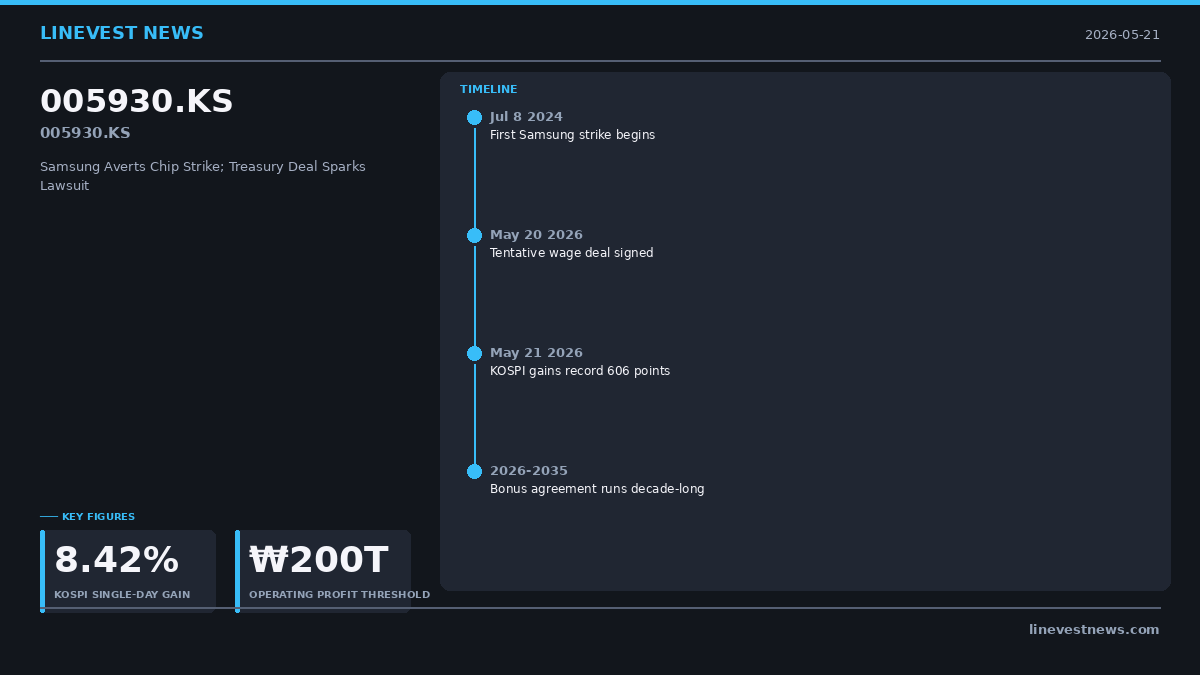
The benchmark KOSPI closed at 7,815.59 on Thursday, up 606.64 points or 8.42%, per The Korea Herald — surpassing the previous point-gain record of 490.36 set on March 5, per Seoul Economic Daily. Samsung Electronics shares rose 8.51% to ₩299,500 (about $199 at the day's exchange rate), per The Korea Times. SK Hynix (000660.KS), Korea's second-largest memory maker, climbed 11.17% to ₩1.94 million ($1,293) on the same positive news. Nvidia's Q1 revenue beat — $81.62 billion, up 85% year-over-year per the Korea Times — amplified the move, but Korean strategists attributed the primary catalyst to the removal of strike risk at the world's dominant DRAM and NAND supplier.
What Samsung paid to keep the lines running
The agreement between Samsung and the National Samsung Electronics Union (NSEU), the company's largest single-employer union, runs from 2026 through 2035. It establishes a Special Management Performance Bonus equal to 10.5% of jointly designated business performance with no payout ceiling, paid entirely in treasury stock on an after-tax basis, per Seoul Economic Daily. Shares vest in three tranches: one-third sellable immediately, one-third locked for one year, one-third locked for two years (Seoul Economic Daily).
The formula is gated by operating-profit thresholds of ₩200 trillion ($133 billion) for 2026–2028 and ₩100 trillion ($67 billion) for 2029–2035 (Seoul Economic Daily). Allocation inside the DS division is 40% pooled across the division and 60% by individual business unit; loss-making units from 2027 onward receive 60% of the common payout rate (Seoul Economic Daily). Combined with a 1.5% basic incentive raise (Seoul Economic Daily), the effective profit-share ceiling reaches roughly 12% — the same percentage at the center of the shareholder complaint.
The National Tax Service (NTS — Korea's tax authority) ran a simulation, reported by Yonhap, showing that a DS engineer earning a ₩100 million ($67,000) base salary could receive up to ₩600 million ($400,000) in bonus this year. Approximately ₩247.19 million ($165,000) would be withheld at the 42% top marginal income-tax bracket, leaving a take-home of about ₩450 million ($300,000) on total compensation of ₩700 million ($467,000) (Chosun Biz).
The strike that almost happened
The NSEU had scheduled an 18-day general walkout to begin May 20; the deal was signed hours before pickets were to go up, per TechTimes, with Korea's Minister of Employment and Labor Kim Young-hoon present at the Gyeonggi District Employment and Labor Office signing. The Suwon District Court had earlier partially granted Samsung's injunction request requiring 7,087 essential workers to maintain fabrication operations during any walkout (TechTimes). Union chair Choi Seung-ho apologized publicly "for causing concern"; DS head Yeo Myung-koo called the deal "a starting point for building a mutually beneficial labor-management culture" (TechTimes).
The precedent investors will use to benchmark the threat is Samsung's 2024 dispute with the same union — the first strike in the company's 55-year history. The strike began July 8, 2024 and was suspended on August 1, 2024, with Samsung and the NSEU subsequently agreeing on a 5.1% wage increase (the union had sought 5.6%), per Wikipedia and Digitimes. This year's threat was materially larger in scale: 18 days, more than 47,000 union members reported by CNBC and Bloomberg coverage of the strike vote, and a Suwon District Court order that itself acknowledged thousands of jobs were operationally critical.
The shareholder counterstrike
Within hours of the agreement, the Korea Shareholders' Movement Headquarters, a Korean minority-shareholder activist group, said the structure linking roughly 12% of pre-tax operating profit to employee compensation amounts to a "disguised illegal dividend" that violates the capital-adequacy provisions of Korea's Commercial Act, per The Asia Business Daily. The group said it will file both an injunction to suspend the agreement's effect and a separate suit seeking a declaration of invalidity once the collective agreement is signed.
The technical question the court will face is whether issuing repurchased treasury stock to employees on a formula automatically indexed to operating profit constitutes a profit distribution that requires shareholder approval — an argument the Korea Shareholders' Movement Headquarters frames as a first-of-its-kind challenge under the Commercial Act, per Asia Business Daily. ETNews described the structure as a restricted-stock-unit (RSU)-style arrangement in which two-thirds of the shares face immediate sale restrictions, per its May 21 reporting, while shareholder activists frame it as a transfer of value that should otherwise flow as a dividend.
What Seoul is saying
The presidential office welcomed the deal but said "broader social consensus" is needed on bonus-distribution standards and pledged "rational adjustment support" to mitigate spillover to other industries, per Yonhap. The Korea Federation of SMEs (KBIZ — Korea's umbrella body for small and mid-sized businesses) said it was relieved chip lines did not stop but warned that the agreement could widen the pay gap between large conglomerates and supplier SMEs, per Asia Business Daily.
What to watch
Union ratification voting runs from 2:00 p.m. Friday, May 22 to 10:00 a.m. Tuesday, May 27 (TechTimes). A rejection re-opens strike risk into the second half of the year. A yes vote triggers the Korea Shareholders' Movement Headquarters' planned injunction filing — and a Korean court ruling that, if granted, would set the first major precedent on whether large-scale treasury-stock employee compensation indexed to operating profit can be enjoined as a disguised dividend under the Commercial Act. Either path presents a binary catalyst for Samsung shares once the court timetable becomes clear.
This article is for informational purposes only and does not constitute investment advice. All figures are sourced from the publications cited inline. KRW–USD conversions use the day's implied rate of approximately 1,500 won per dollar derived from The Korea Times' ₩299,500 / $199 pairing.