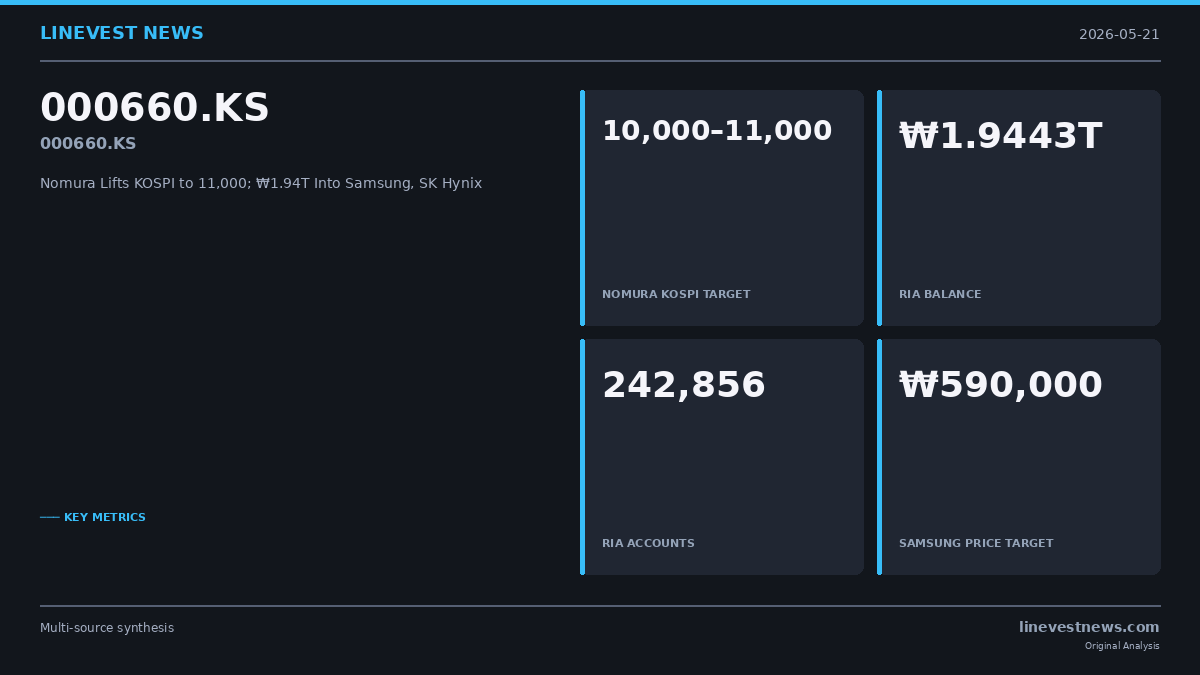
SEOUL — May 21, 2026 — Two data points landed on Korean trading desks within hours of each other Thursday — a Nomura KOSPI target lift to 11,000 and ₩1.94 trillion ($1.42 billion) in repatriated retail cash — and together they reframe the question for offshore allocators trying to decide whether the KOSPI rally is a sentiment trade or a flow trade.
Nomura Securities raised its 2026 KOSPI target band to 10,000–11,000, up from 7,500–8,000, citing what it called a "super cycle" in commodity DRAM and high-bandwidth memory (HBM) and applying TSMC-style multiples to Korea's two memory leaders (Seoul Economic Daily). Hours later, the Korea Financial Investment Association (KOFIA, Korea's securities industry self-regulator) disclosed that the Returning Investor Account — known as RIA, a one-year tax holiday for repatriated overseas equity proceeds — had reached 242,856 accounts and a balance of ₩1.9443 trillion ($1.42 billion) as of May 19, with Samsung Electronics (005930.KS) and SK Hynix (000660.KS) the two largest domestic buys.
The Nomura call and the RIA print are independent events. The interesting question is whether they line up.
The flow side: where the repatriated cash is landing
The RIA, launched March 23, lets retail investors transfer foreign-listed holdings into a designated brokerage account, sell them and reinvest the proceeds in Korean securities free of capital-gains tax. The exemption phases down — 100% through May, 80% in June–July, 50% from August — which front-loads the incentive into this quarter (Bloomingbit citing KOFIA disclosures, link).
Growth has been close to vertical: ₩414 billion ($302 million) at end-March, ₩1.3389 trillion ($977 million) at end-April, ₩1.9443 trillion ($1.42 billion) by May 19. Of that, ₩1.2129 trillion ($885 million) has rotated into Korean assets, per KOFIA.
The rotation has a clear shape. Korean retail's five largest overseas disposals through May 8 were Nvidia (₩180.1 billion / $131 million), the Direxion 3x-leveraged semiconductor ETF SOXL (₩94.7 billion / $69 million), Tesla (₩50.4 billion), Alphabet (₩45.1 billion) and Apple (₩36.5 billion). The five largest domestic purchases were Samsung Electronics (₩78 billion / $57 million), SK Hynix (₩66.7 billion / $49 million), Hyundai Motor (₩14.6 billion), the KODEX 200 ETF (₩13.4 billion) and the TIGER Semiconductor TOP10 ETF (₩12.3 billion) (Chosun Biz; Seoul Economic Daily).
Two observations. First, this is not US-tech-out, EM-equity-in diversification; it is a same-sector substitution — Korean retail is selling US semiconductors (Nvidia, SOXL) to buy Korean semiconductors. Second, the size is modest relative to daily KOSPI semi turnover but the directional message is unambiguous, and KOFIA's age cut shows the buyers skew older: investors in their 40s hold 31% of accounts and those in their 50s 26%, with the 50s cohort holding 32% of total balance — the demographic with the largest investable surplus.
The thesis side: what Nomura is actually saying
Nomura lifted its Samsung Electronics price target to ₩590,000 ($431) from ₩340,000 ($248) and SK Hynix to ₩4 million ($2,920) from ₩2.34 million ($1,708). The valuation argument is explicit: TSMC trades around 20x earnings while the two Korean memory names are around 6x, and Nomura is asking whether that gap survives if memory becomes a structural AI-infrastructure input rather than a cyclical commodity (Seoul Economic Daily).
The broader sector list Nomura flagged for sustainable five-year ROE — memory and HBM, power equipment, ESS and nuclear — maps onto the AI capex stack, and the brokerage cited mandatory target-ROE disclosure and tightening rules on non-core asset holdings as governance tailwinds for KOSPI re-rating (Chosun Biz). Nomura also published price targets of ₩240,000 ($175) for Kia and ₩900,000 ($657) for Samsung SDI, signalling that the call is broader than memory alone.
For context, foreign brokerages have been edging up their KOSPI assumptions for weeks; Seoul Economic Daily reported on May 18 that domestic brokerage houses were holding a KOSPI 10,000 outlook through near-term volatility (link). Nomura's 11,000 upper bound is the first published base-case from a foreign house at that level.
The hedge: a sideways-market product launches the same day
Not every desk is positioning for a continuation. Kiwoom Securities, a Korean retail-focused brokerage, opened subscriptions Thursday for a ₩20 billion ($14.6 million) equity-linked security (ELS), the firm's 4,000th issue, with Samsung Electronics and SK Hynix as underlyings (etnews). ELS pay a fixed coupon if the underlyings stay above a knock-in barrier and are structurally a bet against large drawdowns rather than further upside — Kiwoom positioned the product as an alternative "in a market environment where concerns are growing over external uncertainty in the semiconductor sector." The same names that anchor the bull thesis are anchoring the range-bound product.
What confirms or refutes the thesis
Three dated checkpoints will let allocators mark Nomura's call to flows rather than narrative:
- The June 1 RIA print. The capital-gains exemption drops from 100% to 80% on June 1. If May's ₩605 billion ($442 million) month-to-date pace holds into June, the tax phase-down is not deterring repatriation. If the pace halves, the program is front-loading rather than sustainably reshaping flows.
- SK Hynix Q2 results, expected late July. The HBM super-cycle thesis hinges on pricing and mix. Q1 HBM commentary from both Samsung and SK Hynix will be scrutinised for guidance on 12-Hi HBM3E and HBM4 ramp timing — the gating items for the 20x TSMC-style multiple Nomura is asking the market to underwrite.
- Foreign net flows on the KOSPI. Domestic retail repatriation is real but small; the rerating to 11,000 needs foreign institutional buyers. Weekly Korea Exchange foreign net buy/sell data is the cleanest read on whether Nomura's offshore peers are converging.
Why it matters
The convergence of a foreign brokerage's most aggressive published KOSPI target with the first concrete repatriation data from RIA gives the rally a more defensible foundation than HBM headlines alone. But the flow number — $885 million of repatriated capital actually deployed into Korean assets since March — is roughly two days of average KOSPI semi turnover; this is not yet the wall of money the index needs to clear 10,000, let alone 11,000. The next 60 days, spanning the RIA tax phase-down and Q2 chip earnings, will decide whether Thursday's two data points were the start of a structural rerating or the high-water mark of a sentiment trade.
This article is for informational purposes only and does not constitute investment advice. All figures are sourced from cited disclosures and reporting; readers should verify current data before making any decisions.