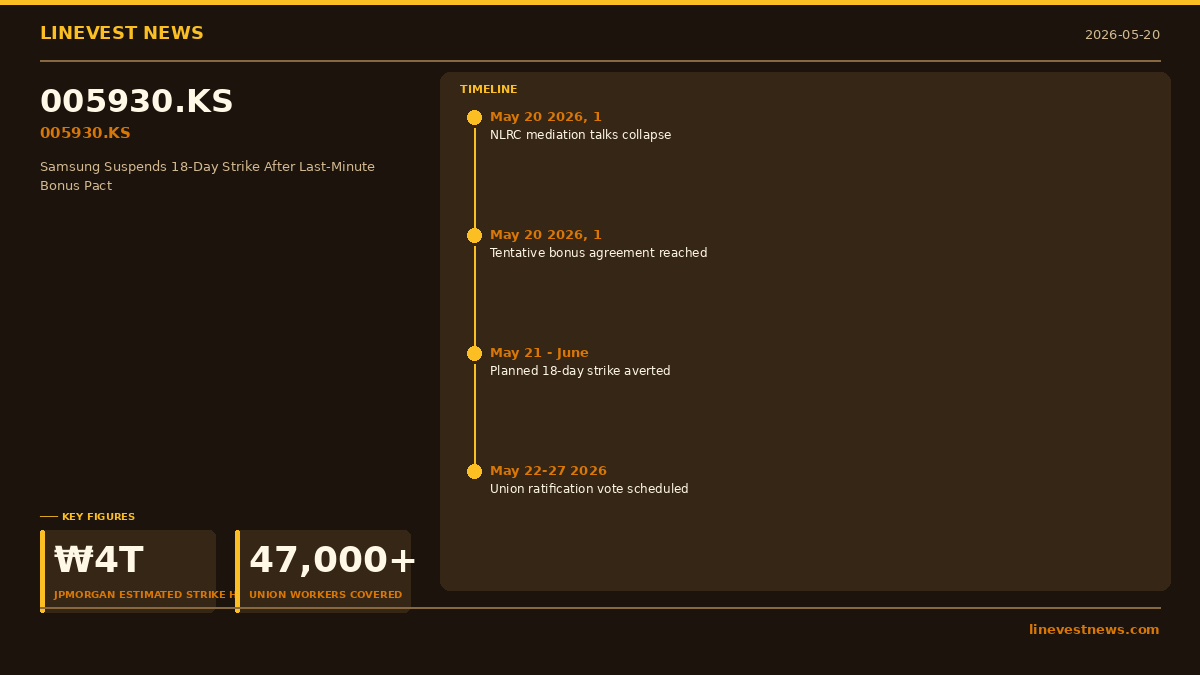
Samsung Electronics' (005930.KS) largest labor union suspended an 18-day general strike on the eve of its planned start, after the two sides reached a tentative bonus-system agreement at the Gyeonggi Regional Labor Office (a regional branch of Korea's Ministry of Employment and Labor) around 10:40 p.m. KST on May 20 — roughly 90 minutes before the walkout was scheduled to begin (Asia Economy / asiae.co.kr; Yonhap).
The pact, brokered with direct intervention by Korean Labor Minister Kim Young-hoon after an earlier round of National Labor Relations Commission (NLRC, Korea's mediation body for industrial disputes) talks collapsed at 11 a.m., spares the world's largest memory chipmaker (Bloomberg) what Yonhap described as potentially the largest production stoppage in its history. Samsung Electronics shares slid more than 4% intraday on the morning collapse, then pared losses to finish roughly flat by the close; the late-night agreement was reached after market hours (Yonhap).
How big was the averted hit
The scheduled walkout would have run May 21 through June 7. Union leader Choi Seung-ho's group covers more than 47,000 Samsung Electronics workers at the company's domestic chip-making complexes, including Pyeongtaek, Samsung's largest domestic semiconductor site (CNBC; The Verge; Taipei Times).
JPMorgan, in research cited by Tom's Hardware, had pegged the direct hit from an 18-day stoppage at roughly 4 trillion won (about $2.9 billion at 1,370 KRW/USD), equivalent to about 1% of Samsung's annual semiconductor-division revenue. Korean Prime Minister Kim Min-seok had publicly warned the broader knock-on damage could reach "up to 100 trillion won (approximately $73 billion at 1,370 KRW/USD)" (Washington Times) — a politically charged figure because semiconductors accounted for 34.0% of South Korea's total exports in April 2026 (Korea Ministry of Trade, Industry and Energy data, via Newsis).
The supply-chain math behind the global concern: Samsung is the largest seller of both DRAM and NAND, with $19.4 billion of memory revenue in Q3 2025 versus $17.5 billion at SK Hynix, Korea's second-largest memory maker (Counterpoint Research). Korean newswire Newsis, drawing on overseas analyst reports, put potential disruption from the planned strike at up to 4% of global DRAM supply and up to 3% of NAND. Those would be meaningful numbers against a backdrop of historically tight memory inventories reported by industry trackers.
What Samsung gave, and what stays unsettled
The single most contested item was bonus allocation across divisions. The union had demanded that 15% of Samsung's annual operating profit be allocated to performance bonuses, and that the existing cap of 50% of base salary be removed; Samsung had described those terms as "excessive" and warned they would "undermine the fundamental principles of company management" (Yonhap).
The breakthrough: Samsung agreed to extend bonus eligibility "beyond its lucrative memory division to less profitable units" — specifically the foundry business, which sits inside Samsung's semiconductor division alongside memory. Samsung executive Yeo Myounggoo framed it as needing to "invest in the future of both our memory and foundry businesses" (Washington Times). Asia Economy, reporting on the signed deal text, characterized the union's reciprocal concession as a one-year deferral on the specific formula by which loss-making divisions are folded into the new bonus pool — a detail worth flagging for next year's bargaining cycle.
What the government nearly did
By Wednesday afternoon, government officials and ruling-party lawmakers were openly discussing invoking emergency arbitration powers, a mechanism under Korea's Trade Union Act that allows the labor minister, with central-commission approval, to halt industrial action for up to 30 days. According to Yonhap, those powers have not been invoked in roughly 21 years. The Ministry of Employment and Labor publicly called talk of emergency arbitration "premature" earlier in the day, then dispatched Minister Kim to mediate directly — the move that produced the late-night pact (Korea Times).
The next data point
The agreement is tentative pending ratification. According to the Korea Times' write-up of the signed text, union members will vote on the tentative 2026 wage agreement from 2 p.m. Friday through 10 a.m. on May 27 (other foreign coverage cites May 22–27 or May 23–28 windows; the Korea Times timing matches the Korean-language announcement).
A clean ratification next week would clear the strike-risk overhang that has weighed on Samsung Electronics' share price since this round of talks intensified. A rejection — against the backdrop of Samsung's Q1 2026 operating profit of 57.2 trillion won (approximately $41.8 billion at 1,370 KRW/USD), which the Washington Times reports rose roughly eightfold year-over-year on AI-related memory demand — would re-open the underlying question of how the AI-cycle profit pool gets split between memory engineers and the rest of the company.
For non-Korean readers tracking the chaebol labor cycle: this is the closest Samsung Electronics has come to a company-wide stoppage since organized labor took root at the group in 2019, when the company's first white-collar union was formally established (Newsis). The next-cycle question is no longer whether bonuses are revisited, but how tightly they get linked to operating profit at the world's largest memory chipmaker.
This article is for informational purposes only and does not constitute investment advice.