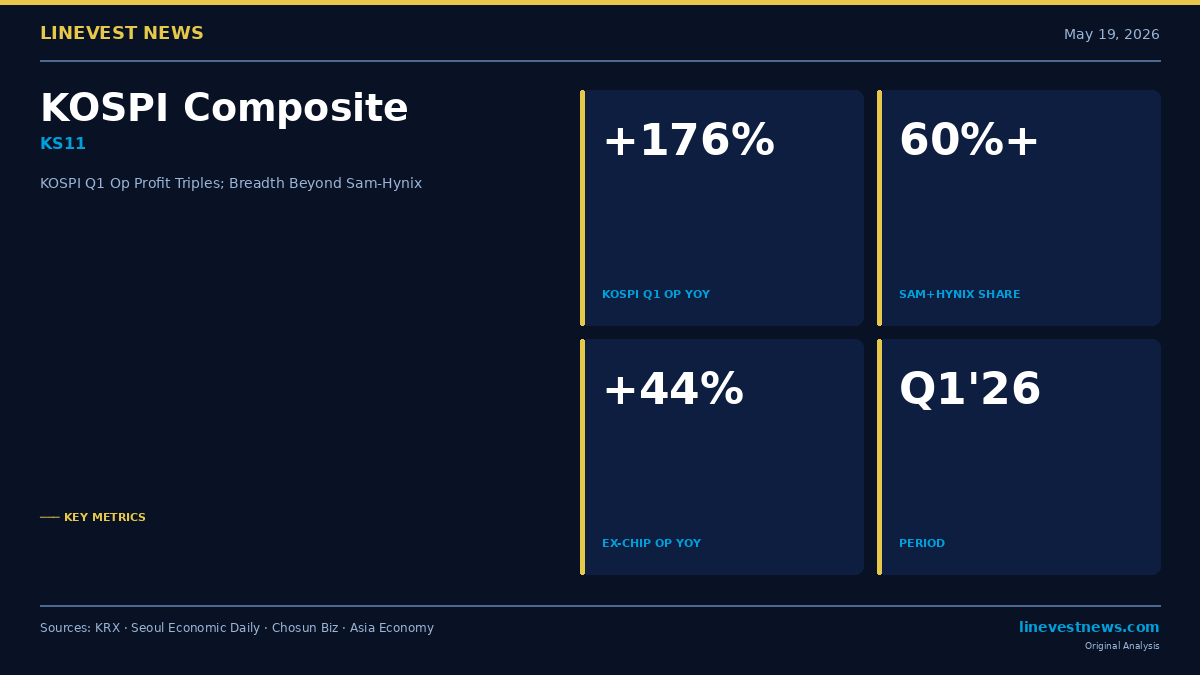
Korea Exchange (KRX, Korea's stock-market operator) on May 19 reported that 639 December-fiscal-year companies listed on the KOSPI (Korea's main equity board) earned consolidated operating profit of ₩156.32 trillion ($114.1 billion) in the first quarter of 2026, up 175.83% from a year earlier. Revenue rose 19.49% to ₩927.54 trillion ($677.0 billion) and net profit climbed 177.82% to ₩141.44 trillion ($103.2 billion), according to the KRX disclosure as summarized by Seoul Economic Daily and Chosun Biz on May 19. Consolidated operating margin widened by 9.55 percentage points to 16.85%.
The concentration question
The immediate question for an offshore allocator looking at the headline is how much of this came from just two stocks. The KRX data is unambiguous: Samsung Electronics (Korea's largest memory and foundry maker) and SK Hynix (Korea's second-largest chipmaker and a global HBM market leader) together generated ₩94.84 trillion ($69.2 billion) of operating profit — more than 60% of the consolidated KOSPI total — on combined revenue of ₩186.45 trillion ($136.1 billion), or 20.10% of total sales. Net profit from the two firms reached ₩87.57 trillion ($63.9 billion) (Seoul Economic Daily, May 19).
The concentration looks even sharper on a parent-only basis. On a separate-accounting view of 727 non-financial KOSPI firms, revenue rose 23.29% to ₩496 trillion ($362.0 billion) and operating profit jumped 226.4% to ₩109 trillion ($79.6 billion); Samsung and SK Hynix alone accounted for 77% of operating profit and 31.73% of revenue on that basis (Chosun Biz, May 19).
Breadth is widening, but unevenly
Stripping the two chipmakers out, the remaining 637 KOSPI firms still posted material improvement: revenue ₩741.09 trillion ($541.0 billion, +9.07%), operating profit ₩61.48 trillion ($44.9 billion, +44.49%), and net profit ₩53.87 trillion ($39.3 billion, +55.79%). The operating margin for this ex-chip cohort improved to 8.30% from 6.26% a year earlier (Seoul Economic Daily, May 19).
By sector, 15 of 20 KOSPI industries posted operating-profit gains while five — including paper & wood and transportation — saw declines, with entertainment & culture swinging to a net loss (Asia Economy, May 19; Chosun Biz, May 19). The standout outside semiconductors was electrical & electronics itself, where consolidated operating profit jumped 927.56% and net profit climbed 457.07% (Seoul Economic Daily, May 19).
Financials were the other strong cohort. Operating profit at securities firms rose 141.2% year on year, with insurers up 25.12% (Chosun Biz, May 19). The number of net-profit-positive companies rose to 590, or 81.16% of the universe, up by 8 firms from a year earlier; 66 of those switched from a loss to a profit (Chosun Biz, May 19).
Context: a quarter that rivals prior full years
For scale, the KOSPI's full-year operating profit reached a record ₩245 trillion ($178.8 billion) in 2025 (Seoul Economic Daily, April 2, 2026). Q1 2026 alone produced ₩156.32 trillion — about 64% of last year's full-year total in a single quarter. The semiconductor cycle is the principal explanation: SK Hynix booked Q1 2026 operating profit of ₩37.6 trillion ($27.4 billion) on a record 72% company-wide operating margin — an all-time quarterly high — driven by HBM and high-capacity server DRAM (KED Global, April 23, 2026).
The KOSDAQ (Korea's tech-heavy junior market) showed a more mixed picture. Its 1,273 surveyed firms grew revenue 21.72% to ₩84.95 trillion ($62.0 billion) and operating profit 78.17% to ₩4.13 trillion ($3.0 billion), but 40.93% of KOSDAQ firms remained loss-making and the aggregate debt ratio sat at 122.03% (Seoul Economic Daily, May 19).
What to watch next
The cleanest test of whether breadth continues to widen — rather than narrow back to a two-stock story — will be the Q2 2026 KOSPI earnings release expected in mid-August 2026. Two specific data points will matter: whether ex-Samsung/Hynix operating-profit growth holds the +44.49% pace as currency and capex cycles flow through industrial names, and whether the five contracting industries narrow further or stabilize. The semiconductor portion of the question is largely answered for now; the broadening portion is not.
This article is for informational purposes only and does not constitute investment advice. Figures are sourced from disclosures by the Korea Exchange (KRX) and reporting by Seoul Economic Daily, Asia Economy, Chosun Biz, Maeil Business, and KED Global. USD equivalents are calculated at an indicative rate of 1 USD = 1,370 KRW.
Sources
- Maeil Business — KOSPI Q1 record operating profit ex Samsung-Hynix breadth, May 19, 2026
- Chosun Biz — KOSPI Q1 operating profit +226% led by Samsung, Hynix, May 19, 2026
- Asia Economy — Q1 listed-company earnings broadly improved beyond chips, May 19, 2026
- Seoul Economic Daily (EN) — KOSPI Q1 operating profit triples on chip boom, May 19, 2026
- Seoul Economic Daily (EN) — KOSPI full-year 2025 operating profit record ₩245T, Apr 2, 2026
- KED Global — SK Hynix Q1 2026 record operating profit ₩37.6T at 72% margin, Apr 23, 2026