Lede
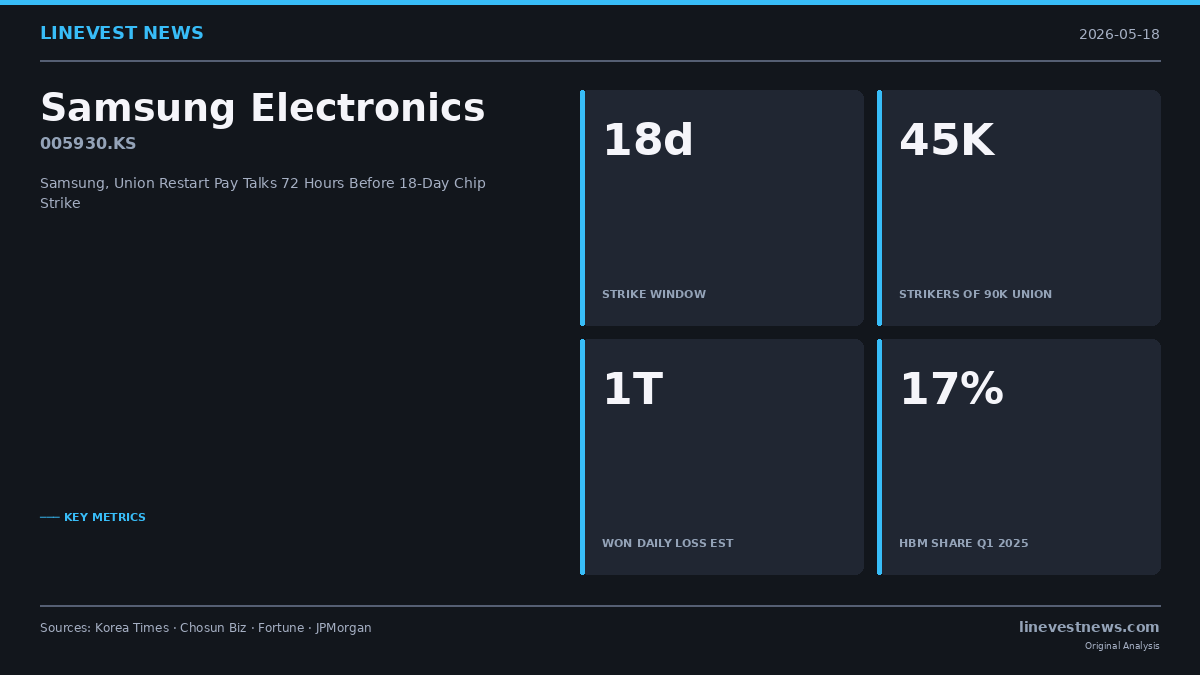
Samsung Electronics (005930.KS) and its largest labor union resumed government-mediated pay talks on Monday, May 18, at the National Labor Relations Commission (NLRC) office in Sejong, three days before a planned 18-day general strike at the world's largest memory chipmaker. Hours earlier the Suwon District Court partially granted Samsung's April 16 injunction request, requiring the union to maintain "usual" staffing at safety-critical facilities and barring occupation of plant sites or blocking of non-striking workers (Korea Times). The signal of state seriousness: NLRC chairman Park Soo-keun personally observed the session, rather than delegating to a panel (Chosun Biz).
The Gap Between Labor and Management Is About a Formula, Not a Number
The dispute is structural rather than incremental. The Samsung Electronics chapter of the National Samsung Electronics Union (전국삼성전자노동조합, a Samsung Group supra-enterprise union) is demanding that 15% of company operating profit be allocated as a performance bonus pool, that the existing cap of 50% of base salary on bonuses be removed, and that a 7% wage increase be written into the agreement (Fortune). Management has offered roughly 13% of operating profit as a one-time payment for 2026, declining to codify the formula in the employment contract (Fortune). Korea Times, separately, reports the company's standing proposal is to allocate 10% of operating profit or economic value added (EVA) under the existing bonus framework (Korea Times).
The benchmark looming over both sides is domestic: crosstown rival SK Hynix has already agreed to allocate 10% of operating profit to bonuses on a recurring basis (Fortune). The union's case is that Samsung's record AI-related semiconductor earnings warrant a permanent, formula-based share — not a discretionary handout. Chairman Lee Jae-yong cut short an overseas trip and issued a public apology on May 16 to clear the way for Monday's resumption, telling reporters at Gimpo Business Aviation Center, "I will take the cold wind and rain on myself" (Chosun Biz).
Sizing the Production Hit: What April 2024 Taught the Market
The last data point is the relevant one. During Samsung's inaugural one-day strike in April 2024 — when union membership stood at roughly 32,000 — memory fab output fell 18% on the affected shift and contract foundry production dropped 58%, according to Fortune's reporting (Fortune). The 2024 action lasted a single shift; the 2026 plan runs 18 days, May 21 through June 7, and the union now encompasses more than 90,000 members, with roughly 45,000 expected to participate in the walkout (Fortune; Human Resources Online).
The loss estimates span a wide range, reflecting different assumptions about second-order yield damage. Korea University professor Song Heon-jae has estimated direct losses at approximately ₩1 trillion ($700 million) per day from a full plant shutdown, citing the multi-month continuous-process nature of wafer fabrication that makes mid-flow stoppages destructive to in-process inventory (Tom's Hardware citing Seoul Economic Daily). JPMorgan, by contrast, has modeled direct revenue impact at over ₩4 trillion ($2.9 billion), or roughly 1% of Samsung's semiconductor-division annual sales (Tom's Hardware). The union itself has cited a maximum of ₩30 trillion ($20.3 billion) in total damages — a figure that includes ripple effects to customers and suppliers (Tom's Hardware). Newsis reports Samsung Electronics' supplier ecosystem comprises 1,061 first-tier and 693 second- and third-tier companies — roughly 1,700 firms exposed to a sustained outage (Newsis).
Why This Strike Carries More AI-Memory Weight Than the Last One
Samsung's competitive position has shifted between the 2024 and 2026 events. In Q1 2025, Samsung held 17% of the high-bandwidth memory (HBM) market versus SK Hynix at 62% and Micron at 21%, leaving it as the laggard in the segment most exposed to AI accelerator demand (Fortune). Samsung did regain overall DRAM market leadership by the end of 2025 after a brief period of trailing SK Hynix for the first time in 33 years (Fortune). An 18-day production gap at the moment Samsung is attempting to qualify advanced HBM with hyperscaler customers carries different downstream consequences than a one-day disruption in 2024.
The macro framing is similarly heavier. Korea's semiconductor exports reached $173.4 billion in 2025, accounting for 24.5% of total national exports, per Newsis (Newsis).
The State's Two Levers: Injunction and Emergency Arbitration
Monday's Suwon District Court ruling is the first lever. The court did not block the strike outright but constrained how it can be conducted, requiring usual staffing at safety facilities and prohibiting facility occupation or interference with workers who choose to report (Korea Times). Samsung's home-court Hankyung characterized the ruling as a near-complete win for the company (Hankyung).
The second lever is emergency arbitration under Article 76 of the Trade Union and Labor Relations Adjustment Act. Prime Minister Kim Min-seok stated on May 17 that the government will "consider all available response measures, including emergency arbitration," if mediation fails (Chosun Biz). Once invoked, the union must immediately suspend any industrial action and is barred from striking for 30 days; if no agreement is reached during that period, the NLRC chair can refer the dispute to binding arbitration (Chosun Biz). Six business associations — the Korea Enterprises Federation, Korea Chamber of Commerce & Industry, Federation of Korean Industries, Korea International Trade Association, Korea Federation of Small and Medium Business, and Federation of Middle Market Enterprises of Korea — issued a joint statement Monday urging immediate invocation (Korea Times).
President Lee Jae-myung weighed in via social media on Monday, writing that "labor must be respected as much as business, and corporate management rights must be respected as much as labor rights" — language read in Seoul as tilting the political ground toward intervention if Wednesday's deadline passes without a deal (Maeil Business Newspaper). Samsung Electronics shares reversed an early decline to trade up around 2% in Seoul following the president's remarks (Hankyung).
What to Watch
No deadline has been set for the second round of mediation, but with the strike notice fixed for Thursday morning, any settlement realistically needs to be reached by Wednesday night Seoul time (Korea Times). The binary outcome is unusually clean for an industrial dispute of this scale: either the parties agree on whether to codify a 13–15% operating-profit bonus formula, or the government chooses between letting an 18-day stoppage proceed under the Suwon court's constraints and invoking Article 76. The next public marker is Choi Seung-ho's post-session briefing after mediation concludes; the marker after that is whether the Ministry of Employment and Labor signals an emergency-arbitration motion.
This article is for informational purposes only and does not constitute investment advice. All figures are sourced as cited.
Sources
- Korea Times — Court partially accepts Samsung Electronics' injunction request against union strike, May 18, 2026
- Korea Times — Samsung Electronics, union resume wage talks as major strike nears, May 18, 2026
- Korea Times — Biz associations express concerns over Samsung unions' strike threat, May 18, 2026
- Chosun Biz — President Lee's intervention in Samsung labor-management conflict; test of new labor policy, May 18, 2026
- Fortune — Labor strike at Samsung, AI HBM chips, and the dividend-revolution memory market, May 17, 2026
- Tom's Hardware — Samsung's last-ditch union talks collapse eight days before planned 18-day chip factory strike, May 2026
- Human Resources Online — Negotiations break down; Samsung Electronics union to stage strike as planned on 21 May 2026
- Newsis — K-semiconductor achievements built on technology and investment, May 17, 2026
- Hankyung — Samsung Electronics strike injunction: complete company win — maintain safety facilities, occupation banned, May 18, 2026
- Hankyung — Samsung Electronics shares reverse after President Lee's labor-management remarks, May 18, 2026
- Maeil Business Newspaper — President Lee: labor and corporate management rights must be respected equally, May 18, 2026