Samsung Biologics (207940.KS), the contract drug manufacturing arm of Samsung Group, said the five-day general strike its union staged in early May caused about ₩150 billion ($102 million) in damage, while a separate dispute at Kakao Corp. (035720.KS), Korea's largest mobile-platform operator, moved one step closer to that company's first headquarters-level walkout. The Korea Times reported Monday that both standoffs center on the same fault line: performance-based pay tied to operating profit.
What actually stopped, and what it cost
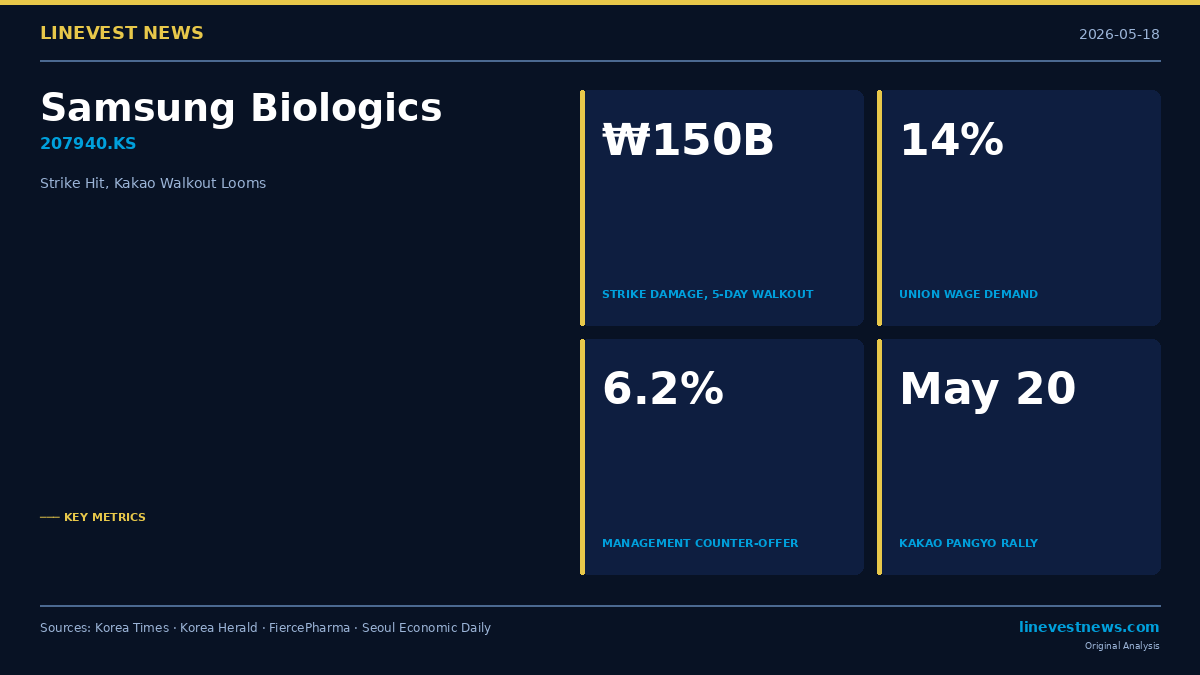
Samsung Biologics' first industrial action since its 2011 founding ran for five days starting May 1, with roughly 2,800 of the union's 4,000 members participating, according to The Korea Times. The company quantified the financial impact at ₩150 billion ($102 million), a figure it attributed to "preemptive production adjustments implemented to mitigate potential impacts across manufacturing lines," per FiercePharma. To size that against the business: Samsung Biologics reported Q1 2026 revenue of ₩1,257.1 billion ($855 million) and operating profit of ₩580.8 billion ($395 million), up 25.8% and 35.0% year-on-year respectively, on full utilization of Plants 1 through 4 and the progressive ramp-up of Plant 5 (Samsung Biologics IR release, April 22, 2026). The ₩150 billion hit therefore equals roughly 12% of a single quarter's sales.
The Korea Herald reported that a separate, longer full-scale strike scenario modeled by the company would push losses above ₩640 billion ($435 million) — roughly half of Q1 sales — with production already halted on cancer and HIV treatments during an earlier three-day partial strike. After the May 1–5 walkout, the union shifted to a work-to-rule campaign that, according to The Korea Times, is "partially disrupting" output. Mediation by Korea's Ministry of Employment and Labor on May 8 failed to close the gap between the union's demand for a 14% average wage increase, a one-off ₩30 million ($20,400) cash bonus and performance pay equal to 20% of operating profit, and management's offer of a 6.2% wage increase (The Korea Herald, The Korea Times).
Why Plants 1–4 matter more than the headline number
Samsung Biologics' Q1 release noted "full utilization across Plants 1 through 4" — meaning there is no slack capacity at the Songdo Bio Campus to absorb lost output. Total bioreactor capacity reached 784,000 liters upon completion of Plant 5 in 2025 (Samsung Biologics, BioProcess International), but the company's earnings commentary indicates Plant 5 is still ramping rather than running flat-out. With cumulative contract value exceeding $21.4 billion across 112 CMO and 169 CDO orders (Samsung Biologics Q1 IR release), any sustained production gap translates directly into deferred client deliveries rather than reallocated batches.
The company's own ₩150 billion estimate already includes "preemptive" line slowdowns, suggesting the operational hit began before the union physically walked out. That is the structural reason the Q2 number bears watching: an industry whose contracts are scheduled in batch slots does not catch up by running harder later.
Kakao: same fight, different sector
Kakao's union has filed for arbitration at the Gyeonggi Regional Labor Relations Commission and is demanding performance-based bonuses equal to 13–14% of operating profit, with grievances also citing overwork and management decision-making style, per The Korea Times. Seoul Economic Daily reported May 18 that Kakao headquarters mutually extended its mediation deadline — averting an immediate first-ever headquarters strike — but mediation at two affiliates, DK Techin and XL Games, ended without agreement, granting their unions the legal right to strike. The Kakao union plans a rally at Pangyo Station plaza in Seongnam on May 20 to consider a strike authorization vote (Seoul Economic Daily).
Kakao management told Seoul Economic Daily it "will continue to make efforts toward an amicable agreement."
Historical comparison
The May walkout is the first industrial action at Samsung Biologics since the company's founding in 2011, per The Korea Times — a 15-year strike-free run that ended after 13 negotiating rounds and two CEO meetings collapsed before May 1, according to The Korea Herald. Participation reached approximately 2,800 of 4,000 union members on the first day, or roughly 70% of organized labor, a high engagement rate by the standards of Korean large-cap first strikes.
What confirms or refutes the thesis
The next data point is Samsung Biologics' Q2 2026 earnings release, expected in late July, which will show whether the ₩150 billion estimate held and how the work-to-rule campaign affected Plant 1–4 utilization. Before that, the May 20 Kakao rally at Pangyo Station will determine whether a second large-cap Korean employer faces a headquarters strike, which has not occurred in Kakao's history according to Seoul Economic Daily. The Ministry of Employment and Labor has not announced a new mediation date for Samsung Biologics following the May 8 breakdown reported by The Korea Times.
This article is for informational purposes only and does not constitute investment advice. All figures sourced inline; currency conversions use the prevailing rate cited by source publications (approximately ₩1,470 per USD).
Sources
- The Korea Times — Labor disputes spill over to major Korean tech firms, May 18, 2026
- FiercePharma — Samsung Bio estimates $102M impact from union strike, May 2026
- The Korea Herald — Samsung Biologics quantifies strike damage; full strike modeled at ₩640B, May 2026
- Samsung Biologics IR — Q1 2026 financial results, April 22, 2026
- Seoul Economic Daily (English) — Kakao averts first-ever HQ strike as mediation extended, May 18, 2026
- BioProcess International — Samsung Biologics expands with 6th plant amid 25% Q1 revenue growth, 2026