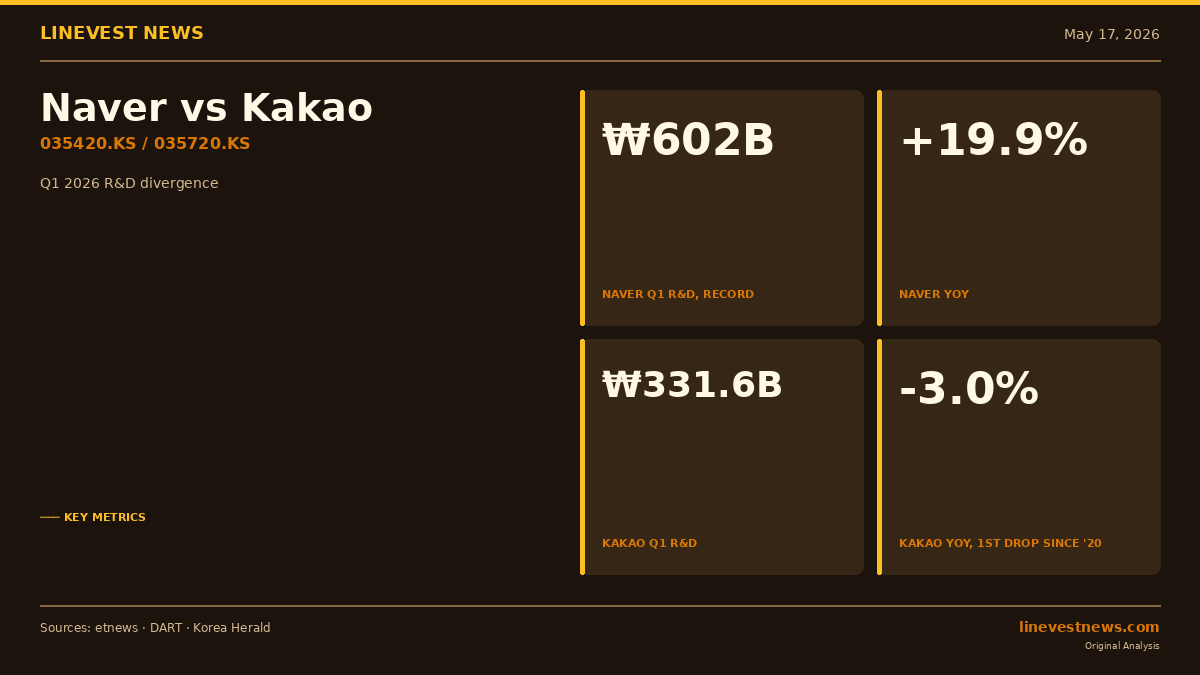
Seoul — Naver (035420.KS), the Korean internet and AI services group behind the country's leading domestic search engine, spent ₩602.0 billion ($439 million) on research and development in Q1 2026 — the first time its quarterly R&D outlay has cleared the ₩600 billion threshold, according to filings on DART (Korea's electronic disclosure system) reported by Electronic Times (etnews) on May 17. The figure was up 19.9% from ₩502.0 billion ($366 million) a year earlier and equated to 18.6% of revenue, versus 18.0% in Q1 2025 (etnews, May 17).
Kakao (035720.KS), the operator of dominant Korean messenger KakaoTalk, moved the other way. Its Q1 2026 R&D spend fell 3.0% to ₩331.6 billion ($242 million) from ₩342.1 billion ($250 million) a year earlier — the company's first quarterly R&D contraction after consistent expansion every year since 2020, per etnews citing the same DART filings.
Why the divergence matters
The ₩270.4 billion quarterly spread is not just a difference in scale; it tracks two different bets on how to build agentic AI products at a moment both companies have publicly framed 2026 as the year AI assistants graduate from answering questions to executing actions on a user's behalf.
Naver is pushing six in-house agent stacks in parallel, per its Q1 disclosure as summarized by etnews:
- Browser-based AI agent systems
- On-device AI technology for browsers
- LLM-powered DevOps agents
- Shopping AI agents
- Video AI agent systems
- Managed-app issue analysis and resolution technology (N3R)
Kakao is leaning the other direction, substituting partnerships for in-house spend. The company plans to deploy "Kanana in KakaoTalk" using Google technology and "ChatGPT for Kakao" via an OpenAI partnership, while keeping selective internal investment in multimodal LLMs and on-device models (etnews, May 17).
Sizing Naver's commitment
The Q1 figure builds on a full-year 2025 R&D bill of ₩2.22 trillion ($1.62 billion), up roughly 20% year-over-year, disclosed in late March (DigitalToday, citing business report filed March 26). CEO Choi Soo-yeon, speaking at Naver's March 23 annual general meeting in Seongnam, said the shopping AI agent has been in beta since February and will expand across all commerce categories by December 2026, with separate specialized agents for finance, health, and local services to follow (Korea Herald). That product roadmap sits on top of a 60,000-unit contract for Nvidia Blackwell GPUs, with 4,000 B200 chips delivered in January 2026 and an additional AMD computing partnership signed in March (Korea Herald).
Naver's R&D-to-revenue ratio creeping from 18.0% to 18.6% in a single year, while the absolute spend rose nearly 20%, implies revenue grew at a slower pace than R&D — the company is bending its cost curve toward AI even as the top line expands.
Why Kakao's first contraction since 2020 is notable
Kakao's R&D budget has expanded annually since 2020, per etnews — through the COVID-era messenger boom, the 2022 SK C&C data-center fire that knocked KakaoTalk offline for days, and the 2023 leadership upheaval. A 3.0% pullback in Q1 2026 is the first break in that pattern. The company is not abandoning AI; it is making a bet that licensing OpenAI's and Google's frontier models is a faster path to KakaoTalk-scale deployment than racing Naver and the global hyperscalers on training spend.
That is a defensible strategy for a platform whose moat is distribution rather than model quality — but it transfers a meaningful share of Kakao's product roadmap to the release cadence and pricing decisions of two foreign suppliers.
What confirms or refutes the thesis
Two near-term checkpoints will signal whether the spending split is a leading indicator or a misread:
- H1 2026 — "Kanana in KakaoTalk" launch. First commercial test of Kakao's Google-powered agent on a platform that anchors most domestic messaging traffic. Adoption metrics here measure whether partner-led AI can ship at KakaoTalk's scale without proprietary control.
- End of 2026 — Naver's specialized-agent rollout in finance, health, and local services, the milestone Naver itself has framed as the moment its AI Tab moves from search to action (Korea Herald).
The Q2 R&D disclosures, due in mid-August on DART, will also show whether the ₩270 billion quarterly gap widens, narrows, or holds — the first indicator of whether either company is reconsidering its 2026 stance.
Disclaimer: This article is for informational purposes only and does not constitute investment advice. All figures are sourced from named publications and public disclosures as cited inline; readers should consult primary filings before making any decisions.
Sources
- Electronic Times (etnews) — Naver R&D first crosses ₩600B; Kakao trims spend, expands AI partnerships, May 17, 2026
- Korea Herald — Naver CEO Choi Soo-yeon AGM remarks on shopping AI agent expansion and GPU deployment, March 2026
- DigitalToday — Naver, Kakao 2025 full-year R&D spending and in-house AI focus, March 2026
- DART (Financial Supervisory Service Electronic Disclosure System) — Naver and Kakao Q1 2026 business reports, filed May 2026