Wall Street Chip Rout Stacks Onto Friday's 6.1% KOSPI Plunge, Setting Up Anxious Monday for Samsung, SK Hynix
If Monday opens down another 3-4%, do I cut KOSPI exposure or buy the dip? That depends entirely on whether you believe the AI memory trade is correcting or unwinding — and Friday's tape gave the bears more ammunition than the bulls.
Two Stocks, 42% of the Index, 6.12% Down
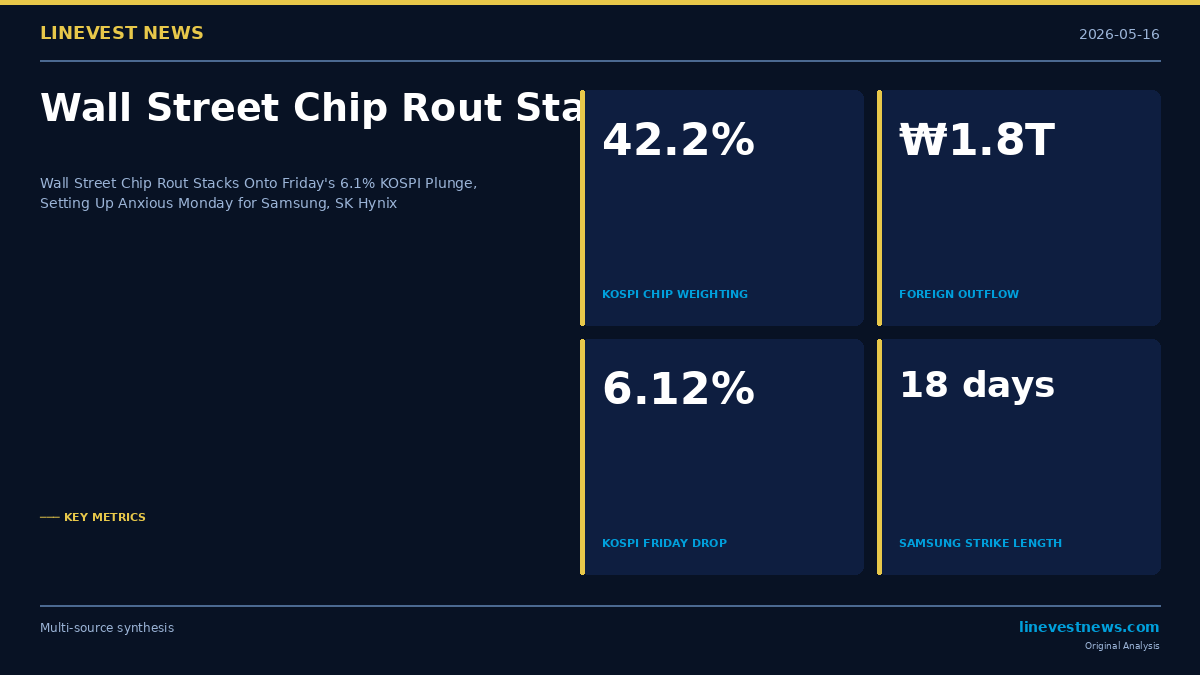
The KOSPI is not a diversified benchmark right now. Samsung Electronics and SK Hynix carry about 42.2% of the index weighting per Benzinga, and on Friday they fell 8.6% and 7.66% respectively. The index dropped 6.12% to 7,493.18, after touching an intraday high of 8,046.78. The math is uncomfortable: the 6.12% index move maps almost entirely onto the two chip names, meaning the rest of the market did not absorb the shock — it amplified it.
Foreign investors pulled roughly ₩1.8 trillion ($1.21 billion) in a single session, per Korea Exchange data cited by Bloomberg. With the KOSPI trading near a 30 P/E against the S&P 500's roughly 22, the premium is underwritten by one assumption: AI memory demand keeps compounding. Friday was the first serious challenge to that assumption.
The 7,500 Line and What Sits Behind It
A break below 7,500 on Monday would erase a meaningful slice of the index's roughly 80% year-to-date gain, and there is no obvious second leg of leadership to catch it. The chip concentration that powered the rally now works in reverse — every percentage point lower in Samsung or SK Hynix translates almost one-to-one into index pain.
Wall Street Handed Seoul a Second Negative Lead
After Seoul closed, US semis sold off in the same direction. Per Investing.com, Micron fell roughly 5%, Nvidia about 3.5%, and Broadcom around 3% during Friday's US session. The 10-year Treasury yield jumped 13.6 basis points to 4.595% and the 30-year reached 5.128%. Brent closed at $109.26, up 3.35%, and WTI rose 4.2% to $105.42 after President Donald Trump signaled patience was "running out" on Iran's enriched-uranium stockpiles.
Maeil Business Newspaper framed the US move as a convergence of "Middle East-related instability, rising rates, and weakening AI investment sentiment." That triad — higher discount rates, higher input costs, a crowded AI trade losing momentum — hits a chip-heavy index harder than almost any other major benchmark.
The Rally That Preceded the Drop
UBS, cited by Investing.com, called April's US equity rally a "2.8 standard deviation event" and warn[ed] of the setup heading into the weekend.
This article is for informational purposes only and does not constitute investment advice.