Korean Retail US Stock Holdings Cross ₩300 Trillion as AI Rally Outpaces KOSPI Boom
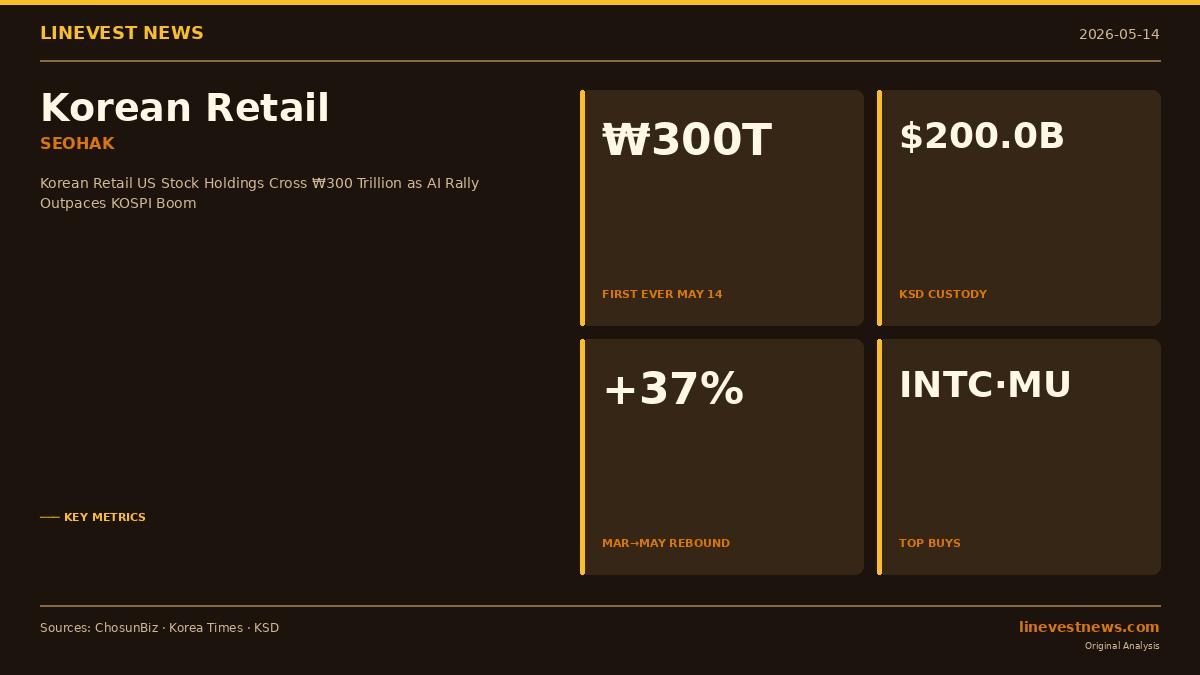
TL;DR - Korean retail investors' US stock holdings hit a record $200.01 billion (~₩300.27 trillion) as of May 14, the first time the threshold has been crossed, per KSD data cited by ChosunBiz. - The KOSPI breached 8,000 intraday on May 15 before plunging 6.12% to close at 7,493.18, per Korea Times. - Watch flows into US semiconductor names (Intel, Micron) and memory-linked ETFs as AI capex re-rates SK Hynix and Samsung Electronics globally.
Lead
Korean retail investors — locally nicknamed "Seohak Ants" (the colloquial term for Koreans buying overseas equities) — pushed their US stock holdings above ₩300 trillion ($200.0 billion) for the first time on May 14, even as Seoul's benchmark KOSPI (Korea Composite Stock Price Index) staged a historic intraday breakout above 8,000 the very next session. The twin milestones, both fueled by global AI capex, set up a tug-of-war between Korea's home-market activation push and the magnetic pull of US technology leaders such as Intel, Micron, and ETFs tracking SK Hynix (000660.KS), one of Korea's two largest memory-chip makers alongside Samsung Electronics.
What Happened
Per KSD (Korea Securities Depository, Korea's central securities settlement agency) data cited by Korean financial daily ChosunBiz, Korean retail holdings of US equities reached roughly $200 billion (~₩300 trillion) on May 14 — a record high, with US tech indices rebounding sharply to new records.
The same week, the KOSPI breached 8,000 intraday on May 15 — its first such print, only seven trading days after first touching 7,000 on May 6, per Korea Times — before profit-taking dragged it to a 7,493.18 close, down 6.12%. A sell-side sidecar triggered at 1:28 p.m. after KOSPI 200 futures fell 5.09% from the prior close, halting program sell orders for five minutes, per Korea Times.
Why It Matters
This is the first concrete signal that Korea's domestic-market activation drive — including Return to Investment Accounts (RIA), a tax-incentive scheme for repatriating overseas capital into Korean equities — is being overwhelmed by the gravitational pull of US AI infrastructure stocks. Korea Herald reported in late April that RIA program balances had topped ₩1 trillion (~$700 million) across roughly 160,000 accounts — equivalent to less than 0.5% of Korean retail US holdings. The data challenges the consensus that a rerating of the KOSPI to record highs would keep Korean savings at home; instead, AI is acting as a single thematic vector lifting both markets in parallel, with US semiconductor names absorbing the largest share of cross-border flow.
Business Impact
For SK Hynix and Samsung Electronics, the cross-border rotation is doubly supportive. KB Securities (one of Korea's largest brokerages) raised its 2026 KOSPI target by 40% to 10,500 on May 15, with analyst Lee Eun-taek projecting combined Samsung and SK Hynix operating profit at ₩630 trillion ($420 billion) in 2026, up from ₩91 trillion ($61 billion) the prior year and rising to ₩906 trillion in 2027, per Bloomingbit. ChosunBiz reported Korean retail buying in the US is concentrated on Intel — the top net-bought stock, on speculation about an Apple chip-foundry partnership — together with Micron, Alphabet, the Roundhill Memory ETF (heavily weighted to Samsung and SK Hynix exposure), and Invesco's Nasdaq 100 ETF.
Domestic positioning, however, remains heavily hedged. Seoul Economic Daily reported the KODEX 200 Futures Inverse 2X ETF — a double-short KOSPI 200 product — drew ₩34.494 trillion ($23 billion) in inflows, more than 15 times the next-largest ETF recipient, despite posting a -31% return over the same rally window.
Industry & Historical Context
The ₩300 trillion line had been a closely watched marker for Korean outbound retail flows. The won traded at 1,500.8 per dollar on May 15, per Korea Times — a level that itself flatters dollar-denominated US returns when converted back to won, reinforcing the feedback loop into further overseas buying. Domestic brokerages have raised KOSPI targets in unison: KB Securities' move follows similar upgrades from peers as analysts reposition Korean memory names as "scarce strategic assets" in the AI supply chain, per Bloomingbit. Semiconductor-specific ETFs led the non-inverse domestic flow league, with SOL Semiconductor TOP 2 Plus drawing ₩480.2 billion and the RISE Samsung–SK Hynix mixed-asset product attracting ₩429.1 billion in inflows over the period, per Seoul Economic Daily.
What to Watch
- The next weekly KSD reading: whether US holdings consolidate above ₩300 trillion or retrace as KOSPI volatility absorbs flows.
- Whether the FSC (Korea's Financial Services Commission) or MOTIE (Korea's Ministry of Trade, Industry and Energy) layers fresh incentives onto the under-subscribed RIA program.
- SK Hynix and Samsung Electronics' Q2 earnings, the key validation point for KB Securities' ₩630 trillion combined operating profit thesis.
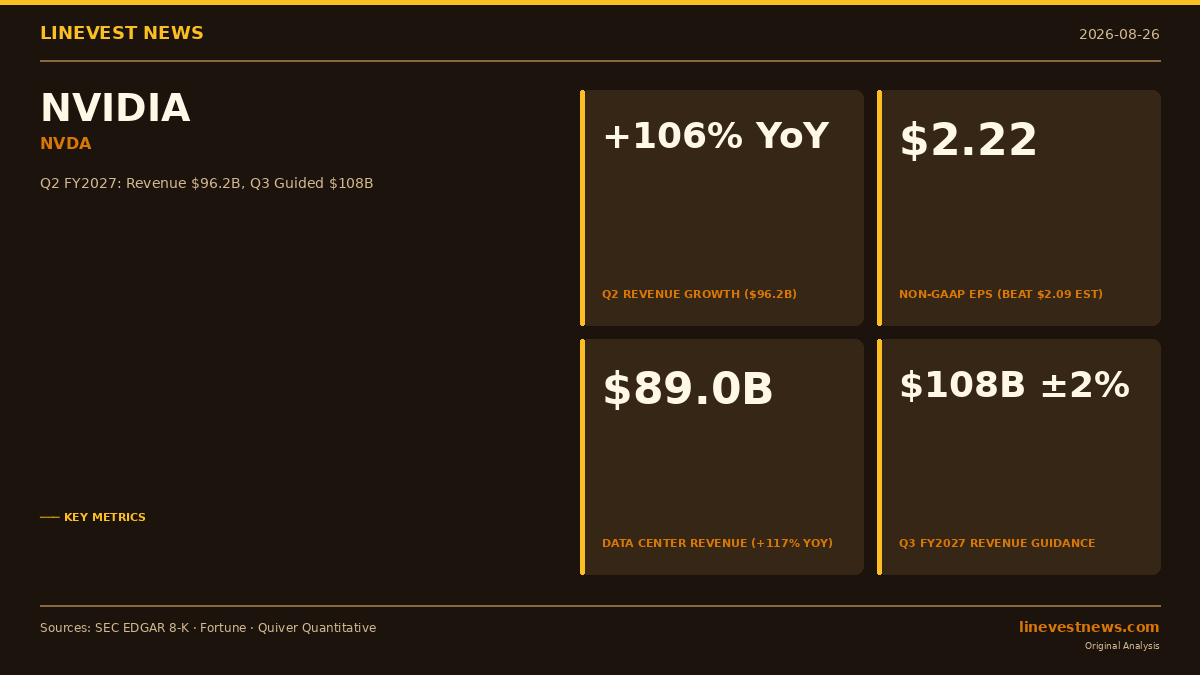
- Nvidia's late-May earnings, flagged by Korea Times as the next macro catalyst for both legs of the trade.
Sources: - ChosunBiz — https://biz.chosun.com/stock/stock_general/2026/05/17/XEPDNHHIZRDSNEPRVWZXJPVJXI/ - Korea Times — https://www.koreatimes.co.kr/economy/others/20260515/kospi-tops-8000-intraday-before-tumbling-below-7500-on-foreign-sell-off - Bloomingbit — https://en.bloomingbit.io/feed/news/112141 - Korea Herald — https://www.koreaherald.com/article/10724170 - Seoul Economic Daily — https://en.sedaily.com/finance/2026/05/17/kospi-hits-8000-but-retail-investors-bet-34-trillion-won-on
By LineVest Markets Desk — 2026-05-17
This article is for informational purposes only and does not constitute investment advice.