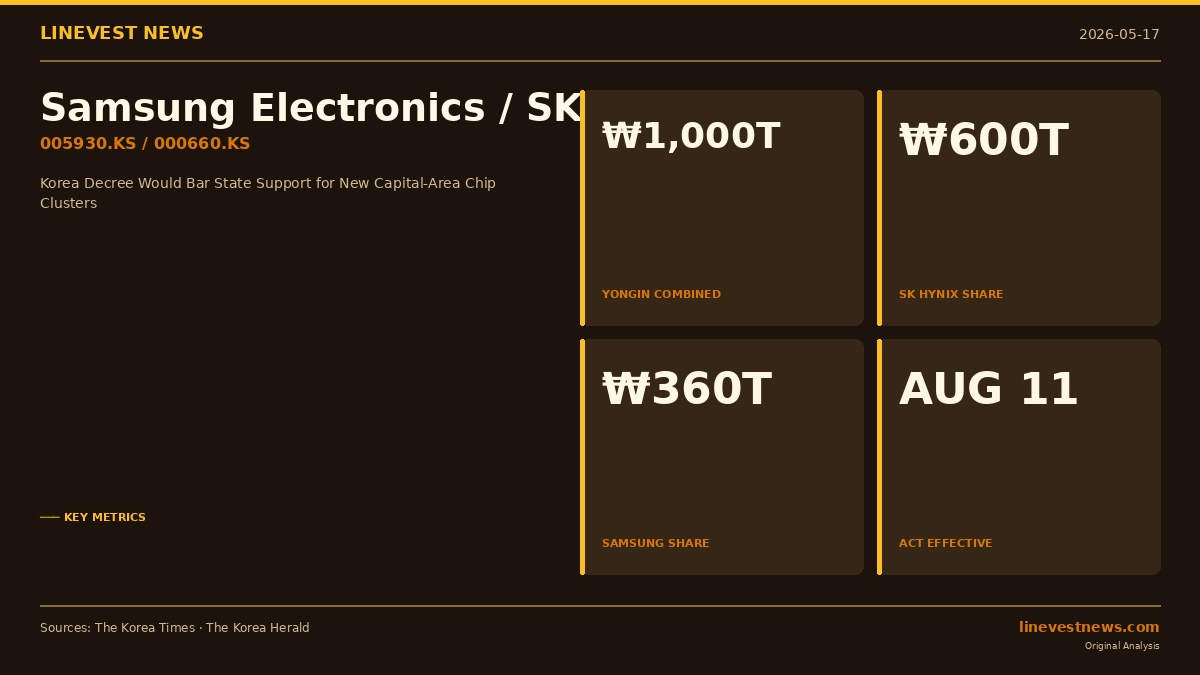
South Korea's Ministry of Trade, Industry and Resources (MOTIR, Korea's industrial-policy ministry) is finalizing an enforcement decree that would deny state support — subsidized electricity, water, and road infrastructure — to any new semiconductor industrial complex built in Seoul, Incheon, or Gyeonggi Province, according to The Korea Times. The decree is expected later this month, and the underlying Special Act on Strengthening Competitiveness and Supporting the Semiconductor Industry, passed by the National Assembly in January, takes effect August 11 (The Korea Times).
Crucially, the Yongin Semiconductor Cluster — a combined ₩1,000 trillion ($670 billion) buildout in Gyeonggi Province by Samsung Electronics (005930.KS), Korea's flagship memory and logic chipmaker, and SK hynix (000660.KS), Korea's leading dedicated memory-chip maker — remains eligible for previously promised support (The Korea Times). Within that envelope, SK hynix's share is roughly ₩600 trillion ($402 billion) for its Yongin Semiconductor general industrial complex; Samsung's share is roughly ₩360 trillion ($241 billion) for its advanced system-semiconductor national industrial complex (The Korea Herald, Feb. 9, 2026).
What the decree actually changes
For Samsung and SK hynix's existing Yongin commitments, the headline numbers do not move: the cluster is grandfathered. The friction sits one step downstream, with the materials, parts, and equipment suppliers that ring any modern fab. Under the proposed decree, any such supplier siting greenfield capacity in the capital region after the act takes effect on August 11 would lose access to subsidized utilities and roads (The Korea Times). Roughly 90 semiconductor materials and equipment firms have already moved into or committed to the Yongin ecosystem (The Korea Herald, Feb. 9, 2026); the decree's practical effect is to push any additional supplier expansion outside Seoul, Incheon, and Gyeonggi.
The Korea Semiconductor Industry Association (KSIA, the country's main chip-industry trade body) pushed back, saying the cluster's location "should not be subject to negotiation" and calling for long-term policy consistency (The Korea Times). MOTIR, for its part, said "nothing has been decided regarding the announcement of the enforcement decree" (The Korea Times).
Political backdrop
The decree lands roughly three weeks before Korea's June 3 local elections, and the politics are unusually direct. Yongin Mayor Lee Sang-il (People Power Party), seeking reelection, called for the decree to be withdrawn, telling reporters that "the proposal effectively means companies must build semiconductor fabs outside the capital region if they want government support" and that "President Lee Jae Myung pledged to support Yongin's semiconductor projects during his campaign, but the government and the ruling party have continued to hinder their progress" (The Korea Times).
Noncapital candidates are running on the mirror image of that message. Min Hyung-bae, the Democratic Party of Korea's candidate for Gwangju mayor, has campaigned on pulling semiconductor investment into South Jeolla Province (The Korea Times). The official rationale offered for the geographic restriction is to use chip subsidies as a lever against the depopulation of regions outside greater Seoul (The Korea Times).
Context: a slow-moving policy push
Korea's semiconductor-policy framework has moved deliberately. The Special Act sat in the National Assembly for an extended period before its January 2026 passage and only takes effect on August 11 (The Korea Times). On the project side, SK hynix broke ground on its first Yongin fab in February 2025 (The Investor), with the cleanroom opening recently pulled forward to March 2027 and commercial operation targeted for the first half of 2027 (Cleanroom Technology) — a schedule that pre-dates the current decree dispute and is not, on the face of that reporting, altered by it.
What to watch
- The decree text, expected by end-May: the precise wording will determine which subsidy categories (utilities, road, administrative fast-track) are gated by location, and which sub-classes of "partner company" fall inside or outside the perimeter.
- The June 3 local elections: results in Yongin and in Gwangju will shape how aggressively the Lee Jae Myung administration implements the geographic restriction.
- Subsequent SK hynix and Samsung capex disclosures: whether either company reroutes any planned partner-supplier expansion outside Gyeonggi will be the first concrete read on whether the decree is reshaping site decisions, or only signaling.
This article is for informational purposes only and does not constitute investment advice. All financial decisions should be made in consultation with a qualified financial advisor.