MSCI Cuts Three Korean Stocks in May Review, Shrinking Korea Index to 77
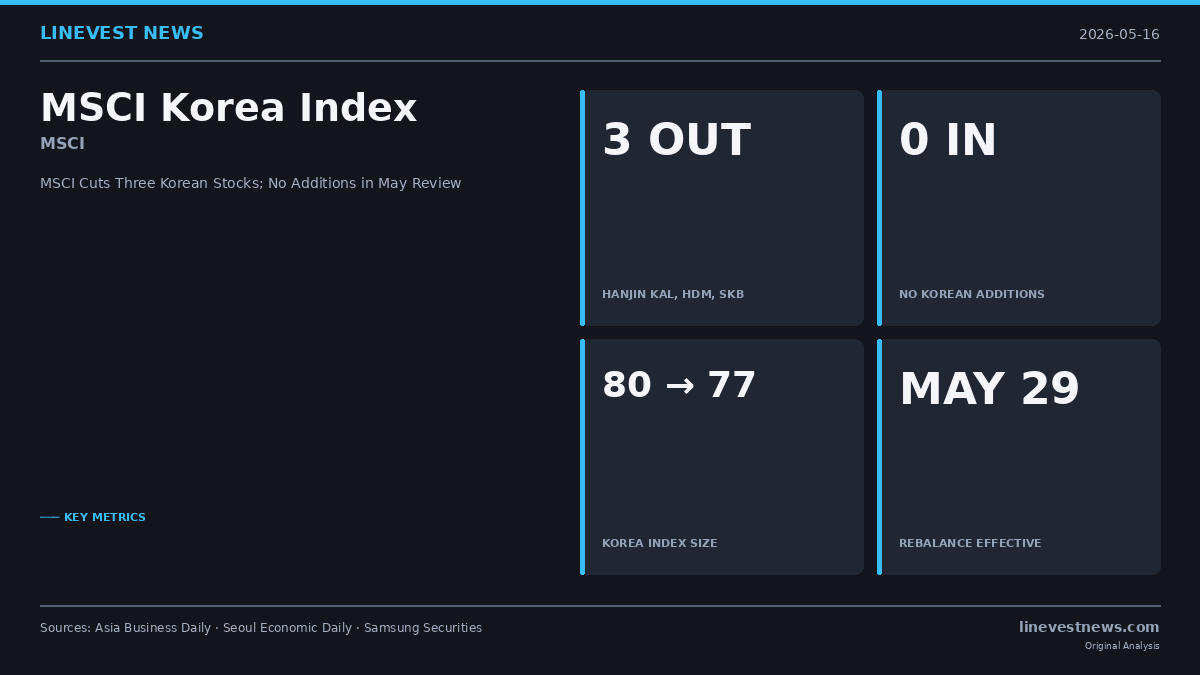
TL;DR - MSCI deleted Hanjin KAL, HD Hyundai Marine Solution and SK Biopharmaceuticals from its Korea Index in the May 12 semi-annual review, with no new additions. - The MSCI Korea Index will fall from 80 to 77 constituents when the rebalance takes effect after the close on May 29, 2026. - Samsung Securities frames the cull as a one-off shock from MSCI's revised free-float methodology, not a verdict on individual names.
MSCI (MSCI Inc., NYSE: MSCI — the independent index provider whose name historically stood for Morgan Stanley Capital International) deleted three South Korean stocks from its flagship MSCI Korea Index in its May 2026 semi-annual review, announced on Monday, May 12 (US time), with no new constituents added. The cuts will shrink the index from 80 to 77 stocks when the rebalance takes effect after the close on Thursday, May 29, 2026, according to The Asia Business Daily. Samsung Securities, the brokerage arm of Korea's Samsung Group, said the simultaneous triple exclusion mostly reflects a one-time overhaul of MSCI's free-float methodology rather than a re-rating of the underlying companies.
What Happened
The three deleted stocks are Hanjin KAL, Hanjin Group's airline holding company that owns Korean Air; HD Hyundai Marine Solution, HD Hyundai Group's ship after-sales service unit; and SK Biopharmaceuticals, SK Group's epilepsy-drug developer. All three are large-cap names on the KOSPI (the main board of the Korea Exchange). No Korean stocks were added in this tranche, breaking what The Asia Business Daily described as a recent run of quarterly additions for the index.
According to The Asia Business Daily's Korean-language report citing Kim Dong-young, an analyst at Samsung Securities, MSCI shifted its free-float inclusion factors from rounded 5% steps to a more granular rounding rule in this review. As a result, HD Hyundai Marine Solution's free-float factor was lowered to 30% from 35%, and SK Biopharmaceuticals's to 35% from 40% — mechanically reducing each stock's index-eligible market capitalization. Kim added that SK Group cut its stake in SK Biopharmaceuticals to 50.1% from 64% on March 26, tightening the free-float metric further. Hanjin KAL's free-float ratio was unchanged but its free-float market cap was deemed insufficient to remain in the index, the report said.
Seoul Economic Daily, in an April 20 preview citing Samsung Securities, had flagged Hanjin KAL and HD Hyundai Marine Solution as the two most at-risk names. Hanjin KAL's total market cap of ₩7.81 trillion ($5.7 billion at roughly ₩1,370 per dollar) cleared MSCI's absolute threshold, but its free-float market cap of ₩2.73 trillion ($2.0 billion) sat below the ₩2.90 trillion ($2.1 billion) deletion line; HD Hyundai Marine Solution's free-float market cap of ₩2.97 trillion ($2.2 billion) was, the outlet warned, "only marginally above" the cut-off.
Why It Matters
The deletions are the first concrete signal that MSCI's revised free-float rounding can dislodge multiple Korean blue-chips in a single review, even when their absolute market values clear the threshold. The change challenges the consensus that quarterly MSCI reshuffles would keep producing modest net inflows of passive money for Korea; instead, this cycle records a structural reduction in the country's representation in the benchmark, which anchors widely tracked products including BlackRock's iShares MSCI South Korea ETF (NYSE: EWY).
Business Impact
For the three excluded companies, exit from MSCI Korea removes a passive-buying tailwind that has historically supported large-cap Korean stocks. Seoul Economic Daily noted that index removal "tends to trigger outflows" from benchmark-tracking funds; neither it nor The Asia Business Daily provided a specific won or dollar estimate of the May-cycle outflows.
On the addition side, Seoul Economic Daily's April preview reported that Samchundang Pharm (a Korean pharmaceutical maker), Kiwoom Securities (a leading Korean online brokerage) and Samsung Securities (016360.KS) were the closest theoretical add candidates. None cleared MSCI's ₩13.06 trillion ($9.5 billion) market-cap cut-off: Samchundang Pharm fell about 12.8% short, Kiwoom Securities about 10.1% short, and Samsung Securities roughly 25% short, according to the outlet.
Industry & Historical Context
MSCI conducts regular index reviews four times a year — in February, May, August and November — reassessing constituents on total and free-float market capitalization, per Seoul Economic Daily. Korea remains classified as an emerging market in MSCI's framework; KED Global reported in June 2025 that MSCI maintained that status pending further capital-market reforms. Kim Dong-young of Samsung Securities characterized the three-stock drop as a one-time methodology shock and said future quarterly cycles should revert to a balance of additions and removals, with little net change in the Korean component count absent sustained relative outperformance.
What to Watch
The rebalance becomes effective after the close on May 29, 2026, when trading desks typically see the bulk of mechanical passive flows. The next MSCI quarterly review is scheduled for August 2026 — the first chance to test whether the new free-float methodology yields a more balanced add/delete ledger, or whether Korea's constituent count drifts lower still. Also worth tracking: whether Samchundang Pharm, Kiwoom Securities or Samsung Securities can grow free-float market cap toward MSCI's threshold by then.
Sources: - Seoul Economic Daily — https://en.sedaily.com/finance/2026/05/13/msci-removes-hanjin-kal-hd-hyundai-marine-solution-sk - The Asia Business Daily (Korean) — https://www.asiae.co.kr/article/2026051416464186026 - The Asia Business Daily (English) — https://www.asiae.co.kr/en/article/stock-etc/2026051307480140502 - Seoul Economic Daily (April preview) — https://en.sedaily.com/finance/2026/04/20/msci-may-review-uncertain-no-new-additions-likely-for-korea
By LineVest Markets Desk — May 16, 2026This article is for informational purposes only and does not constitute investment advice.