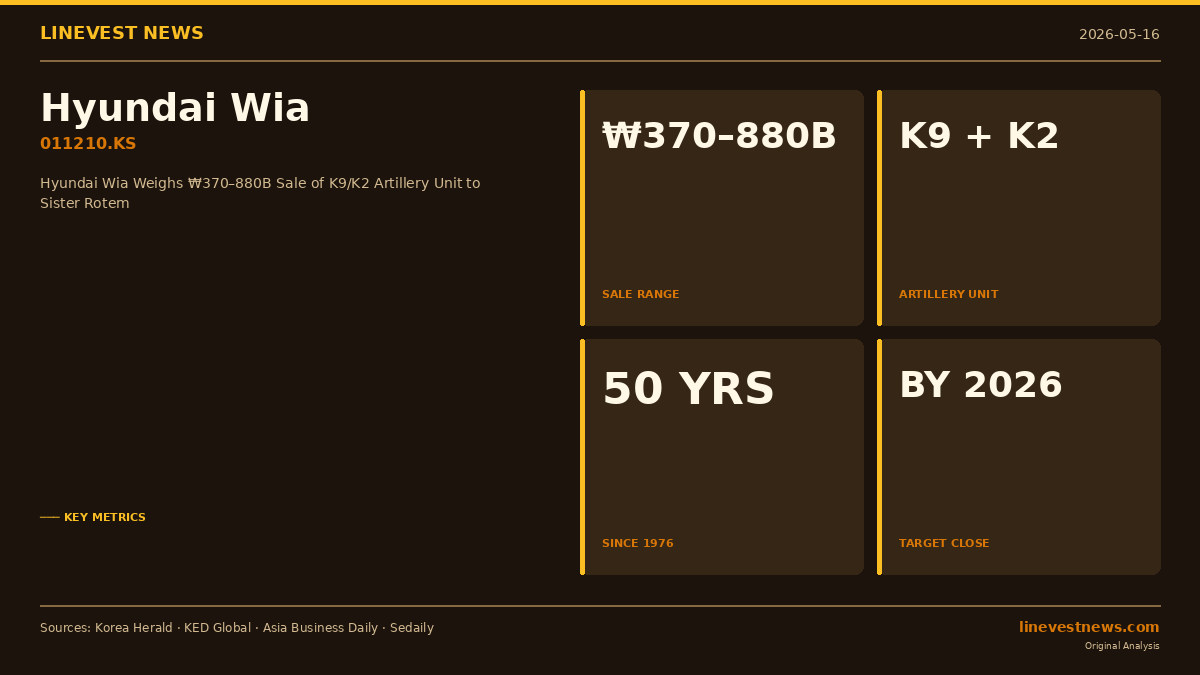
Hyundai Wia is exploring a ₩370–880 billion sale of its defense unit to sister affiliate Hyundai Rotem, industry sources said. The transfer would move K9 howitzer barrels and K2 tank main-gun production from Korea's sole large-caliber artillery specialist into its armored-vehicle counterpart — 50 years after the artillery unit's 1976 founding — in what appears to be a strategic relocation of capital toward robotics and electric-vehicle thermal management.
The defense division, dating to Hyundai Wia's 1976 founding, generates roughly ₩400 billion in annual revenue and is regarded as one of the company's most profitable operations. Its products include barrels for Hanwha Aerospace's K9 self-propelled howitzers and the main guns mounted on Hyundai Rotem's K2 main battle tanks — Korea's two best-known artillery and armored-vehicle export platforms.
Analyst frame: a capital relocation
Yoo Ji-woong, an analyst at Daol Investment & Securities, characterized the move as "a strategic relocation of capital, exiting low-growth businesses to reinvest in medium-to long-term growth." Hyundai Wia, in a brief statement, said it was "reviewing various measures to strengthen the company's competitiveness, but no specific details have been decided." Hyundai Rotem confirmed it is "reviewing various options but no decision has been made."
The valuation band sits between roughly 0.9 and 2.2 times annual revenue, an honest range that industry watchers said reflects uncertainty over how the artillery business should be priced amid a global defense up-cycle. Tighter point estimates have not been disclosed, and both sides are described as still negotiating perimeter — whether ammunition components and certain export-licensed product lines transfer alongside the core barrel and main-gun assets.
Serial divestiture pattern
The sale push comes as Hyundai Wia leans into robotics, AI vision systems and EV thermal management. In July last year, the company agreed to divest its machine tools business in a separate transaction, marking the second mooted divestiture inside twelve months. Two sales in under a year, analysts said, increasingly reads as a pattern rather than an isolated reshuffle.
A Chosun Biz report on May 16 said the defense unit's employees and minority shareholders have raised objections, citing the unit's profitability and its long history as Hyundai Wia's founding business. Resolving that pushback — through retention packages, governance commitments or share-class assurances — is now seen as one of the principal hurdles to closing the deal before year-end.
Rotem absorption logic
For Hyundai Rotem, absorbing the artillery business would centralize K2 ammunition and barrel sourcing under one roof and tighten its grip on export campaigns to Poland, Romania and Saudi Arabia, where K2 deliveries have run alongside K9 deals at Hanwha Aerospace. Daol's Yoo argued the unified production system could shorten lead times on follow-on orders that have already pushed Hanwha Aerospace and Hyundai Rotem to multi-year backlogs.
Group context: physical AI as growth engine
The strategic logic for Hyundai Motor Group is broader still. Chairman Chung Euisun has framed physical AI — robots, autonomous mobility and humanoid platforms — as the group's next growth engine, backed by a $6.3 billion investment program announced for the Saemangeum complex earlier this year. Hyundai Mobis, another affiliate, has already shed lower-margin bumper production for similar reasons, suggesting the Wia divestiture fits a wider portfolio recomposition rather than a one-off transaction.
What to watch
Both companies stress that no decision has been made and that the review remains at the working level. Industry sources say the parties are aiming to complete the transaction within 2026 if internal approvals — and the more delicate matter of employee and minority-shareholder support — fall into place.
For investors, three signposts now matter: whether the final perimeter includes the higher-margin export ammunition lines, whether Hyundai Wia's robotics and thermal-management bookings can plausibly replace ₩400 billion in artillery revenue within three years, and how Hyundai Motor Group itself frames the Wia–Rotem combination at its next analyst day. The artillery cash cow is leaving home; what fills the room behind it is the real question.
Sources: The Korea Herald, KED Global, The Asia Business Daily, Seoul Economic Daily, Chosun Biz, MarketScreener.