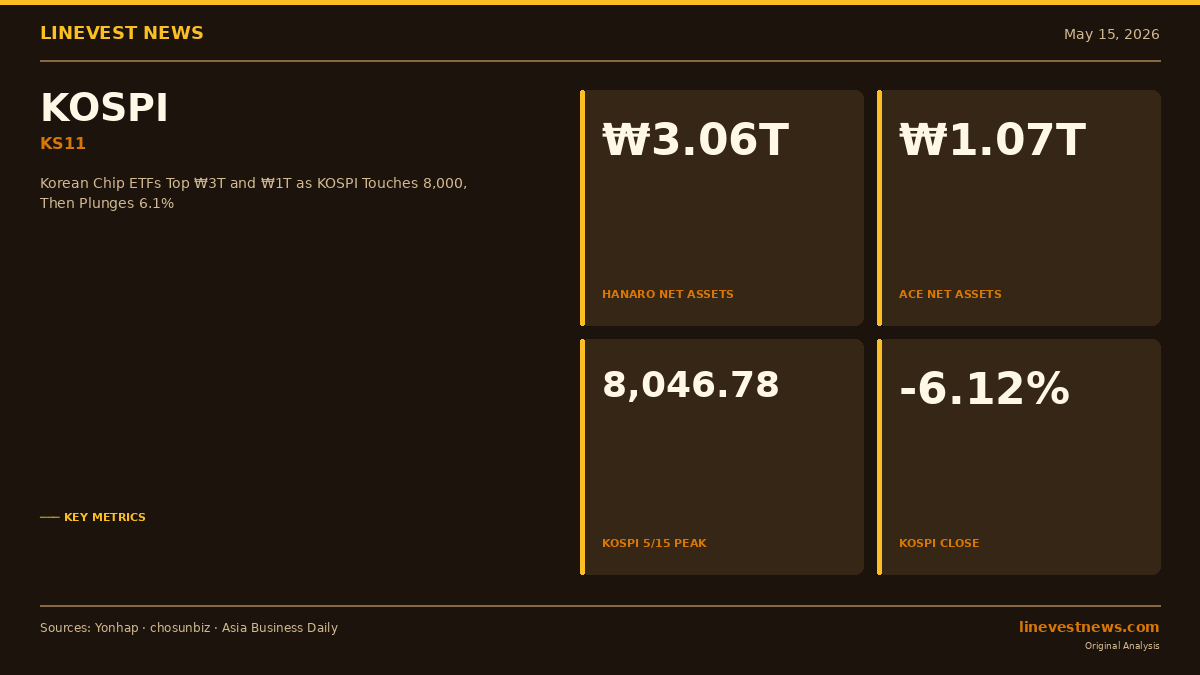
Korean Chip ETFs Cross ₩3 Trillion and ₩1 Trillion as KOSPI Touches 8,000
TL;DR - NH-Amundi's HANARO Fn K-반도체 ETF crossed ₩3 trillion ($2.01 billion) in net assets on May 13, while Korea Investment Management's ACE AI반도체TOP3+ ETF cleared ₩1 trillion ($671 million) the next session. - HANARO returned 504.19% over one year and added roughly ₩1 trillion in just two weeks; ACE's net assets have expanded about 703% year-to-date. - Watch whether foreign net selling — ₩6.28 trillion ($4.21 billion) on May 15 alone, per Yonhap and Asia Business Daily — cools the retail-led ETF surge after the KOSPI's first 8,000-point print and a same-day 6.1% reversal.
Lead
Two Korean semiconductor ETFs crossed marquee asset thresholds within 24 hours of each other, evidence that Korean savers and institutions are channeling the AI-memory rally through ETF wrappers at a pace not previously seen. NH-Amundi Asset Management — the Korean joint venture between NongHyup Financial and Amundi — said its HANARO Fn K-반도체 ETF closed May 13 with ₩3.0639 trillion ($2.06 billion) in net assets, while Korea Investment Management, a major Korean asset manager, said its ACE AI반도체TOP3+ ETF reached ₩1.0728 trillion ($720 million) the next session. Both disclosures landed May 15, the day the KOSPI (South Korea's benchmark equity index) briefly traded above 8,000 for the first time — touching an intraday high of 8,046.78 — before plunging back to close at 7,493.18, down 488.23 points or 6.12%, after a sell-side sidecar was triggered, according to Yonhap and Asia Business Daily.
What Happened
NH-Amundi disclosed on May 15 that HANARO Fn K-반도체 ETF's net asset value reached ₩3.0639 trillion as of May 13, citing Korea Exchange (KRX, the country's primary bourse operator) data. The fund crossed ₩2 trillion ($1.34 billion) only in late April, meaning it added roughly ₩1 trillion in two weeks. NH-Amundi reported trailing returns of 178.19% year-to-date, 197.63% over six months and 504.19% over one year — figures the firm describes as the best among non-leveraged Korean equity semiconductor ETFs.
The same day, Korea Investment Management said its ACE AI반도체TOP3+ ETF reached ₩1.0728 trillion as of May 14, citing the same exchange. The fund had crossed ₩500 billion ($336 million) in March, meaning it roughly doubled in two months; year-to-date asset growth is about 703%, the firm said. Launched in October 2023, the ETF concentrates about 75% of its portfolio in three names — SK Hynix, Samsung Electronics and Hanmi Semiconductor — which the issuer describes as global leaders in HBM (high-bandwidth memory) and HBM-related capital equipment.
Why It Matters
These twin milestones are the first concrete signal that Korean ETF flows, not single-stock picking, have become the dominant retail vehicle for the AI-memory thesis. For most of 2024–2025, retail engagement with the HBM trade ran through direct holdings of Samsung Electronics and SK Hynix. The pace at which sector-basket ETFs are now absorbing capital points to a structural shift toward index-style exposure as single-name valuations stretch. It also concentrates beta risk: both funds derive most of their performance from the same two memory leaders.
Business Impact
For the asset managers, the milestones translate into management-fee revenue and reputational lift in a fee-pressured Korean ETF market. NH-Amundi credited Samsung Electro-Mechanics (Samsung's listed components affiliate) with driving recent NAV gains via high-margin MLCC capacitors and FC-BGA packaging substrates used in AI data-center hardware. ACE channels nearly three-quarters of inflows into SK Hynix, Samsung Electronics and Hanmi Semiconductor — the last described by Korea Investment Management as the global leader in TC (thermo-compression) bonders used to stack HBM dies. Samsung Electronics and SK Hynix — which together drive most of the basket performance for both funds — slid alongside the KOSPI on May 15, with the broader index dropping 6.12% from its 8,046.78 intraday peak to close at 7,493.18, per Yonhap. The KOSDAQ also fell roughly 5%. The combined drawdown is a reminder that index-basket mechanics amplify declines as well as rallies.
Industry & Historical Context
The ETF milestones land during one of the most compressed bull runs in Korean equity history. The KOSPI crossed 8,000 within roughly 10 minutes of the open on May 15 — only seven trading days after first clearing 7,000, per chosunbiz — before reversing sharply. Foreign investors net-sold ₩6.28 trillion ($4.21 billion) on the day, their seventh consecutive session of selling, and institutions sold a further ₩2.23 trillion ($1.50 billion), Asia Business Daily reported. Domestic individuals net-bought ₩2.4 trillion ($1.61 billion), a pattern broadly consistent with the retail-led ETF inflows reported by the two asset managers. Separately, Korean HR-tech firm Incruit reported on May 15 that SK Hynix overtook Samsung Electronics and Hyundai Motor as the most-searched employer among Korean jobseekers (6.1% of page views) — a soft indicator of how thoroughly the HBM cycle has reshaped the national equity narrative.
What to Watch
- Foreign flows versus retail ETF demand. Foreign investors net-sold ₩6.28 trillion ($4.21 billion) on May 15 — their seventh straight day of selling — as the KOSPI touched 8,046.78 then collapsed 6.12% to close at 7,493.18. Continued foreign selling would test whether domestic ETF inflows can absorb sustained profit-taking.
- AUM cadence. HANARO needed roughly two weeks to add its most recent trillion won; ACE took two months for its prior half-trillion. A slowdown would be the earliest visible sign retail conviction is digesting.
- HBM pricing commentary. Both funds' performance depends on HBM average selling prices and shipment trajectories at SK Hynix and Samsung Electronics. Any softening at the next earnings cycle would translate directly into ETF NAVs given basket concentration.
Sources: - chosunbiz — https://biz.chosun.com/stock/stock_general/2026/05/15/5UY263IMPRDRBCJJDYUKT2YM3Q/ - chosunbiz — https://biz.chosun.com/stock/stock_general/2026/05/15/OW5HYFM7VVGZ3GZW7RMGNKWDOQ/ - chosunbiz — https://biz.chosun.com/stock/stock_general/2026/05/15/VYHBDNZCZBDCZIN6J4T3ZWC4RE/ - chosunbiz — https://biz.chosun.com/topics/topics_social/2026/05/15/2I45GMGAYBFRTPA5A3LS4NFC7U/ - Asia Business Daily — https://www.asiae.co.kr/article/2026051509050875180 - Yonhap — https://www.yna.co.kr/view/AKR20260515125400008 - Asia Business Daily (Pal-cheon-pi curse close) — https://www.asiae.co.kr/article/2026051515540729716
By LineVest Markets Desk — May 15, 2026
This article is for informational purposes only and does not constitute investment advice.