KB, Shinhan, Woori Defend SEC Risk Filings Over Korea's Inclusive-Finance Push
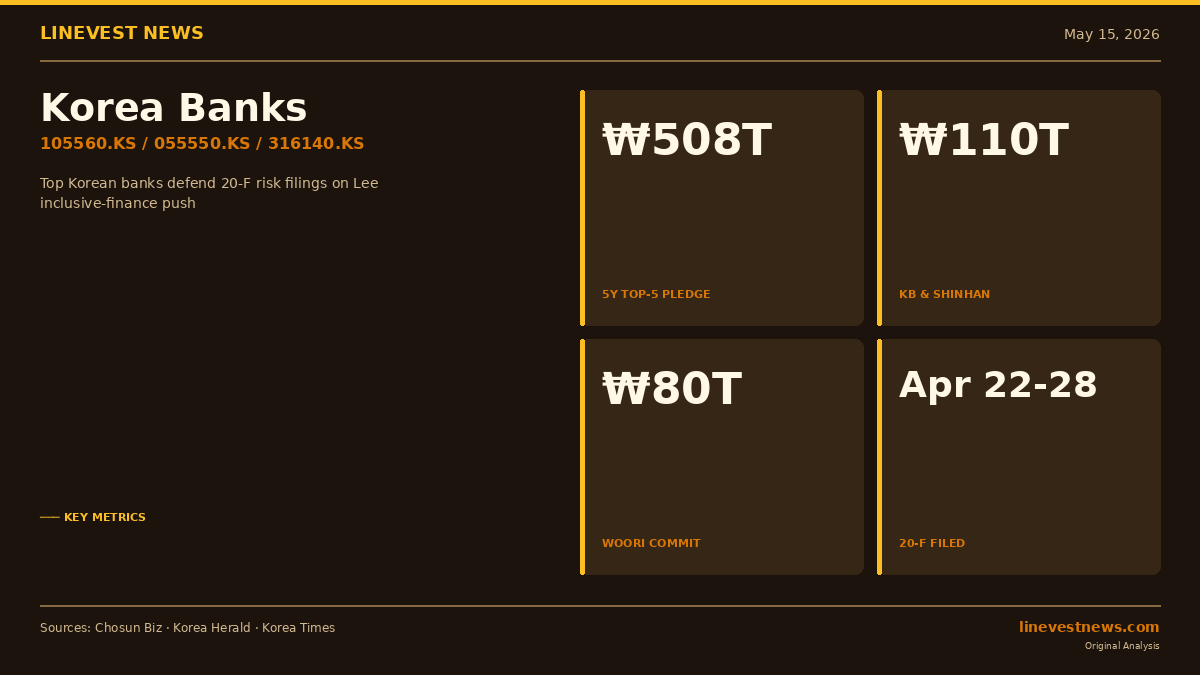
TL;DR - KB Financial, Shinhan Financial and Woori Financial issued a rare joint Friday-evening statement defending SEC 20-F risk language about Korea's productive- and inclusive-finance policies. - The three groups have collectively pledged a share of the roughly ₩508 trillion ($371 billion) five-year commitment by the country's top five banking groups to those programs. - Watch whether Korea's Financial Supervisory Service or ruling-party lawmakers move to align domestic and US-disclosure standards on policy-driven risk factors.
Lead KB Financial Group (KB금융지주, 105560.KS), Shinhan Financial Group (신한지주, 055550.KS) and Woori Financial Group (우리금융지주, 316140.KS) — three of Korea's top banking holding companies — released an unusual joint statement on Friday evening, May 15, defending risk-factor language in their US Securities and Exchange Commission filings that flagged government-led productive- and inclusive-finance programs as potential drags on profitability and asset quality. The wording, absent from their domestic Korean reports, triggered a political backlash earlier in the week.
What Happened
According to a statement distributed jointly by the three groups and reported by Chosun Biz on May 15, the holding companies said they "deeply sympathize with the government's productive- and inclusive-finance policy direction and are pursuing it as one of our core management priorities." The companies framed the SEC disclosures as a function of US securities law's "Full Disclosure" standard and litigation-risk practice rather than a substantive policy critique.
The controversy stems from each group's annual report on Form 20-F filed with the SEC for fiscal 2025. Shinhan Financial filed its Form 20-F on April 22, 2026, and KB Financial filed on April 28, 2026, according to The Korea Herald. KB's filing warned that new inclusive-finance regulations could "reduce our profit margins, limit our operational flexibility and increase competition, which in turn could have a materially adverse effect on our operations and financial condition," per The Korea Times. The Korea Herald, in separate coverage, paraphrased KB's warning as one that could "require adjustments to its business practices that may increase the risk of defaults by its customers," and reported Shinhan used "nearly identical wording" in its April 22 filing.
Woori Financial's filing went further, stating that government requests for sectoral financial support "may also require us to provide financial support to sectors which we would not otherwise support, as a result of which we may incur unintended costs or losses," as quoted by The Korea Times.
The three groups said the SEC framework "requires comprehensive description of various scenarios that could occur," and noted they similarly disclosed risk factors tied to the 2015 technology-finance expansion, 2020 household-debt tightening and 2024 political uncertainty — precedents they argued make this filing unexceptional.
Why It Matters
This is the first concrete signal that Korea's largest banking groups see real downside in the Lee Jae-myung administration's flagship productive- and inclusive-finance agenda, even as they publicly support it. Joint Friday-evening statements from competing financial holding companies are themselves unusual in Korea, and the wording exposes a structural tension between Korean disclosure practice — which has historically downplayed policy-driven risk — and the US 20-F standard for NYSE-listed Korean issuers. The regulator and ruling-party response will shape whether Korean banks can disclose policy risks candidly to US investors without political fallout at home.
Business Impact
The Korea Herald reported in November 2025 that Korea's five largest banking groups collectively committed about ₩508 trillion ($371 billion) over five years to productive- and inclusive-finance programs, with KB and Shinhan each pledging ₩110 trillion ($80 billion), Hana Financial ₩100 trillion ($73 billion), NongHyup Financial ₩108 trillion ($79 billion), and Woori ₩80 trillion ($58 billion). The Korea Times reported Woori has earmarked ₩7 trillion ($4.7 billion) specifically for inclusive-finance lending over five years.
KB Financial's ₩110 trillion package, per The Korea Herald, breaks down into ₩68 trillion ($50 billion) in corporate loans, ₩17 trillion ($12 billion) for inclusive-finance initiatives, ₩15 trillion ($11 billion) in direct investments and ₩10 trillion ($7 billion) to a Public Growth Fund supporting AI and advanced industries. The SEC filings suggest the banks see scenarios where these commitments could compress margins or elevate delinquencies in lower-income lending books.
Industry & Historical Context
Productive finance refers to channeling bank capital into strategic industries and venture growth beyond household lending, while inclusive finance covers preferential credit to low-income borrowers, small business owners and SMEs. Both have been pillars of the Lee administration's financial agenda since 2025. The three groups argued the SEC language was not aimed at giving US investors information withheld from Korean shareholders filing through DART (Korea's electronic disclosure system), but at meeting Form 20-F's forward-looking risk standard.
The banks' invocation of 2015, 2020 and 2024 precedents is notable — each a policy cycle (technology-lending mandates, household-debt curbs, post-martial-law political uncertainty) where similar 20-F risk language appeared without domestic backlash.
What to Watch
First, whether the Financial Services Commission or Financial Supervisory Service — Korea's twin financial regulators — issues guidance on aligning domestic risk-factor disclosure with US 20-F practice. Second, whether ruling-party lawmakers escalate the controversy to a parliamentary hearing. Third, whether Hana Financial Group or NongHyup Financial — the other large committers to the ₩508 trillion package — face similar scrutiny on their next disclosures.
Sources: - Chosun Biz — https://biz.chosun.com/stock/finance/2026/05/15/IAGFP5NB6NGTLH3QC3DBILXY6E/ - The Korea Herald (SEC filings coverage) — https://www.koreaherald.com/article/10738070 - The Korea Times — https://www.koreatimes.co.kr/business/banking-finance/20260514/financial-groups-flag-risks-from-govt-led-inclusive-finance-in-us-filings - The Korea Herald (₩508 trillion commitment) — https://www.koreaherald.com/article/10612008 - Etoday — https://www.etoday.co.kr/news/view/2585095
By LineVest Markets Desk — 2026-05-15This article is for informational purposes only and does not constitute investment advice.