NTS Audit Targets Meritz Securities as Korea's Finance Sweep Widens
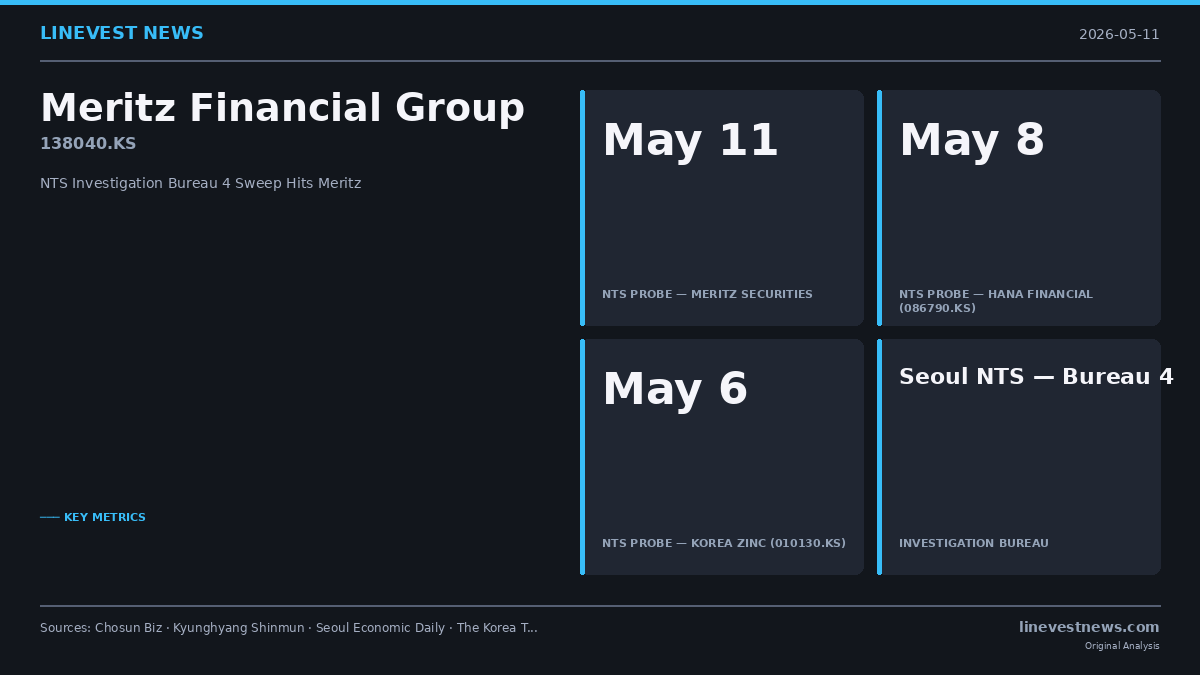
TL;DR - Korea's National Tax Service opened a special, non-routine audit of Meritz Securities on May 11, the third such probe of a major financial firm in a week, per Chosun Biz. - The same Seoul Regional Tax Office bureau (Investigation Bureau 4) opened audits of Hana Financial Group on May 8 and Korea Zinc on May 6, signaling a coordinated sweep. - Watch whether the audits expand to other large brokerages and bank holding companies, and how prosecutors' parallel insider-trading case at Meritz progresses.
Lead
Korea's National Tax Service (NTS), the country's central tax authority, opened a special tax audit of Meritz Securities on May 11, according to Chosun Biz. It is the third non-routine probe of a major financial-sector firm in six days, and it lands on a brokerage already under prosecutors' insider-trading investigation tied to its 2022 corporate restructuring.
What Happened
Chosun Biz reported on May 11 that Investigation Bureau 4 of the Seoul Regional Tax Office — the NTS unit that handles non-regular corporate tax probes — was conducting an on-site audit at Meritz Securities' headquarters. Chosun Biz wrote that the bureau had "identified tax-evasion suspicions" before launching the audit, without specifying the alleged conduct or the period under review.
Meritz Securities has been a wholly owned subsidiary of Meritz Financial Group (138040.KS), a Seoul-listed financial holding company, since the brokerage was delisted from the Korea Exchange in April 2023 as part of the group's governance overhaul. The audit therefore touches the listed parent indirectly rather than through Meritz Securities' own shareholders.
The action follows two other recent moves by the same NTS bureau. On May 8, Investigation Bureau 4 opened a special audit at Hana Financial Group (086790.KS), one of Korea's four largest bank holding companies, and at its commercial banking arm Hana Bank, the Kyunghyang Shinmun (Khan) reported in English. On May 6, the same unit launched a tax probe at Korea Zinc — the world's largest zinc smelter — on suspicion of tax evasion or embezzlement, according to Seoul Economic Daily.
Why It Matters
This is the first concrete signal that the Lee Jae-myung administration is using tax-administration tools — not just financial-regulatory ones — to apply pressure on Korea's financial sector. Three non-routine audits at three of the country's largest financial-sector or industrial groups in six days, all driven by the same Seoul bureau, is unusual; banks and large brokerages in Korea typically face regular tax audits roughly every four to five years (Kyunghyang Shinmun, May 8).
The sweep also tracks closely with public remarks by President Lee Jae-myung, who took office earlier this year. Chosun Biz noted that the audits followed Lee's comments at a Cabinet meeting on May 6, in which he said the "public character" of Korean financial companies was "too weak" and criticized the view that "making money is the be-all of a financial institution's purpose." Khan English reported the same remarks in the context of the Hana audit. Whether that political backdrop translates into formal tax assessments will determine how durable the campaign is.
Business Impact
For Meritz Securities, the audit arrives while the firm is already managing a parallel criminal track. Korean prosecutors have been investigating allegations that a former Meritz Fire & Marine executive learned in advance of the November 2022 plan to convert Meritz Fire and Meritz Securities into wholly owned subsidiaries of Meritz Financial Group, and used family accounts to buy shares before the announcement, Chosun Biz reported. Chosun Biz characterized the alleged trading profits as in the "hundreds of millions of won" range; The Korea Times has separately described the alleged gains as "billions of won," citing the Securities and Futures Commission (SFC) — Korea's securities-law enforcement body — and its July 2025 referral of the case to prosecutors.
The immediate financial impact of a special tax audit in Korea is bounded but unpredictable: tax-assessment outcomes typically arrive months after fieldwork concludes, and any assessed amount is recognized as a tax expense or contingent liability rather than a regulatory fine. For Hana Financial, the more measurable near-term backdrop is a record quarter: the group posted ₩1.21 trillion ($883 million) of Q1 2026 net income, up 7.3% year on year, per Khan English.
Industry & Historical Context
Investigation Bureau 4 is informally nicknamed the "grim reaper of the corporate world" inside Korean business media because its caseload is concentrated on suspected tax evasion rather than routine compliance review, Seoul Economic Daily noted in its Korea Zinc coverage. Its previous high-profile financial-sector targets have generally arrived one at a time; the May 6–May 11 cluster of Korea Zinc, Hana Financial, and Meritz Securities is what distinguishes this episode from prior bureau activity.
For Meritz Financial Group specifically, the 2022–2023 wholly-owned-subsidiary conversion of Meritz Fire and Meritz Securities — announced on Nov. 21, 2022, per The Korea Times — is now the factual core of both the criminal insider-trading case and, indirectly, the heightened scrutiny that has followed the group ever since.
What to Watch
- Whether NTS Investigation Bureau 4 opens a fourth special audit at another large Korean brokerage or bank holding company in the coming weeks.
- Any formal NTS statement on the scope and tax years under review at Meritz Securities; Chosun Biz did not specify either.
- Progress in the Seoul Southern District Prosecutors' Office's insider-trading case tied to the November 2022 Meritz merger announcement.
- Whether Meritz Financial Group discloses the tax audit through Korea's DART (Korea's Financial Supervisory Service electronic disclosure system) under its materiality obligations.
Sources: - Chosun Biz — https://biz.chosun.com/policy/policy_sub/2026/05/11/WIR4UPWIJFA7NO6AUTMVLPMI7A/ - Kyunghyang Shinmun (Khan English) — https://www.khan.co.kr/en/article/202605082222017/ - Seoul Economic Daily (English) — https://en.sedaily.com/finance/2026/05/06/nts-special-investigation-unit-launches-tax-probe-into - The Korea Times — https://www.koreatimes.co.kr/economy/policy/20250717/ex-meritz-fire-ceo-accused-of-insider-trading-over-merger-plan
By LineVest Markets Desk — 2026-05-11This article is for informational purposes only and does not constitute investment advice.