BIOSECURE Spillover Reaches Korea's Small-Molecule API CDMOs: Yuhan Chemical, ST Pharm in Focus
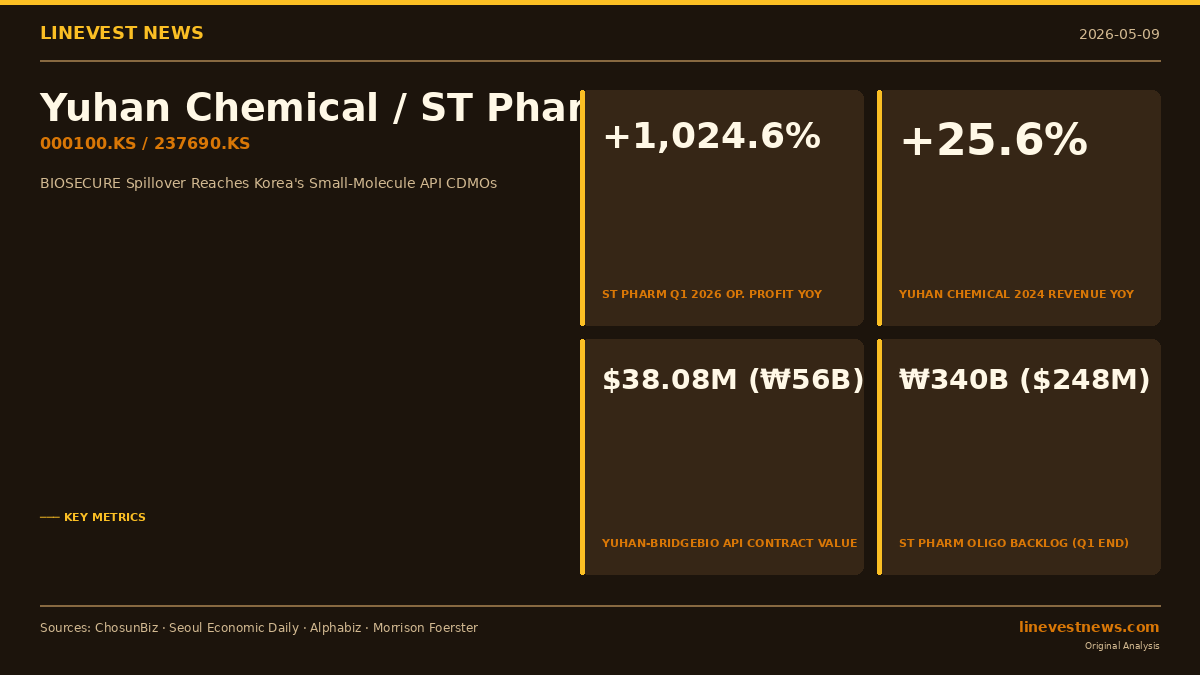
TL;DR - Korea's BIOSECURE-driven CDMO tailwind, long associated with biologics names like Samsung Biologics and Celltrion, is now visibly spreading into small-molecule active pharmaceutical ingredient (API) outsourcing, with Yuhan Chemical and ST Pharm cited by ChosunBiz as the most exposed Korean players. - ST Pharm, a Dong-A Socio Group oligonucleotide CDMO, posted Q1 2026 revenue of ₩67 billion ($49 million) with operating profit up 1,024.6% year-on-year to ₩11.5 billion ($8.4 million), per Seoul Economic Daily; oligo order backlog stands at roughly ₩340 billion ($248 million). - Watch the second-quarter Korean disclosure cycle: ChosunBiz cites industry sources expecting a wave of new small-molecule API supply contracts as global pharma firms accelerate sourcing decisions ahead of BIOSECURE Act enforcement.
Lead
For most of the last year, the read-through from the U.S. BIOSECURE Act — signed into law on December 18, 2025 as part of the FY2026 National Defense Authorization Act, according to Morrison Foerster — has been written almost exclusively in biologics terms: Samsung Biologics (207940.KS), Korea's largest contract biologics manufacturer, and Celltrion (068270.KS), the country's biggest biosimilar developer. ChosunBiz reported on May 9 that the same redirection of Western pharma supply chains away from Chinese contract manufacturers is now visibly extending into small-molecule API work, where Yuhan Chemical — a wholly-owned API subsidiary of Yuhan Corporation (000100.KS), Korea's oldest pharmaceutical company — and ST Pharm (237690.KS) are emerging as the principal Korean beneficiaries.
What Happened
ChosunBiz reported that global pharmaceutical companies are increasingly approaching Korean small-molecule API CDMOs as they reassess Chinese exposure under the BIOSECURE Act. Industry sources cited by the outlet said "new contract disclosures from domestic players are likely to follow from the second quarter onwards."
A concrete data point landed earlier this week. On May 6, Yuhan Corporation disclosed an API supply contract with U.S.-listed BridgeBio Pharma covering a cardiomyopathy treatment, according to Alphabiz. The deal is worth approximately $38.08 million (₩56 billion), equivalent to 2.56% of Yuhan's prior-year revenue of ₩2.1866 trillion ($1.60 billion), and runs from May 5, 2026 through March 1, 2028.
The contract follows ST Pharm's first-quarter results, released April 27. Seoul Economic Daily reported revenue of ₩67 billion ($49 million), operating profit of ₩11.5 billion ($8.4 million) — a 1,024.6% year-on-year jump — and net profit of ₩15.2 billion ($11.1 million). Oligonucleotide revenue of ₩40.4 billion ($29.5 million) included ₩27.1 billion of commercial-stage product, or roughly 67% of the segment.
Why It Matters
This is the first concrete signal that BIOSECURE-driven supply chain rebalancing is migrating beyond biologics into the chemistry-based API tier of Korean pharma. According to the Morrison Foerster and Hogan Lovells analyses, BIOSECURE prohibitions on new federal contracts touching 1260H-listed Chinese biotech companies will phase in around Q3-Q4 2028, with a separate Office of Management and Budget designation track and a five-year grandfather period for pre-existing contracts at OMB-named entities. That timeline gives global pharma roughly two years to qualify alternate suppliers — and small-molecule API qualification cycles typically take 18-30 months when filed under FDA or EMA dossiers.
ChosunBiz noted a structural reason this matters more than usual: in novel-drug API work, switching suppliers requires re-validating manufacturing sites and re-filing regulatory dossiers, so contracts awarded now tend to lock in vendors through commercialization. That "lock-in" dynamic is what makes near-term order flow disproportionately important for the next decade of revenue.
Business Impact
For Yuhan Chemical, audited 2024 filings (as reported by Catch and other Korean corporate-data providers) show revenue grew from ₩169.0 billion ($123 million) in 2023 to ₩212.2 billion ($155 million) in 2024 — a 25.6% year-on-year increase — with 2024 operating profit of ₩12.04 billion ($8.8 million), up 133.5% year-on-year, and operating margin of approximately 5.7%. The order backlog at end-2024 stood at $217 million (about ₩300 billion). Capacity is currently around 995,000 liters of fermentation-based API capability at the company's HB facility, with a 290,000-liter HC expansion targeted for the second half of 2027 per ChosunBiz; commercial production from HC is expected only in 2028, according to Kyobo Securities analyst Jung Hee-ryung quoted in the same article.
For ST Pharm, oligonucleotide capacity at the second oligo plant has been raised to 14 moles per year from 6.4 moles previously, ChosunBiz reported, with an additional incremental expansion under consideration. Heungkuk Securities analyst Lee Ji-won, quoted by ChosunBiz, projected the second oligo plant will run at roughly 60% utilization this year and reach "full operation" in 2027. Total order backlog at the end of Q1 was approximately ₩460 billion ($336 million), of which the oligo book accounts for ₩340 billion ($248 million).
ChosunBiz also flagged downside risks: Yuhan Chemical carries debt of approximately ₩260 billion ($190 million) at year-end and took additional Korea Development Bank borrowing in February. ST Pharm has seen working capital pressure from the build-out, with cash halving year-on-year and inventory rising more than ₩40 billion. Top-five customer concentration across the two firms sits near 70%, according to the same report.
Industry & Historical Context
Korean CDMOs have spent the last 18 months being repriced primarily on biologics flow — Samsung Biologics in particular has booked multiple multi-trillion-won contracts since the original BIOSECURE bill cleared the U.S. House in 2024. The small-molecule tier has been slower to move because chemistry-based APIs are easier to second-source than living-cell biologics, dampening urgency. ChosunBiz's reporting suggests that calculus changes for novel-drug APIs, where the regulatory cost of switching is the binding constraint rather than chemistry.
ST Pharm's earlier public guidance has framed the BIOSECURE moment in similar terms. Korea Biomedical Review previously quoted ST Pharm management saying a recent supply deal "presents a chance for us to make a comeback in the small molecule CDMO sector" alongside its core oligonucleotide business.
What to Watch
- Korean DART (Korea's electronic disclosure system) filings through Q2 and Q3 for additional small-molecule API supply contracts at Yuhan Corporation and ST Pharm, which ChosunBiz expects to accelerate.
- Progress and timing slippage on Yuhan Chemical's HC expansion, which currently has commercial production gated to 2028 — directly aligned with the BIOSECURE Act's expected 1260H enforcement window.
- ST Pharm's decision later this year on whether to add further oligonucleotide capacity in the reserve space within Plant 2, and any disclosed move into GLP-1 obesity-drug API work that the company is reportedly evaluating.
Sources: - ChosunBiz — https://biz.chosun.com/science-chosun/bio/2026/05/10/RBI37ACWFVGNLBUDLXWBRAT67E/ - Seoul Economic Daily (ST Pharm Q1) — https://en.sedaily.com/business/2026/04/27/st-pharm-q1-operating-profit-surges-1024-percent-on-oligo - Alphabiz (Yuhan-BridgeBio contract) — https://alphabiz.co.kr/news/view/1065623343646815 - Morrison Foerster (BIOSECURE Act Update) — https://www.mofo.com/resources/insights/251218-biosecure-act-update - Hogan Lovells (BIOSECURE in 2026 NDAA) — https://www.hoganlovells.com/en/publications/updated-biosecure-to-be-enacted-following-senate-passage - Korea Biomedical Review (ST Pharm small-molecule comeback) — https://www.koreabiomed.com/news/articleView.html?idxno=24928 - Catch (Yuhan Chemical 2024 audited financials) — https://www.catch.co.kr/Comp/CompInfo/353450
By LineVest Markets Desk — May 9, 2026
This article is for informational purposes only and does not constitute investment advice.