Samsung Biologics (207940.KS) Files Criminal Complaint on Strike
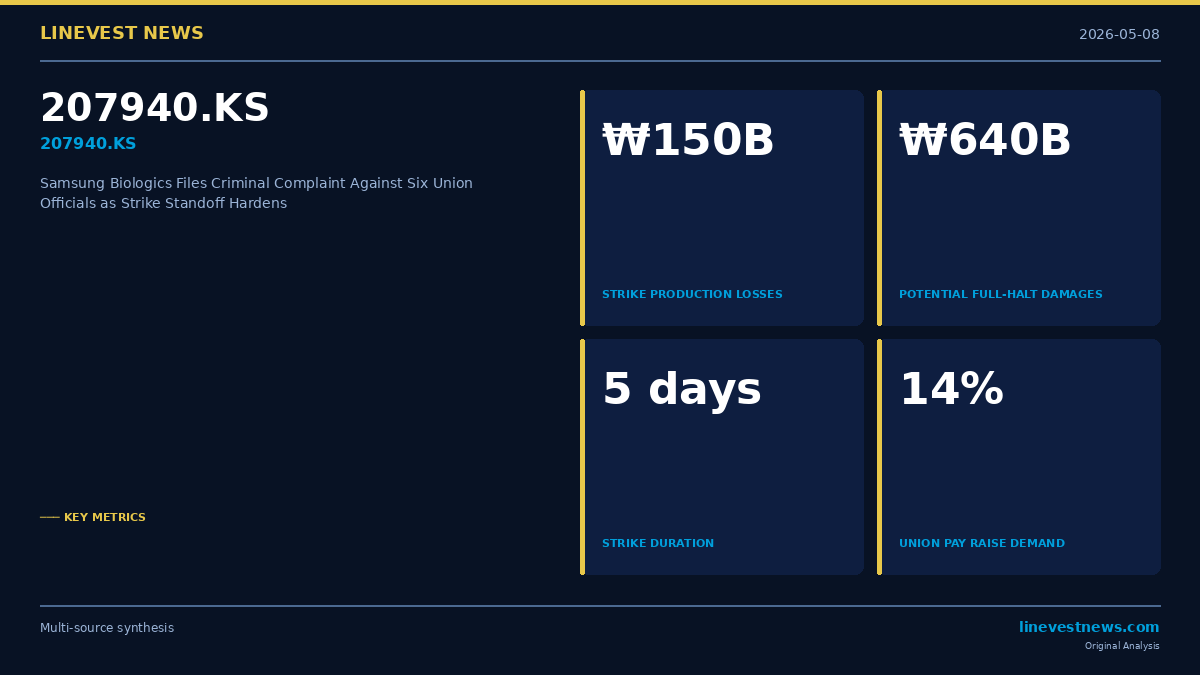
TL;DR - Samsung Biologics filed a criminal complaint on May 8 against six members of its enterprise union, including the branch chair, alleging obstruction of business during last week's first-ever strike. - The company estimates roughly ₩150 billion ($110 million) in production losses from the May 1-5 walkout, with potential damages reaching ₩640 billion if work fully halts again. - A tripartite labor-management-government meeting on Friday is the next near-term checkpoint as the union shifts to a work-to-rule campaign.
Lead
Samsung Biologics (207940.KS), the Korean contract drug manufacturer that supplies major global pharmaceutical companies from its Songdo bio-campus, has escalated a deepening labor conflict by filing a criminal complaint with Incheon Yeonsu Police on May 8 against six members of its in-house union, including branch chair Park Jae-sung. The move — which the company says targets alleged obstruction of business during last week's five-day general strike — comes hours before a scheduled tripartite meeting with the Ministry of Employment and Labor and signals that the dispute is hardening into a legal contest. It is the first criminal action of its kind in Samsung Biologics' 15-year history.
What Happened
According to Maeil Business Newspaper and Yonhap News, Samsung Biologics submitted the complaint to Incheon Yeonsu Police on the morning of May 8, naming Park Jae-sung — head of the Samsung Biologics Sangsaeng ("Coexistence") branch of an inter-enterprise union (초기업 노동조합) — together with two other union executives and three shop-floor manager-grade members. The company alleges the six obstructed operations by leading or coordinating strike action on production steps that an Incheon court had specifically excluded from lawful industrial action.
On December 23, 2025, the Incheon District Court's 21st Civil Division partially granted Samsung Biologics' injunction request, prohibiting strike activity on three of nine production processes — concentration and buffer exchange, drug-substance filling, and buffer manufacturing — on the grounds that interruptions could spoil thawed cell lines, according to Seoul Economic Daily's English edition. The company says approximately 300 union members were collectively involved in alleged obstruction across those steps; the union counters that members fulfilled all duties on the three court-restricted processes and that the lawsuits are an attempt to chill organizing.
The complaint follows the union's first-ever general strike, which ran May 1 through May 5, 2026. Roughly 2,800 of the union's approximately 4,000 members took part, the union told The Korea Herald. From May 6, members shifted to a "work-to-rule" posture — refusing overtime and weekend shifts — while top-level negotiations scheduled for that day were canceled after a leaked phone call inflamed both sides, per The Korea Times.
Why It Matters
This is the first concrete signal that Korea's flagship CDMO can no longer treat its labor relations as an internal matter resolvable behind closed doors. Samsung Biologics had been strike-free since its 2011 founding, a record cited repeatedly in investor materials and Korean press. The combination of a court injunction, a five-day walkout and now a criminal referral marks an inflection point for a company that competes globally on reliability of supply to multinational pharmaceutical clients. For the broader Korean contract-manufacturing sector — which has positioned itself as a stable alternative amid the U.S. BIOSECURE-driven realignment of biopharma supply chains — the dispute challenges the consensus that Songdo offers labor-risk-free outsourcing.
Business Impact
Samsung Biologics has publicly estimated production losses from the May 1-5 strike at about ₩150 billion ($110 million), as reported by Seoul Economic Daily and FiercePharma. The Korea Herald, citing the company, noted that a fully sustained shutdown could generate damages of as much as ₩640 billion — roughly half of the company's first-quarter sales by the company's own framing. Disrupted output, per company statements quoted in the same coverage, includes oncology and HIV therapies produced under contract for global clients.
The gap between the parties remains wide. The union is seeking a 14% increase in base and performance pay, a one-time cash incentive of ₩30 million ($21,900) per employee, and bonuses equivalent to 20% of annual operating profit, alongside consent rights over executive appointments, hiring, M&A and outsourcing decisions, according to The Korea Herald and Seoul Economic Daily. Management has offered a 6.2% combined wage increase and argues that the union package would translate to a 21.3% effective raise. Choi Joon-sun, an industry professor cited by Seoul Economic Daily, characterized the governance demands as "asking for more power than shareholders who have invested capital."
Industry & Historical Context
Samsung Biologics, founded in 2011 and listed on KOSPI as 207940.KS, operates a combined biomanufacturing capacity of roughly 785,000 liters across Bio Campus I and II in Songdo, Incheon, plus 60,000 liters at its Rockville, Maryland site — a global total of around 845,000 liters following the April 2025 start-up of its 180,000-liter Plant 5, per company disclosures summarized by BioProcess International and Pharma Manufacturing. That scale has made the company a central node for monoclonal-antibody and biosimilar production for clients across the U.S., Europe and Japan.
Until this spring, the company's labor record had been a selling point. The Korea Herald reported that the May 1 walkout was the first general strike in Samsung Biologics' history, ending a 15-year run without industrial action. Management, in statements carried by Seoul Economic Daily, has called on the union to "stop making unreasonable demands and coercively forcing a strike, and immediately return to the negotiating table"; the union, through chair Park Jae-sung, argues that the Trade Union Act does not require maintaining 100% of normal operations during a lawful dispute.
What to Watch
- The May 8 tripartite meeting between Samsung Biologics, the union and the Jungbu Regional Employment and Labor Office: whether mediators can re-open a top-table channel after the May 6 cancellation.
- Any second-quarter financial guidance update from Samsung Biologics referencing the strike's revenue impact, particularly for clients with delivery-linked penalty clauses.
- Police handling of the obstruction complaint — investigation timelines for white-collar cases in Korea typically run several months, but a fast referral to prosecutors would sharpen the legal stakes.
- Whether the union's work-to-rule campaign — refusing overtime and weekend shifts — measurably extends batch-cycle times at Songdo, which would be visible in subsequent disclosures.
Sources: - Yonhap News (Korean) — https://www.yna.co.kr/view/AKR20260507110651017 - Maeil Business Newspaper — https://www.mk.co.kr/news/it/12041012 - Maeil Business Newspaper — https://www.mk.co.kr/news/it/12041110 - Seoul Economic Daily (English) — https://en.sedaily.com/finance/2026/05/08/samsung-biologics-files-criminal-complaint-against-union-20260508 - Seoul Economic Daily (English) — https://en.sedaily.com/finance/2026/05/01/samsung-biologics-suffers-150-billion-won-loss-from-first - Seoul Economic Daily (English) — https://en.sedaily.com/culture/2026/05/03/samsung-biologics-union-demands-veto-power-over-hiring-ma - The Korea Times — https://www.koreatimes.co.kr/business/companies/20260506/samsung-biologics-labor-dispute-drags-on-amid-tensions-over-police-complaint-ai-plants - The Korea Herald — https://www.koreaherald.com/article/10730418 - FiercePharma — https://www.fiercepharma.com/manufacturing/cdmo-samsung-bio-estimates-102m-impact-stemming-ongoing-union-strike
By LineVest Markets Desk — May 8, 2026
This article is for informational purposes only and does not constitute investment advice.