China Blocks Meta's $2 Billion Manus Deal, Forcing Korean AI Sector to Reprice Cross-Border Risk
Lead China's regulators ordered Meta Platforms to unwind a $2 billion acquisition of agentic AI startup Manus on April 27, 2026, an extraterritorial veto on a deal that had already closed. For Korea's AI ecosystem — heavily intertwined with Chinese capital, talent pipelines, and Singapore-domiciled holdcos — the ruling rewrites the playbook on cross-border M&A involving Chinese-origin technology.
What Happened Beijing announced the block on Monday, demanding Meta divest its stake in Manus, a Singapore-headquartered AI agent firm with Chinese founding roots, according to CNBC and Bloomberg. The decision followed a months-long antitrust and technology-export probe, TechCrunch reported. Bloomberg framed the move as a step "unlike anything" China has previously attempted overseas, characterizing the unwinding of an already-completed transaction as a test of Beijing's extraterritorial reach. Yahoo Finance carried parallel wire reporting confirming the $2 billion price tag and the agentic-AI focus of Manus's product stack. The order targets technology leakage from Chinese-origin engineering teams to a US acquirer — a vector Beijing has flagged repeatedly across the 2025–2026 AI export-control updates.
Sources for this section: Bloomberg, CNBC, TechCrunch, Yahoo Finance.
Part B — Korea Impact Analysis
Direct Exposure: Korean AI Holdcos with Chinese Capital Korea's two largest internet platforms carry direct Chinese shareholder linkages. Tencent-affiliated entities have held a meaningful minority stake in Kakao (035720.KS) since the 2012 funding round, per Kakao's audited disclosures, and Tencent remains an anchor investor in several Korean game and AI subsidiaries. Naver (035420.KS) operates Z Holdings/LY Corp jointly with SoftBank, but maintains Chinese cloud and chip dependencies disclosed in its 2024 sustainability report. Beijing's willingness to unwind a closed $2 billion deal on technology-transfer grounds inserts a new tail risk into any Korean AI transaction whose IP, codebase, or engineering team traces to Chinese soil — even when the legal entity sits in Singapore, Seoul, or Tokyo. Korean private-equity sponsors evaluating the roughly 40+ Korean AI startups that took Chinese strategic capital between 2022 and 2025, per Korea Venture Capital Association data, must now price in a unilateral Chinese veto right that did not exist in their original deal models.
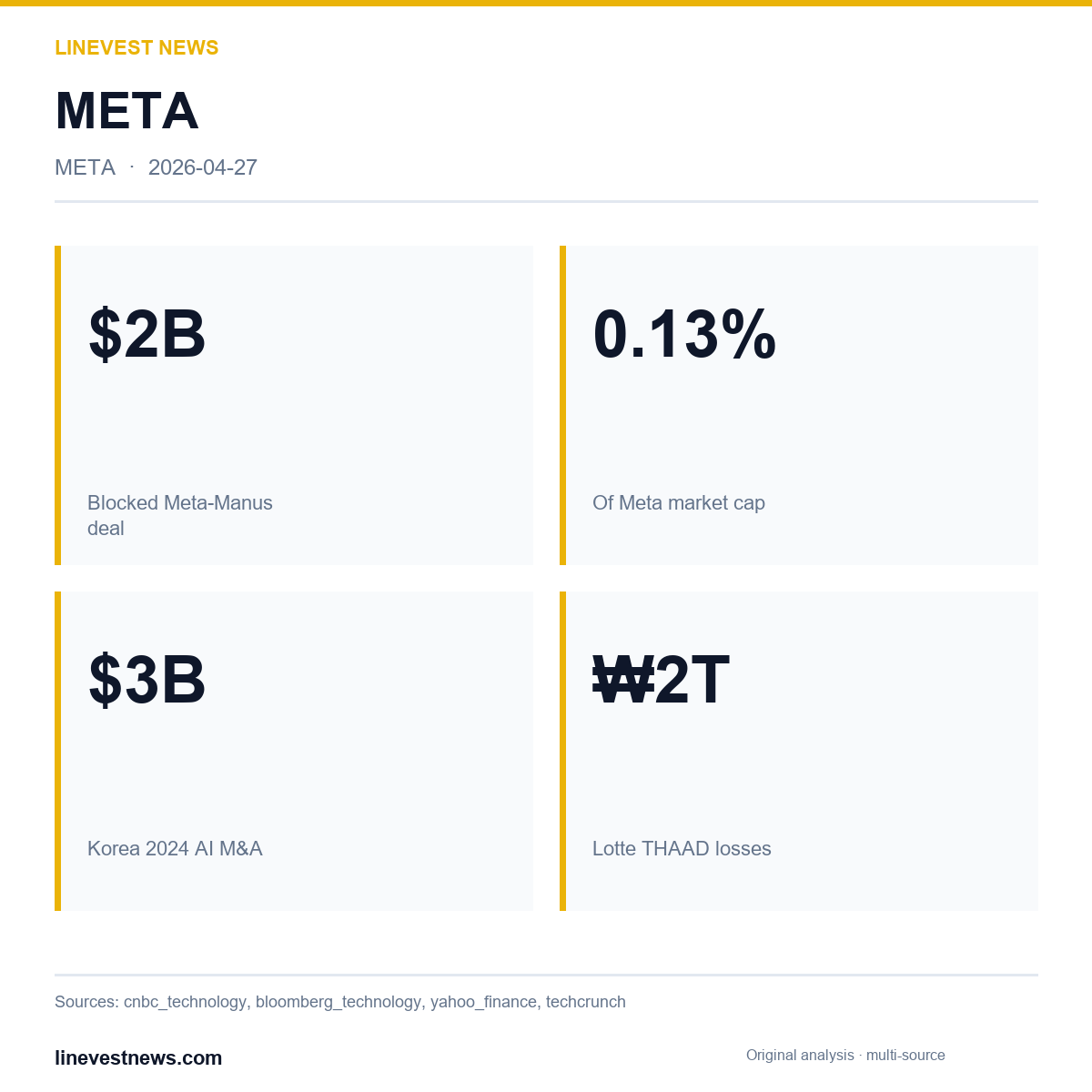
Quantitative Sizing The blocked transaction equals approximately 0.13% of Meta's market capitalization of around $1.5 trillion, per the company's most recent NASDAQ filings — a financially trivial sum that is strategically loaded because Manus anchored Meta's agentic-AI roadmap. For context, Korea's entire 2024 outbound AI M&A spend, as tracked by Korea Investment Corporation disclosures and KED Global reporting, did not exceed $3 billion across all transactions. A single Chinese veto of this size therefore eclipses Korea's full annual cross-border AI deployment in AI assets — a useful benchmark for the magnitude of regulatory friction Korean acquirers must now underwrite.
[Chart: see article cover image]
Sector Read-Across to KOSPI Tech Samsung Electronics (005930.KS) and SK Hynix (000660.KS) face a second-order channel. Both firms supply HBM and advanced logic to US hyperscalers, including Meta, whose AI capex trajectory now carries an agentic-strategy delay of indeterminate length. Yonhap reported in March 2026 that Samsung's HBM3E shipments to Meta were ramping into the second half. A stalled Manus integration does not cancel that demand, but it shifts the timing risk for downstream Korean memory revenue tied to Meta's agentic-AI training clusters. LG AI Research's Exaone and Naver's HyperCLOVA X — both pure-Korean IP without Chinese co-development — gain a competitive narrative as "geopolitically clean" alternatives for global enterprise customers re-evaluating Chinese-rooted vendors.
Historical Parallel The Manus block echoes the 2016–2017 THAAD episode, when China's informal sanctions cost Lotte Group an estimated 2 trillion won in lost China revenue and forced a full retail exit, per Lotte's 2018 restructuring disclosures. The mechanism is different — informal commercial pressure then, formal regulatory veto now — but the precedent for Korean firms is that Chinese regulatory decisions can extinguish closed transactions and sunk capital. The Foreign Investment Promotion Act review thresholds at Korea's Ministry of Trade, Industry and Energy do not currently require disclosure of acquirer-side Chinese veto risk, a gap that will pressure the National Assembly's 2026 review cycle.
What to Watch - Kakao Q1 2026 earnings on May 8, 2026, for any commentary on Tencent-related governance. - MOTIE's mid-2026 update to cross-border M&A guidance for AI assets. - Samsung Electronics Q2 capex guidance for any Meta-linked HBM order revisions. - Any Manus-Meta divestiture price, which sets a market-clearing benchmark for Korean AI assets with Chinese lineage.
Sources: - Bloomberg — https://www.bloomberg.com/news/articles/2026-04-27/china-blocks-meta-s-2-billion-acquisition-of-ai-startup-manus - CNBC — https://www.cnbc.com/2026/04/27/meta-manus-china-blocks-acquisition-ai-startup.html - TechCrunch — https://techcrunch.com/2026/04/27/china-vetoes-metas-2b-manus-deal-after-months-long-probe/ - Yahoo Finance — https://finance.yahoo.com/sectors/technology/articles/china-blocks-meta-2-billion-095700004.html
By LineVest Markets Desk — 2026-04-27 This article is for informational purposes only and does not constitute investment advice.
[Chart: see article cover image]