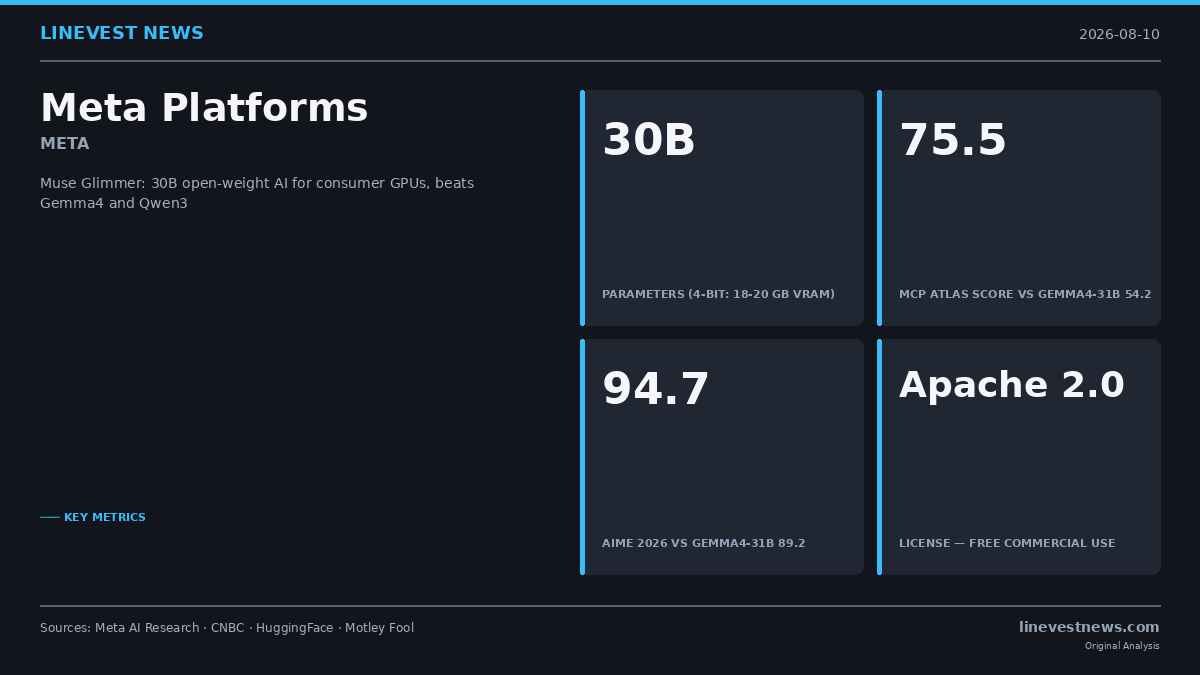
TL;DR - Meta released Muse Glimmer, a 30-billion-parameter open-weight AI model on August 10, 2026, under an Apache 2.0 license - Runs on a consumer GPU with 24–32 GB VRAM; 4-bit quantization reduces the full-precision memory footprint to 18–20 GB - Outperforms Google's Gemma4-31B and Alibaba's Qwen3.6-27B on most agentic and coding benchmarks - Zuckerberg published a 6,500-word essay clearly targeting OpenAI and Anthropic's closed-model strategy — without naming them by name - META shares gained roughly 1% pre-market; the company plans to open-source frontier model Muse Spark 1.2 next
Part A — What Muse Glimmer Is
Meta Superintelligence Labs (MSL), led by Chief AI Officer Alexandr Wang, released Muse Glimmer on August 10, 2026, making it available for free download on Hugging Face under the permissive Apache 2.0 license. The model has 30 billion parameters and is specifically engineered to run locally — without cloud infrastructure — on standard consumer hardware.
Through 4-bit quantization and memory optimization, Meta compressed the model's memory footprint to approximately 18–20 GB — putting it within reach of a single GPU with 24 GB or 32 GB of VRAM, or a MacBook Pro with a large unified-memory chip. The company's DFlash speculative decoding technique improves generation speed by 1.5x to 3.1x depending on hardware configuration.
Muse Glimmer is optimized for agentic workloads — tasks that require a model to take sequences of actions autonomously:
- Multi-step coding and debugging
- Calendar and schedule management
- File organization and search
- Function calling and tool orchestration via OpenClaw patterns
- Autonomous failure recovery (the model detects and retries failed tool calls)
- Multimodal input (text + images, via a dedicated perception encoder)
The model supports over 100 languages and integrates with popular local inference frameworks including llama.cpp, MLX, ExecuTorch, vLLM, and SGLang. Distribution partners — Ollama, LM Studio, Together AI, Fireworks AI, and OpenRouter — will make it installable via a single command.
Benchmark Performance vs. Open-Weight Rivals
Meta benchmarked Muse Glimmer against Google DeepMind's Gemma4-31B and Alibaba's Qwen3.6-27B — the two most prominent open-weight models in its parameter range.
Agentic Task Benchmarks
| Benchmark | Muse Glimmer-30B | Gemma4-31B | Qwen3.6-27B |
|---|---|---|---|
| MCP Atlas | 75.5 | 54.2 | 62.5 |
| DeepSearch QA | 74.6 | 61.7 | 71.1 |
| τ³-Banking | 23.5 | 15.1 | 16.7 |
| WildClawBench | 47.6 | 37.6 | 43.2 |
| GAIA2 | 43.3 | 36.4 | 40.0 |
Agentic Coding Benchmarks
| Benchmark | Muse Glimmer-30B | Gemma4-31B | Qwen3.6-27B |
|---|---|---|---|
| SWE-Bench Pro | 51.2 | 36.9 | 50.2 |
| SciCode | 43.6 | 43.4 | 39.8 |
| TerminalBench 2.1 | 51.7 | 43.4 | 60.7 |
Reasoning Benchmarks
| Benchmark | Muse Glimmer-30B | Gemma4-31B | Qwen3.6-27B |
|---|---|---|---|
| AIME 2026 | 94.7 | 89.2 | 94.1 |
| AA-LCR | 80.0 | 68.3 | 73.3 |
| IFBench | 77.0 | 76.0 | 70.8 |
Muse Glimmer leads on all five agentic task benchmarks and all three reasoning benchmarks listed. In agentic coding tasks, Qwen3.6-27B outperforms on TerminalBench 2.1 (60.7 vs. 51.7), a benchmark centered on sustained multi-file terminal editing — an area where Meta's model concedes an edge.
Part B — Investment Implications
Zuckerberg's Essay: A Formal Declaration of War on Closed AI
The model launch was accompanied by a 6,500-word essay from CEO Mark Zuckerberg — the most comprehensive public attack on closed-source AI rivals he has yet published. Without naming OpenAI and Anthropic by name, he challenged the logic of companies that publicly warn about AI dangers while simultaneously racing to build and lock down frontier systems.
"Our goal should be for American open source models to be the best globally."
Zuckerberg argued that open systems allow communities to "identify vulnerabilities, harden the systems, and easily upgrade to the latest most secure versions" — the inverse of the safety argument that Anthropic in particular deploys to justify its closed approach. On U.S. policy, he was pointed: "U.S. policy must reduce this additional friction if we want American open source models to lead over time," citing compliance restrictions that disadvantage American labs relative to foreign developers.
The essay is simultaneously a product announcement, a lobbying document, and a competitive positioning statement. Its 6,500-word length signals that Meta is treating open-source AI as a core strategic identity, not merely a go-to-market tactic.
The USD 145B CapEx Question
Meta's aggressive open-source posture takes on additional urgency given its capital expenditure trajectory. The company is spending up to USD 145 billion in 2026, against USD 72 billion deployed in 2025 — and the market is watching closely. META shares have declined roughly 10% year-to-date through August 10, while the broader tech sector has performed better.
At a forward price-to-earnings multiple of 19.8x, META's valuation assumes the AI spending eventually pays off. Muse Glimmer — and more importantly, the planned release of frontier model Muse Spark 1.2 — is Meta's argument that its approach will generate compounding returns through developer lock-in and enterprise adoption, not just advertising revenue.
Meta's advertising engine generated USD 114 billion in H1 2026 revenue (97.7% of total sales), growing at a projected 21.6% annual rate through 2028. That cash flow funds the AI build-out. Open-source models are a bet that monetization will eventually follow ecosystem dominance — the same path that made Android the world's most-used operating system.
The Enterprise Cost Argument
Beyond the competitive framing, Muse Glimmer addresses a real enterprise concern. Businesses have grown uneasy about two things: the size of their AI API bills, and a series of recent security incidents tied to cloud-based models. A model that runs entirely on local hardware answers both objections simultaneously — data never leaves the premises, and there are no per-token costs.
For Meta, every enterprise that adopts Muse Glimmer builds dependency on Meta's ecosystem of frameworks, tooling, and future model versions. This is a durable monetization pathway that does not show up in near-term earnings but compounds over time.
Muse Spark 1.2: The More Significant Signal
Muse Glimmer is Meta's most capable open-weight model released to date. Yet the more forward-looking announcement is Zuckerberg's confirmation that Meta intends to open-source Muse Spark 1.2 — described internally as a frontier-class model — in the near future. If Spark 1.2 weights become freely available, enterprises can self-host at infrastructure cost alone, cutting API bills to near zero.
For OpenAI and Anthropic, that is a direct threat to their API subscription revenue. Both companies have built substantial businesses on premium access to their largest models. The moment Meta makes comparable-quality weights freely available, the pricing power of closed-model providers is structurally impaired.
Institutional Sentiment
Institutional positioning in META remains constructive despite the year-to-date drawdown. Hedge fund ownership increased to 262 funds in the most recent quarter, up from 256 the prior quarter. Short interest stands at just 1.72% of float — suggesting professional investors are not broadly betting against the AI strategy, even as they have not yet bid the stock higher.
META shares gained approximately 1% in pre-market trading on August 10 following the Muse Glimmer announcement.
Key Watch Points for META Investors
- Muse Spark 1.2 release timing: The moment frontier weights are public, expect OpenAI and Anthropic to respond — either with their own open-source releases or with aggressive pricing cuts
- Enterprise adoption pace: Hugging Face download volume and GitHub fork counts in the first 30 days will measure whether this triggers real enterprise migration away from cloud APIs
- META Q3 2026 earnings (October): Management's commentary on AI monetization and CapEx guidance revision will be the next fundamental test
- Washington's regulatory posture: Zuckerberg's essay is also a lobbying document; reduced compliance friction on open-source AI could structurally advantage Meta over rivals
This article is for informational purposes only and does not constitute investment advice. Meta Platforms, Inc. (NASDAQ: META) is discussed solely as a subject of financial journalism.
Sources
- Meta AI Research Blog — Introducing Muse Glimmer
- Hugging Face — Muse Glimmer Model Blog
- CNBC — Meta to open source its most powerful AI model as it takes swipe at OpenAI, Anthropic
- The Motley Fool — Zuckerberg's 6,500-word essay targeting OpenAI and Anthropic
- Open Source For You — Meta Open Sources Muse Glimmer: A 30B Agentic AI Model
- Yahoo Finance — Meta (META) Unveils Muse Glimmer as Open-Source AI Spending Debate Intensifies
- Phoronix — Meta Publishes Muse Glimmer As 30B Open Agentic Model