Tesla and BYD Claim One-in-Four Korean Car Sales as Import Share Tops 25% for the First Time
TL;DR - Imported cars hit 25.8% of Korea's passenger market in May 2026 — first month ever above the 25% threshold - Tesla: 56,139 units H1, up 192% YoY, capturing 30.5% of all imports; Model Y is now Korea's top-selling single model - BYD: 11,675 units, overtook Lexus, Volvo and Audi to rank 4th among importers - EVs crossed 51.1% of all imports in June — the first time electric models took the majority of import sales - Hyundai and Kia face intensifying home-market pressure; Kia has already cut EV prices by up to ₩3M per vehicle
Part A — What Happened
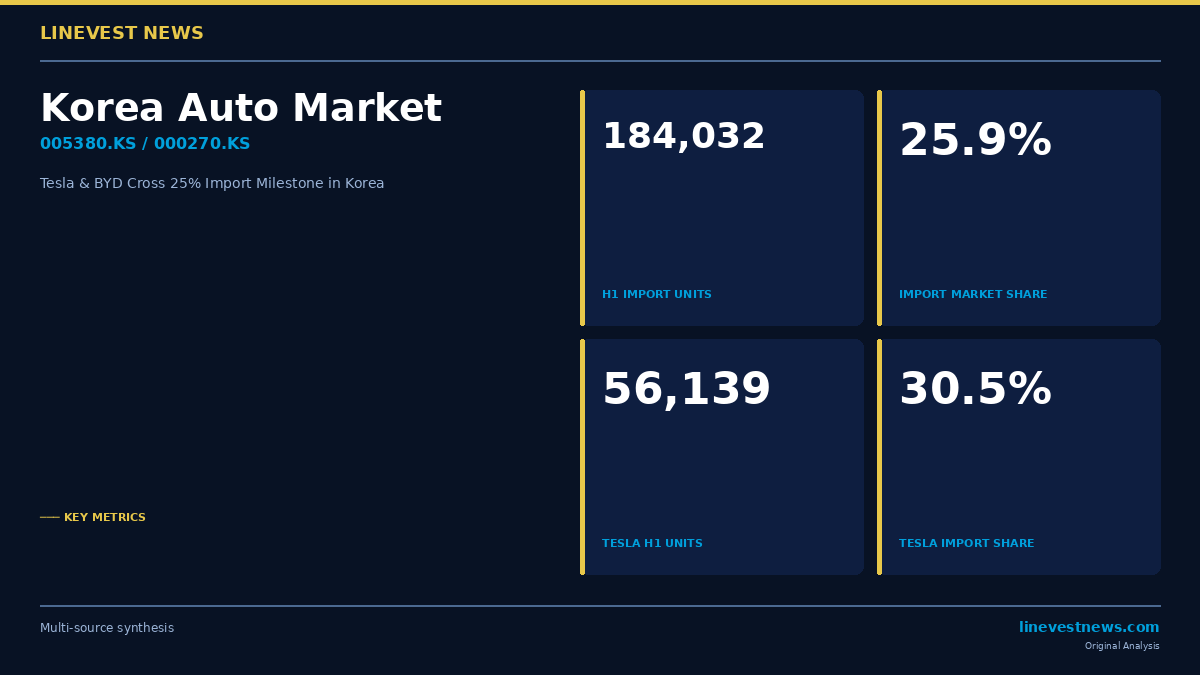
South Korea's imported car market has crossed a threshold that industry analysts have been watching for years. According to data compiled by the Korea Automobile Importers & Distributors Association (KAIDA) and the Korea Automobile & Mobility Association (KAMA), foreign-brand passenger cars accounted for 25.8% of all new registrations in May 2026 (29,860 of 115,680 total) and 25.9% in June (38,059 units, +37% YoY) — the first consecutive months above 25% in the market's modern history.
For the full first half of 2026, importers registered 184,032 passenger cars, a 33.2% surge versus 138,120 units in H1 2025. Korea's import market has expanded steadily over two decades — from roughly 10% share in 2012 to 15% by 2015 and an annual 20.3% in FY2025 — but the 25% barrier had never been breached until now.
Brand-Level Breakdown (H1 2026 Imports)
| Brand | H1 Units | Import Share | YoY Change |
|---|---|---|---|
| Tesla | 56,139 | 30.5% | +192% |
| BMW | ~39,200 | 21.3% | -5%+ pts decline |
| Mercedes-Benz | ~29,800 | 16.2% | -5%+ pts decline |
| BYD | 11,675 | 6.3% | New entrant ranking 4th |
| Lexus / Volvo / Audi | Below BYD | — | All surpassed by BYD |
Tesla alone generated nearly half of the entire year-on-year import growth (+46,000 units market-wide, Tesla +~37,000 units). Its H1 import share leapt from 13.9% to 30.5% — a near-tripling in just twelve months.
BYD's breakthrough is arguably more structurally significant: reaching 6.3% of Korea's import segment, a market historically dominated by German luxury brands, with no government subsidies and against entrenched consumer skepticism toward Chinese vehicles.
EV Tipping Point
Electric vehicles now account for the majority of imported car sales. In June, EVs represented 51.1% of all imports — the first month that battery-electric models took more than half. For H1 in aggregate, imported EV registrations reached 83,790 units, a 158.5% surge year-on-year.
The Model Y Long Range ranked first in June's individual model sales at 5,155 units and the Model Y base was May's top-selling single model at ₩49.99M — notably at a price point below many German diesel options.
Part B — Korea Investor Implications
Hyundai Motor and Kia: Defending the Home Market
The domestic squeeze arrives at an awkward time for Hyundai Motor Group. The group's international performance in 2026 has been strong — H1 2026 U.S. sales reached 920,383 units (+3% YoY) with hybrids surging 65.5% — but the Korea home base is being contested more aggressively than at any point in the automakers' history.
Kia (000270.KS) has already moved defensively: price cuts of up to ₩3M per vehicle on its key EV models, paired with enhanced financing packages. Hyundai Motor (005380.KS) has not yet publicly matched the discount depth, but the brand is investing heavily in its own EV/software-defined vehicle roadmap and a \$5.4 billion AI research hub.
The competitive arithmetic is stark. If imports capture 25% of the domestic market on a sustained basis, the combined Hyundai-Kia domestic volume base (approximately 700,000 units per year historically) could face structural erosion of 30,000–50,000 units annually compared to a 20% share environment.
Korea's Tariff Asymmetry Is a Structural Disadvantage
Unlike the United States, which levies a 100% tariff on Chinese-made EVs, or the European Union, which applies up to 35.3% on BYD and peers, South Korea maintains only standard most-favored-nation rates on Chinese passenger vehicles. There is no meaningful tariff buffer.
This asymmetry means Korea is now one of the few open developed markets where BYD competes on a near-level pricing field — making it, in effect, a live stress test of Chinese EV competitiveness against established local champions.
What the Import Share Trajectory Implies for Valuations
Import penetration compressing domestic OEM volumes tends to weigh on earnings-based valuations by: 1. Reducing absolute unit volumes, shrinking fixed-cost absorption 2. Forcing ASP (average selling price) concessions and/or higher marketing spend 3. Narrowing pricing power on ICE models as EV substitutes multiply
Hyundai Motor trades at approximately 6–7× forward P/E in mid-2026, already one of the world's cheaper OEM multiples relative to profitability. Bulls argue the discount is excessive given the group's global EV optionality. Bears point to domestic erosion, potential U.S. trade policy risks, and the capital intensity of the EV transition.
Import Market Momentum Is Unlikely to Reverse Near Term
Korea's government has shown no appetite for protective automotive tariffs in the current trade environment. Tesla continues to roll out localised pricing and financing, and BYD has flagged Korea as a priority market for its Atto 3 and Seal SUV lines. Structural demand for cheaper EVs from China will likely persist as long as the won-yuan exchange rate and Korean EV subsidy structures remain unchanged.
For KOSPI investors, the calculus is whether Hyundai Motor's and Kia's superior global profitability profile (both reporting record international revenues) more than offsets the domestic squeeze — or whether 25% import share is the new floor, not a ceiling.
Sources: - BigGo Finance — South Korea's Imported Car Market Share Surpasses 25% - KED Global — Tesla, BYD Offensive Pushes Imported Car Share Past 25% - Korea Times — Tesla Tops Imported Car Sales in Korea in H1 - Seoul Economic Daily — Imported EV Share Tops 50% as Tesla, BYD Set Monthly Sales Records - Korea Herald — Why Buyout Giants Are Chasing Korea's Rental Car Operators
LineVest News is an independent publication. Nothing in this article constitutes investment advice or a solicitation to buy or sell securities.