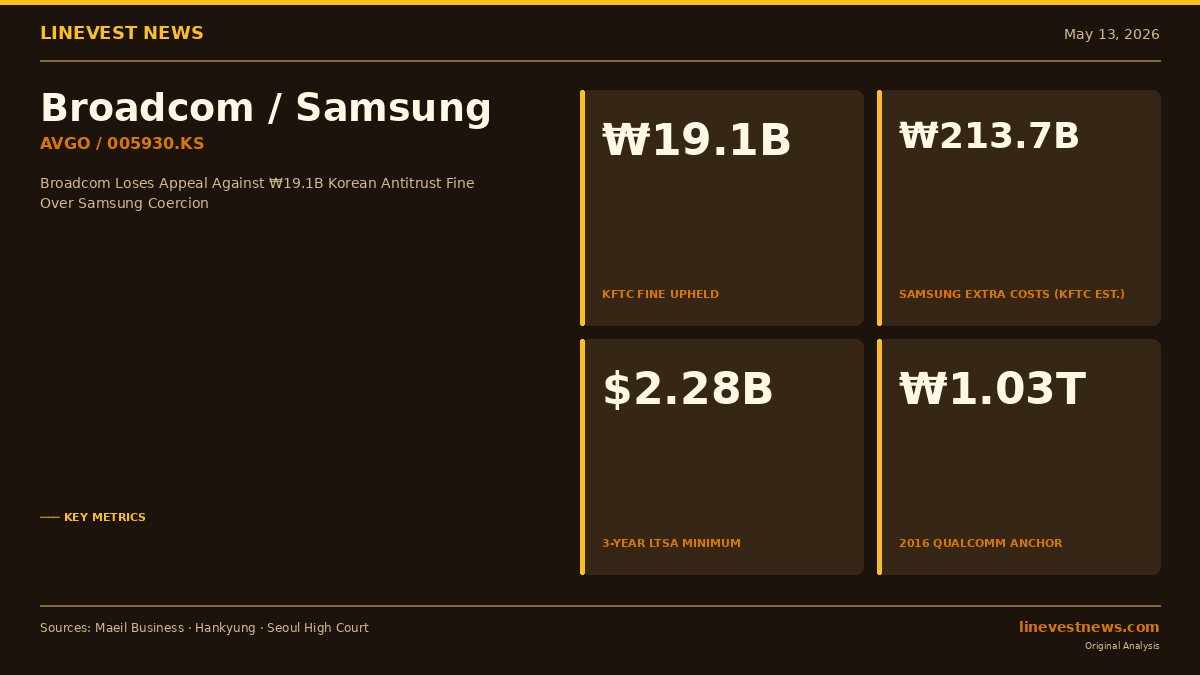
Broadcom Loses Appeal Against ₩19.1B Korean Antitrust Fine Over Samsung Coercion
TL;DR - Seoul High Court on May 13, 2026 dismissed Broadcom's challenge to a 2023 Korean antitrust fine for coercing Samsung Electronics into a multi-year wireless-chip supply contract. - The ₩19.1 billion ($14 million) penalty stands; KFTC estimated Samsung incurred at least ₩213.7 billion ($156 million) in extra costs under the deal. - Broadcom can still appeal to Korea's Supreme Court; the ruling tightens regulatory leverage over foreign chip suppliers selling into Korea.
Lead
A Seoul appellate court on Wednesday rejected Broadcom's bid to overturn a ₩19.1 billion ($14 million) fine imposed by Korea's antitrust regulator in 2023, ruling that the U.S. chipmaker abused its dominant position to lock Samsung Electronics (005930.KS) into a three-year wireless-component supply contract. The decision keeps intact one of the highest-profile cross-border antitrust enforcement actions against a foreign semiconductor supplier in Korea.
What Happened
Per Maeil Business Newspaper (MK), the Seoul High Court's Administrative Division 6-1 — sitting with Judges Park Young-joo, Kim Min-ki, and Choi Hang-seok — dismissed administrative lawsuits filed by Broadcom's U.S. headquarters, its Korean unit, and affiliated entities. The Korea Fair Trade Commission (KFTC, Korea's antitrust regulator) had imposed the ₩19.1 billion ($14 million) fine and corrective orders on four Broadcom entities — including the U.S. parent and Korean and Singapore branches — in September 2023, according to web search coverage of the original decision.
The case centered on a March 2020 long-term supply agreement (LTSA) under which Samsung Electronics, Korea's largest smartphone maker, agreed to purchase at least $760 million per year in Broadcom RF Front-End (RFFE), Wi-Fi, and Bluetooth components for three years starting in 2021 — a minimum commitment of roughly $2.28 billion over the contract life. Per Hankyung, Samsung was contractually required to compensate Broadcom for any shortfall against that annual floor.
The KFTC found that Broadcom — a dominant supplier of high-performance wireless connectivity chips for smartphones — denied purchase orders, delayed shipments, and threatened to halt supply after Samsung began diversifying its component sourcing, coercing Samsung into the LTSA. Broadcom argued in court that it had merely "clarified supply conditions in contract form" because of Samsung's repeated failures to meet earlier commitments. Per Hankyung's account of the ruling, the Seoul High Court rejected that defense.
Why It Matters
The ruling is the first concrete signal that Korea's appellate courts will uphold the KFTC's expanded use of the "abuse of superior bargaining position" doctrine against a major foreign chip vendor — even when the buyer is a global giant like Samsung. For years the doctrine was applied chiefly to domestic chaebol-supplier relationships; this decision affirms that a Korean conglomerate can itself be the protected counterparty when negotiating with a global oligopolist. That marks a structural shift in how Seoul polices foreign-component dependence in its strategic semiconductor and smartphone supply chains.
Business Impact
The direct financial impact on Broadcom is modest in absolute terms — ₩19.1 billion ($14 million) is a small line item for the U.S. semiconductor major — but the precedent is the larger cost. Per the Hankyung account of the original KFTC findings, the regulator estimated Samsung's minimum extra outlay under the LTSA at roughly ₩213.7 billion ($156 million), while Samsung's own figures cited in the same coverage put potential damages at about ₩437.5 billion ($319 million) from constrained supplier choice. Those numbers could now anchor any follow-on civil damages claim by Samsung, and they raise the regulatory risk premium on similar take-or-pay contracts that foreign chip suppliers have used with Korean OEMs.
For Samsung Electronics, the ruling validates the KFTC's 2023 decision but does not by itself recover any cash; a separate civil action would be required. Broadcom retains the option to appeal to Korea's Supreme Court (대법원).
Industry & Historical Context
The KFTC's September 2023 case applied the abuse-of-bargaining-position doctrine to a foreign semiconductor supplier of Korea's largest smartphone maker — part of a broader pattern of Korean regulators policing foreign chip-vendor conduct toward Korean buyers. The most prominent prior precedent is the KFTC's December 2016 ₩1.03 trillion ($854 million) fine on Qualcomm for abusive modem-chip licensing practices, a penalty Korea's Supreme Court upheld in April 2023, per Fortune and KED Global coverage.
The Broadcom matter also lands amid Samsung's multi-year effort to diversify away from single-source dependence on advanced RFFE, Wi-Fi, and Bluetooth modules — an area where Broadcom, Qualcomm, and Skyworks are the dominant global suppliers.
What to Watch
- Whether Broadcom files a final appeal to Korea's Supreme Court, and how the Supreme Court rules on the underlying doctrine.
- Any follow-on civil damages suit by Samsung Electronics seeking the ₩213.7 billion (KFTC estimate) or ₩437.5 billion (Samsung-cited) cost differential.
- Whether the KFTC opens parallel investigations into other foreign chip suppliers' long-term agreements with Korean smartphone, automotive, or memory makers.
Sources: - Maeil Business Newspaper (MK) — https://www.mk.co.kr/news/society/12046469 - Hankyung — https://www.hankyung.com/article/2026051345601 - Hankyung — https://www.hankyung.com/article/2026051340797 - Seoul Economic Daily (English) — https://en.sedaily.com/society/2026/05/13/broadcom-loses-appeal-against-191-billion-won-fine-for - Asia Business Daily (English) — https://www.asiae.co.kr/en/article/incidents-accidents/2026051314593325412 - Fortune (Qualcomm 2016 background) — https://fortune.com/2016/12/27/qualcomm-korea-antitrust/ - KED Global (Qualcomm Supreme Court background) — https://www.kedglobal.com/tech,-media-telecom/newsView/ked202304130008
By LineVest Markets Desk — May 13, 2026
This article is for informational purposes only and does not constitute investment advice.